Federal Judge Lets Lawsuit Proceed From U.S. Citizen Detained Three Times by ICE
U.S. District Judge Jeffrey Beaverstock declined to dismiss a lawsuit by Leo Garcia Venegas, a Baldwin County construction worker and U.S. citizen who says immigration officers detained him three times despite his Alabama REAL ID.
Leo Garcia Venegas is a U.S. citizen. He carries an Alabama-issued REAL ID. Since the spring of 2025, according to his attorneys, immigration officers have detained him three times.
On Thursday, a federal judge in Mobile refused to make his lawsuit go away.
U.S. District Judge Jeffrey Beaverstock rejected the government’s request to dismiss the case, ruling after a hearing earlier this month that the suit may proceed.
What the Lawsuit Alleges
Garcia Venegas, a construction worker in Baldwin County, filed the federal lawsuit seeking to stop what his attorneys describe as unconstitutional raids by immigration officers.
According to his attorneys, the pattern went like this:
In May and June of 2025, officers entered his private job sites without warrants and detained him. Both times, they refused to believe he was a citizen and declined to recognize his REAL ID as proof of legal status.
This year, officers followed him home and confronted him in his own driveway. He was removed from his car, tackled to the ground, handcuffed, shackled and locked in the back of a vehicle.
“Americans cannot be stopped and held by law enforcement when they are doing nothing wrong,” Garcia Venegas said. “I’m glad my case is moving forward, and I hope it can make lasting change.”
The Fourth Amendment Claim
Jared McClain, a senior attorney with the Institute for Justice who represents Garcia Venegas, framed the ruling as procedural but necessary.
“The court’s decision was an important first step,” McClain said. “We know the Department of Homeland Security thinks it can raid construction sites without a warrant, round up all the workers, and refuse to credit their government-issued IDs. Now we’ll have the chance to prove these violations of the Fourth Amendment.”
Surviving a motion to dismiss is not a finding that the allegations are true. It means the court has concluded that, if they are true, they would state a legal claim — which is what allows a case to move into discovery, where evidence is gathered.
The REAL ID Contradiction
The most striking element of the case concerns the identification document itself.
At a May hearing on Garcia Venegas’s motion for a preliminary injunction, a DHS official testified that agents do not treat REAL ID as reliable proof of legal presence.
His attorneys point to the obvious tension: DHS certifies and administers the REAL ID Act. Then-Secretary Kristi Noem spent considerable time last year encouraging Americans to obtain their REAL ID.
The REAL ID Act sets federal standards for state-issued identification, and compliance requires applicants to document lawful status. A state cannot issue a REAL ID-compliant credential without verifying that. The argument, then, is that the agency setting the verification standard is declining to accept the result of its own standard in the field.
What Has Not Been Decided
Beaverstock has not yet ruled on the lawsuit’s request for a temporary injunction against the raids and detentions.
That request is the part with immediate practical consequences. An injunction would restrict the conduct while the case is litigated; without one, the case proceeds and the underlying practices continue.
Why This Case Is in Mobile
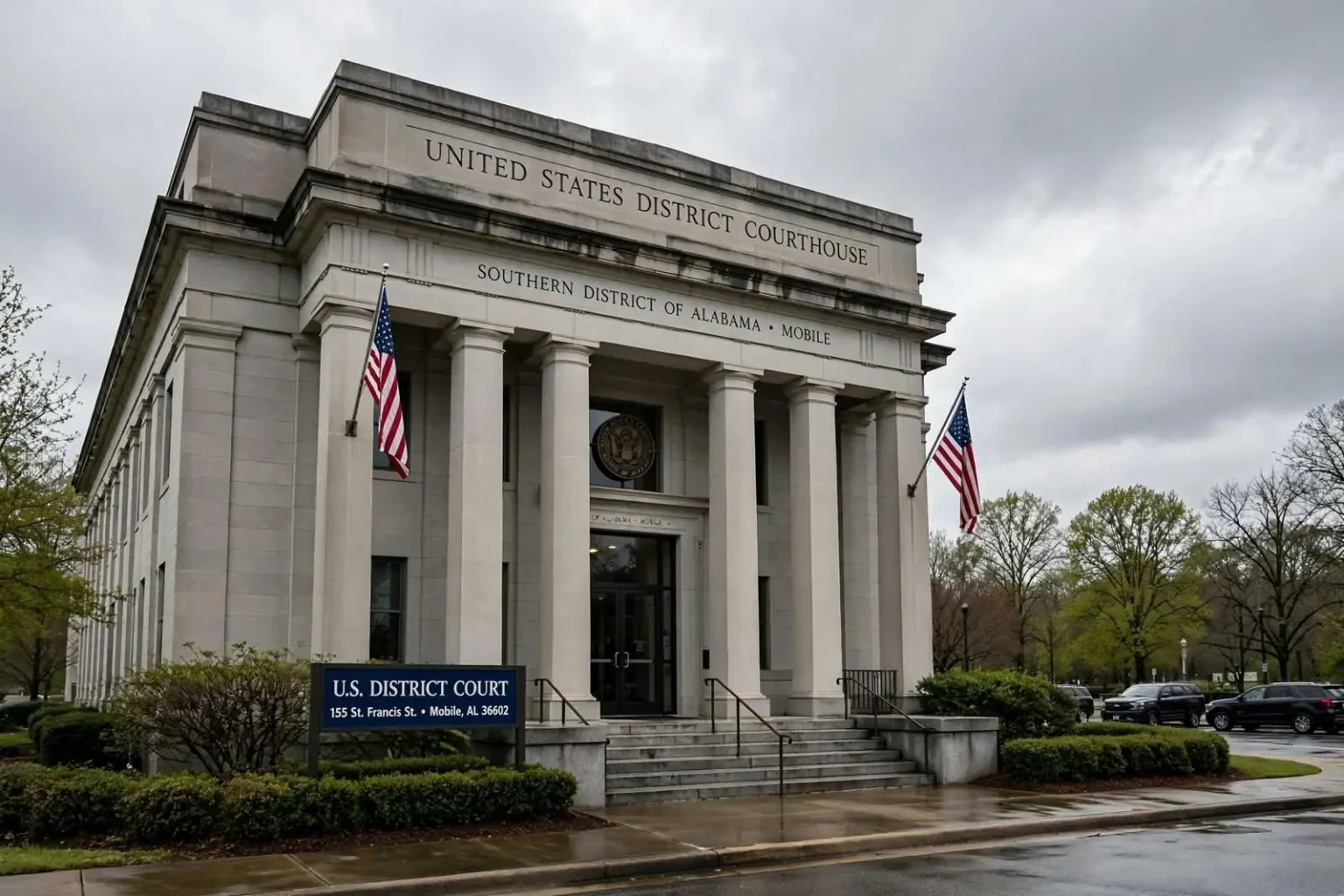
Garcia Venegas works in construction in Baldwin County, and the detentions described in the lawsuit occurred at job sites and at his home in this part of the state. The case is before the U.S. District Court for the Southern District of Alabama.
The questions it raises — whether officers may enter private job sites without warrants, and what weight a government-issued identification carries when an officer decides not to credit it — are not local ones. But the record that answers them is being built here.