

Someone once described Boligee, Alabama, as the “Chicago of the South.” The friend who passed along the line grew up there, and he meant it half as a joke and half as history: the little Greene County town had everything a boomtown needed — a river, a railroad and, eventually, an Interstate highway. What it never got was the boom.
Boligee sits in west-central Alabama’s Black Belt, about halfway between Tuscaloosa and Demopolis, eleven miles from Eutaw, the county seat, where you buy your groceries and find a table that isn’t the Boligee Cafe. Like dozens of towns across the cotton South, it has seen better economic days. Stately homes have fallen into disrepair; row crops have given way to timber, cattle and catfish. But spend a weekend there — as a group of Mobile friends did recently, staying at a family camp house on the Tombigbee River — and you’ll find that the story of rural Alabama is being rewritten by the people who stayed, and by the ones who come back.
Watching the sun go down on an era
The visitors arrived at about 4:30 on a winter afternoon, just in time for sunset — and for the phone calls announcing that Nick Saban had retired as Alabama’s head coach. Everyone knew the day would come; it was a shock anyway. Word travels fast even eleven miles from the nearest grocery store, and by nightfall the rumor mill was running at full speed in the camp house living room, over grilled salmon and cocktails.
The camp house belongs to a Tuscaloosa family that has held land along the Tombigbee for generations, dating back before the Civil War. The current caretaker — a land broker by trade who knows everyone within a fifty-mile radius — built a second cabin next door just to house friends and family. Up the hill, a new home was rising above the river, designed by Mobile architect Robert McCown, with simple, elegant lines and views across the water to green fields and pine forest.
The rivers that made everything
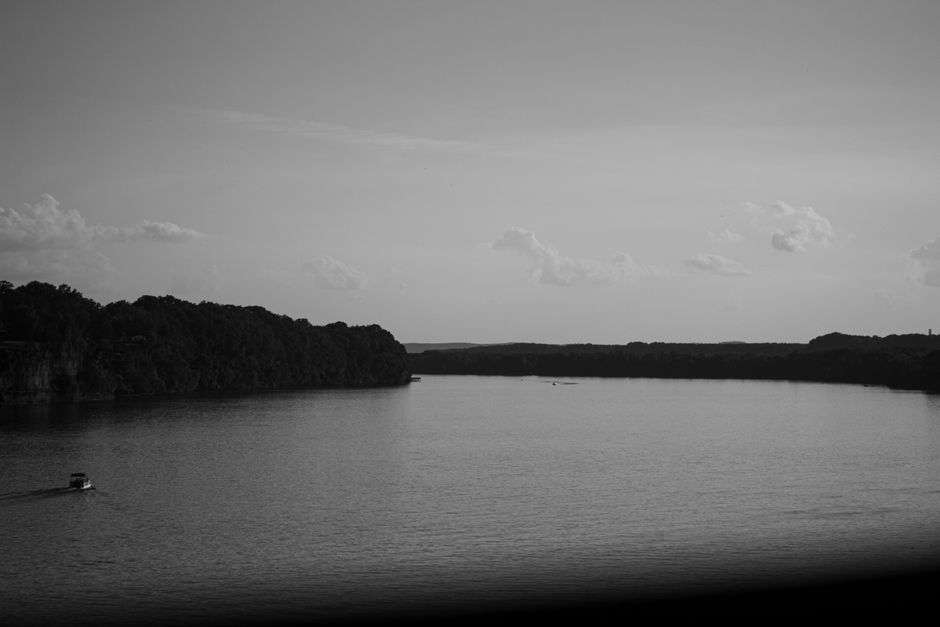
Geography explains Boligee’s ambitions. A short drive west, at Demopolis, the Tombigbee River meets the Black Warrior, and the combined flow winds south toward the port of Mobile. Barges and recreational boats share the water, and in principle the system connects to navigable waterways that reach across the continent — one of the camp’s recent guests is spending a year doing exactly that with his wife.
In winter, a drive through the Black Belt can look bleak to unknowing eyes: fields cut to stubble, tan winter grass, cows staring at passing trucks, catfish ponds dotting the landscape like scattered mirrors. But the ponds and pines are working landscape. Greene County has long been one of Alabama’s centers of catfish farming, though the industry has had lean years lately. “Too much supply, and foreign fish imports,” the camp’s host says. “Plus the price of feed is high.”
Timber, hogs and prescribed fire
Land management is a full-time obsession for property owners here. The family spends much of its time maintaining roads, bush-hogging under the pines, and running prescribed burns every other year — a practice that improves both timber and wildlife habitat. Then there’s the war on wild hogs, which root up fields and threaten the turkey and quail hunting. Friends come by with infrared scopes to hunt them at night; the hogs reproduce every five or six months, so the battle never ends. The harvest doesn’t go to waste — the meat is donated to charities that feed the local community.
The timber side of the visit included a working harvest down the road: dying trees cut to salvage value, sorted into saw-timber and pulp, loaded by skilled operators onto trucks bound for the sawmill or paper mill. Timber prices are down across the board — too much supply, the foresters say — making it a capital-intensive, timing-dependent business.
Wildlife, meanwhile, seems to be winning. On the two-mile drive to the property gate, the group counted hundreds of white-tailed deer and several large flocks of wild turkeys feeding in planted fields — more game than a decades-long visitor could remember seeing.
Horses and hometown enterprise
The surprise of the weekend sat just outside town: Triple C Performance Horses, a family horse farm operated by lifelong Boligee residents, with manicured pastures, a covered arena that would embarrass some state facilities, exercise and riding yards, and hundreds of beautiful horses. What began as a hobby has become an enterprise; a traveling farrier from Texas stops by every five or six weeks. The operation specializes in cutting horses — mostly quarter horses, bred for the intelligence, speed and quick stops the sport demands.
At the Boligee Cafe, the town’s unofficial town hall, everyone from the horse farm’s operator to the owner of a large industrial boring company stops in, and not much escapes scrutiny. The cafe is where the lay of the land actually gets laid out.
Thornhill and the view from the tower
No visit to the area is complete without a stop at Thornhill, the antebellum home near Forkland owned by a Tuscaloosa businessman who has restored the main house, an old schoolhouse and several outbuildings on the property. He is, by local accounts, a walking history book, and he was out trimming limbs from ancient live oaks as the visitors arrived. On a nearby hill stands an old fire tower he bought in Florida, re-galvanized and re-erected; the climb is rewarded with sweeping views of the Black Belt at sunset. A short walk away, a small family cemetery keeps the property’s longest records.
Thornhill hosts occasional weddings and historical-group events — part of a common Black Belt pattern in which people from all walks of life buy old places and weekend land to hunt, fish and entertain friends, pouring money and attention back into places the highway forgot.
The long way home
By the time the Mobile visitors pointed south, the rain had cleared, the coaching search had resolved, and the weekend had delivered its quiet argument: the “Chicago of the South” never became a metropolis, but the land along the Tombigbee — tended, hunted, farmed, and now carefully restored — is doing what it has always done, sustained by people who know everyone within fifty miles and treat that as an advantage rather than a limit.