Gov. Ivey Announces Expanded FEMA Public Assistance for Hurricane Sally Recovery
Gov. Kay Ivey announced expanded FEMA Public Assistance for Hurricane Sally recovery, adding nine Alabama counties to the aid list.
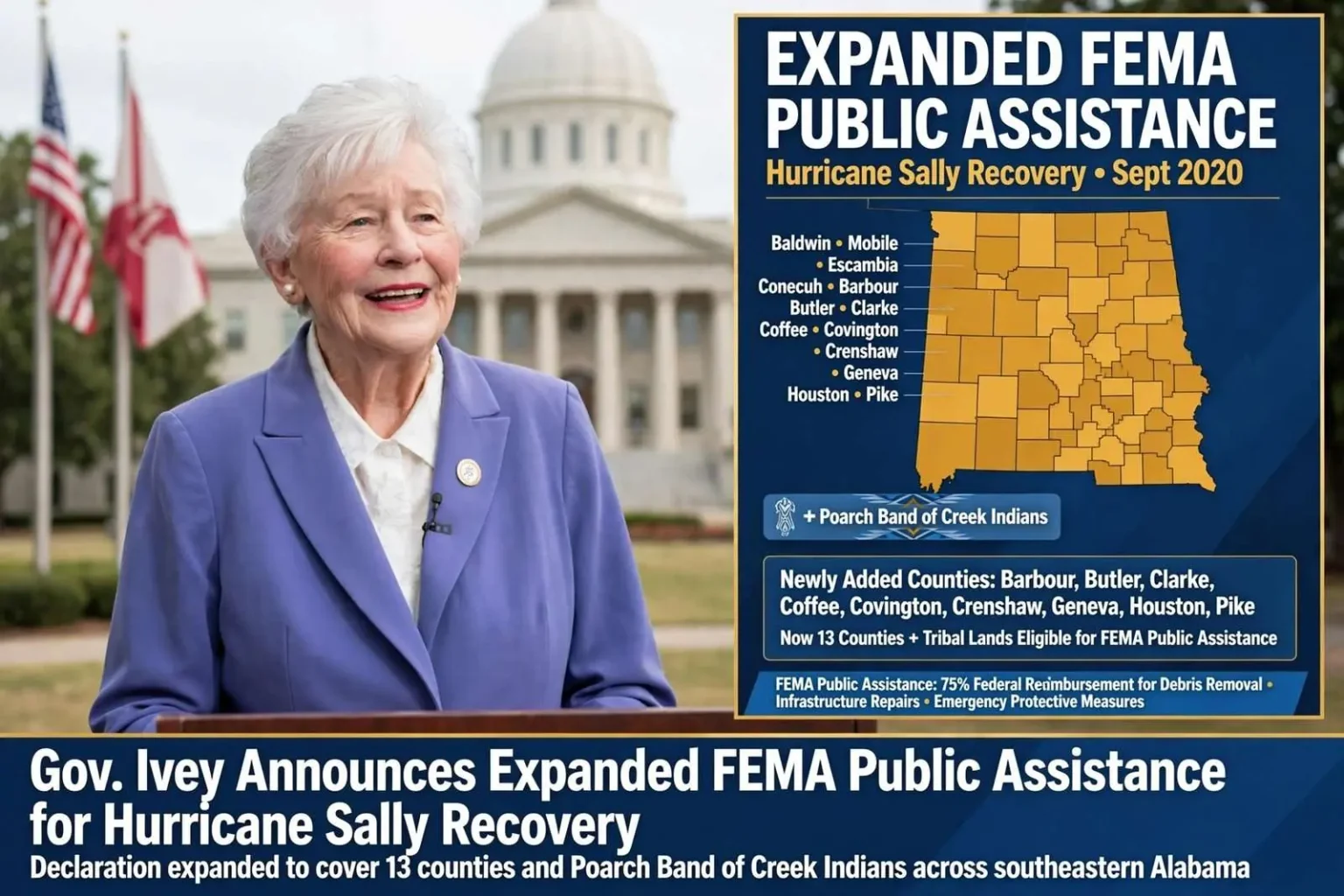
MONTGOMERY, Ala. — Gov. Kay Ivey said President Donald Trump’s Sept. 20 disaster declaration for Alabama has been amended to extend FEMA Public Assistance to additional counties recovering from Hurricane Sally. The expansion adds Barbour, Butler, Clarke, Coffee, Covington, Crenshaw, Geneva, Houston and Pike counties, along with the Poarch Band of Creek Indians, to the list of jurisdictions eligible to apply for federal help. The amendment marked a significant widening of the federal recovery net, reaching counties well inland of where Sally came ashore.
Combined with four counties declared eligible earlier — Baldwin, Conecuh, Escambia and Mobile — a total of 13 counties and the Poarch Band are now covered. Hurricane Sally made landfall in September 2020 near Gulf Shores as a slow-moving Category 2 storm, and its most severe damage concentrated along the Alabama and Florida coastlines; the delayed expansion recognized that the storm’s heavy rains and flooding spread destruction far beyond the beaches, through river towns and rural communities across the state’s southeastern half.
Public Assistance is FEMA’s largest disaster grant program. Eligible state, county and local governments, as well as certain private nonprofits, may be reimbursed for at least 75 percent of disaster-related costs, including debris removal, emergency protective measures and repairs to public facilities such as roads, bridges, water systems, buildings and utilities. The program is the financial backbone of public-sector disaster recovery, covering the enormous municipal bills — fallen trees, washed-out roads, damaged public buildings — that local budgets cannot absorb alone.
What the Expansion Adds
The newly added counties stretch across southern and southeastern Alabama, from Clarke and Butler in the west through Coffee, Covington, Crenshaw, Geneva, Houston and Pike, along with Barbour on the Georgia line. Many of these communities took Sally’s rain bands and saturated ground seriously: days of steady rain swelled creeks and rivers, closed roads and flooded neighborhoods miles from the Gulf. Adding them to the declaration means their governments and qualifying nonprofits can now seek reimbursement for response costs and repairs they had been carrying on their own.
The Poarch Band of Creek Indians, whose reservation and lands sit near Atmore in Escambia County, joined the eligible list as a tribal jurisdiction in its own right. As a federally recognized tribe, the Poarch Band applies to FEMA directly rather than through county government, and its inclusion brought tribal infrastructure and facilities into the federal recovery program alongside the counties.
Baldwin and Mobile counties — Alabama’s two coastal counties and the areas hit hardest by the storm — had been declared eligible when the major disaster declaration was announced Sept. 20, along with Conecuh and Escambia. The original declaration also made Individual Assistance available to residents in the hardest-hit areas, opening the door to federal help with home repairs, temporary housing and other personal disaster costs. Public Assistance, by contrast, flows to institutions: governments, school systems, water authorities and the nonprofit organizations that provide critical services.
“As Alabama continues to recover following the devastating impacts from Hurricane Sally, I am pleased to continue working with FEMA to provide the necessary assistance to our citizens,” Ivey said in a statement. The governor’s office worked with Alabama Emergency Management Agency officials and FEMA’s regional office to compile the damage documentation that supports an expansion request — a process that requires counties to report response costs and repair estimates and the state to demonstrate that the damage exceeds what state and local resources can cover.
How Public Assistance Works
The Public Assistance process begins long before money moves. After a declaration, applicants register with the state, and FEMA and state officials conduct site inspections to document damage and develop cost estimates. Projects fall into categories, from debris removal and emergency protective measures through permanent repairs to roads, bridges, water control facilities, public buildings, utilities and parks. Reimbursement comes on a cost-share basis — at least 75 percent federal, with the state and applicant splitting the remainder — and payments follow as projects are obligated and completed.
For small towns and rural counties, the program can be the difference between recovery and lasting budget damage. A single county road crew’s storm response — overtime, equipment, contracted debris haulers — can run into six figures quickly, and major repairs to a water system or a public building can dwarf an entire small-town annual budget. The 75 percent federal share keeps those costs from falling entirely on local taxpayers.
Certain private nonprofits are eligible as well, including organizations that provide critical services such as utilities, education, emergency medical care and custodial care. Nonprofits whose facilities sustained Sally damage — from community centers to private schools and volunteer rescue squads — can apply through the same process as governments, provided their facilities and services meet FEMA’s eligibility rules.
Hazard Mitigation on a Statewide Basis
Federal funding is also available on a cost-sharing basis for hazard mitigation work statewide. Hazard mitigation projects are the investments made after a disaster to reduce the damage from the next one — drainage improvements, elevated structures, hardened utilities, updated building codes and buyouts of repeatedly flooded properties. Because mitigation funding is available statewide under the declaration, communities that suffered only modest Sally damage can still compete for grants aimed at long-term resilience.
Mitigation has become an increasingly central piece of federal disaster policy, driven by studies showing that every dollar spent on prevention saves multiple dollars in future response and repair costs. For Alabama, a state that has absorbed repeated hurricane impacts in recent decades, the statewide mitigation availability attached to the Sally declaration gives local governments a funding channel for resilience work that ordinary budgets rarely accommodate.
The Recovery Road Ahead
The amendment to the Sept. 20 declaration reflects the cumulative picture of Sally’s toll across Alabama. The storm’s slow track — crawling northward after landfall at barely walking pace — dumped a foot or more of rain in some areas, and the wind-driven surge and prolonged onshore flow punished the coastal counties. Assessments in the weeks that followed documented damage spreading inland through the river systems of south and southeast Alabama, building the case for the expanded county list.
For the governments now eligible, the work of applying begins immediately. Public Assistance is reimbursive — applicants spend first and document everything — and the counties and tribes added to the declaration face a calendar of registration deadlines, applicant briefings and project formulations ahead. State emergency management officials typically walk new applicants through the process, and FEMA field teams help scope the larger projects.
Residents of the newly added counties should note the distinction between the programs: the expansion covers Public Assistance, meaning governments and eligible nonprofits, not direct aid to households. Individuals in declared counties seeking help with home repairs or temporary housing apply through FEMA’s Individual Assistance program where it is designated, or turn to the U.S. Small Business Administration’s disaster loan program, which offers low-interest loans to homeowners, renters and businesses in declared areas.
The 13-county footprint now covered by the declaration — Baldwin, Mobile, Escambia, Conecuh, Barbour, Butler, Clarke, Coffee, Covington, Crenshaw, Geneva, Houston and Pike — plus the Poarch Band represents a substantial share of Alabama’s southeastern quarter. From the beachfront communities of Baldwin County to the pineywoods towns along the Georgia line, the expanded declaration puts the costliest public burdens of Sally’s landfall on the federal cost-sharing table.
Ivey’s office said the state would continue working with FEMA as recovery assessments proceed, and further adjustments to the declaration remain possible as damage documentation comes in. For now, the expanded eligibility stands as the latest federal commitment to a recovery that will run for years — from the first debris haul after landfall to the last repaired public building in the last county on the list.
The bureaucratic machinery behind an expansion runs on data. County emergency management agencies tallied debris volumes, road damage, equipment hours and emergency response costs in the weeks after the storm, feeding those figures to the Alabama Emergency Management Agency, which compiles the state’s request to FEMA. The governors of disaster states submit formal amendment requests when preliminary assessments show that initial declarations underestimated the damage, and the federal government responds by adding jurisdictions where the documentation supports eligibility.
Sally’s September 2020 landfall was the second named storm to strike the Alabama coast within the same hurricane season, and the recovery workload it created stacked on top of the pandemic-era strain on local budgets. Counties borrowed equipment, contracted debris haulers and ran extended emergency operations — costs that accumulate fastest in the first weeks, precisely when documentation discipline is hardest to maintain. The eventual reimbursements depend on that paperwork, and Public Assistance officials urge applicants to preserve records from the earliest hours of a response.
For the Poarch Band, eligibility opens the same cost-shared funding channels for tribal facilities and infrastructure, from roads and buildings to utilities serving tribal lands. Tribal governments participate in the Public Assistance program through FEMA’s tribal declarations pathway, and their project pipelines proceed alongside the counties’ rather than through the state.
The expansion also carries practical meaning for the region’s school systems, several of which fall under county governments newly added to the declaration. Public school districts apply through their county or city governments for reimbursement of storm costs — damaged roofs, fallen trees on campuses, flooded facilities and the expense of lost instructional days. With 75 percent federal cost sharing, districts in the added counties can now recover a substantial share of what the storm cost them.