Hurricane Sally recovery: Schools, businesses announce reopening plans
After Hurricane Sally, Baldwin and Mobile counties and the Pensacola area announced school and business reopening plans as recovery continued.
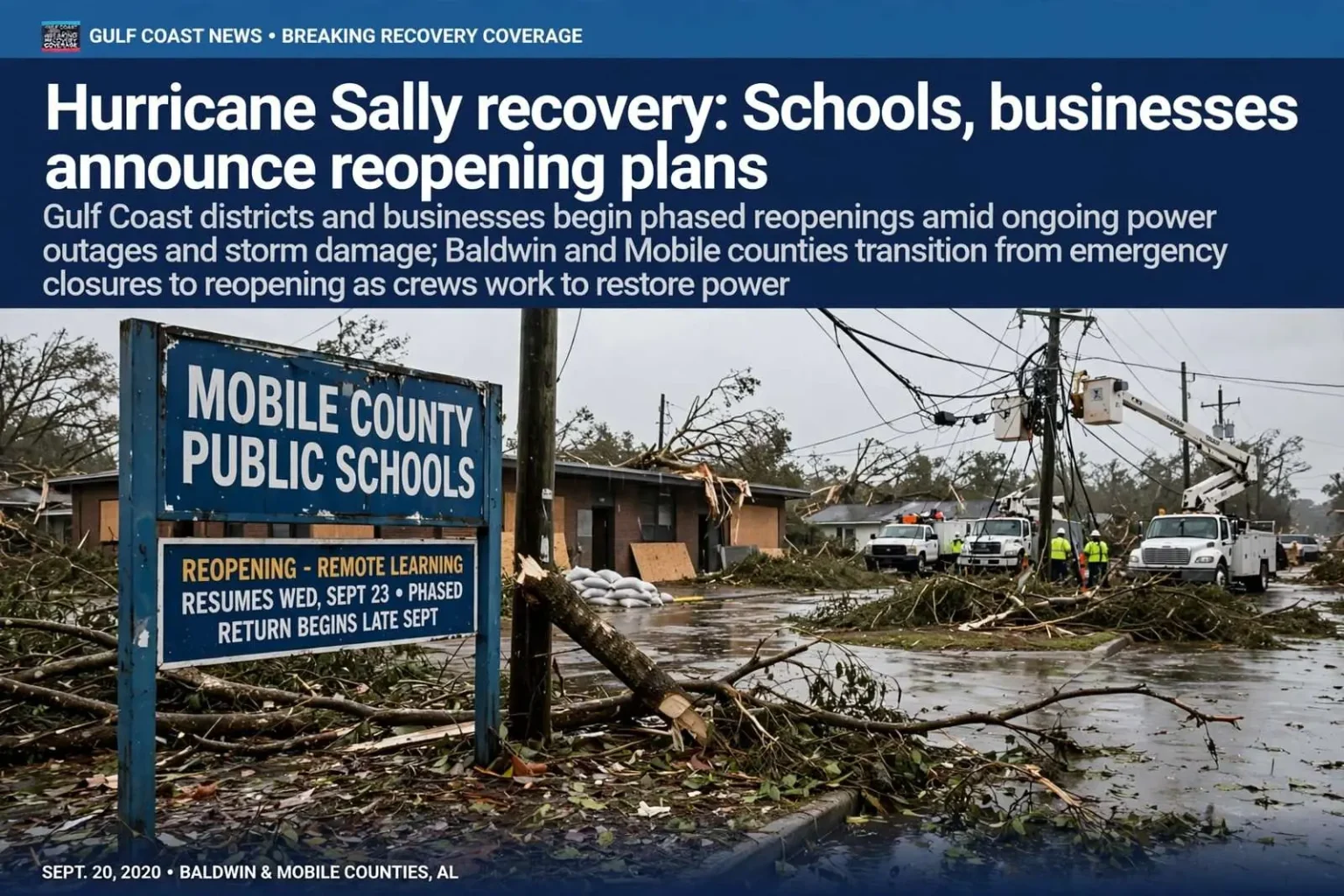
In the wake of Hurricane Sally, schools, businesses and government offices across the Gulf Coast began announcing reopening plans, though some remained closed as residents dealt with power outages and damage. The storm, which came ashore near Gulf Shores as a Category 2 hurricane in mid-September, left hundreds of thousands of utility customers without electricity across the central Gulf Coast and knocked out power for days in parts of Baldwin and Mobile counties, making reopening decisions a question of infrastructure as much as scheduling.
The patchwork of closures and reopenings reflected the uneven path of the storm’s damage. Communities close to the landfall point saw downed trees, damaged roofs, blocked roads and prolonged outages, while areas farther east and north recovered faster. For families, the week after the storm became a logistics puzzle: which employers were open, whether childcare was available, and when students would return to classrooms — in person or remotely.
Sally’s slow track made the disruption worse than its category suggested. The storm crawled toward and across the coast, driving prolonged tropical-storm-force winds and heavy rain into the same areas for many hours, downing trees into power lines and pushing water into neighborhoods along the bay. By the time the sky cleared, utility companies faced one of the largest restoration jobs in recent Alabama history, and the region’s recovery timeline was measured in days and weeks rather than hours.
Baldwin County Government Operations
Baldwin County Commission offices and facilities were closed Monday and Tuesday, with exceptions for probate offices, the Emergency Management Agency, detention and corrections centers, and landfills. The exceptions traced the essential functions of county government in a disaster’s aftermath: probate offices handle everything from marriage licenses to emergency filings, the EMA coordinates the ongoing response, the jail and corrections facilities must operate around the clock, and landfills face surging demand as residents clear storm debris from their properties.
The Sheriff’s Office administrative offices were closed to the public, though first responders continued operating. That distinction — back-office functions shut down while deputies, investigators and dispatchers stayed on the job — became the standard pattern across the affected counties. Deputies worked storm-damaged roads, handled welfare checks and assisted utility crews moving through affected areas, even as the public-facing offices people normally visit remained dark.
Mobile County Schools Go Remote
Mobile County Public Schools remained closed Monday, with remote instruction set to resume that Wednesday and a phased return of students by grade beginning late September. The state’s largest school district faced the same equation as every district on the coast: buildings without power, homes without internet access and families still cleaning up. Remote instruction allowed classes to resume in some form while campuses were restored, though district leaders acknowledged that students without power or connectivity at home would face real gaps until in-person classes resumed.
The phased return beginning late September gave the district time to verify that each campus had power, safe drinking water, working air conditioning and cleared access routes before welcoming students back. Principals used the interim days to assess damage, communicate with staff and families, and adjust schedules. For parents juggling work and recovery, the announcements — delivered through the district’s alert systems and local media — became essential reading.
Why School Reopenings Took Priority
School reopenings draw outsize attention after a hurricane for practical reasons. When schools close, thousands of working parents suddenly need childcare, which keeps more adults home from work and slows the region’s economic recovery. Districts also serve as community anchors — the places where families get information, where students in need receive meals, and where the visible sign that a community is functioning returns first. That is why superintendents pushed to announce reopening dates even when the dates were uncertain, and why families tracked every update.
Storm-era school operations also carry safety constraints that everyday scheduling does not. Districts must confirm that traffic signals are working on bus routes, that campuses have safe water and working kitchens, and that staff themselves have somewhere to live and a way to get to work. In the hardest-hit zones, some employees had lost roofs or were staying with relatives out of the area. Reopening a school system after a hurricane is less like flipping a switch and more like rebuilding a schedule one school at a time.
Colleges Set Their Own Timetables
Bishop State Community College and Coastal Alabama Community College resumed classes after midweek, joining the wave of higher-education institutions across the region that balanced campus conditions against the need to keep semesters on track. Two-year colleges serve students who often also hold jobs and family responsibilities, and leadership at both institutions weighed commute conditions, campus power status and the availability of online options before resuming.
The Archdiocese of Mobile reopened most of its Catholic schools Monday with two exceptions. The archdiocese’s schools span Mobile and Baldwin counties, and conditions varied enough from campus to campus that reopening proceeded school by school rather than system-wide. Families at the two campuses that remained closed were told to watch for updates as power and facilities were restored.
The Florida Panhandle’s Slower Recovery
In Florida, Pensacola State College suspended classes until the following Monday, while Escambia County schools stayed closed through Tuesday and Santa Rosa County schools reopened Monday. The split between the two Panhandle counties reflected the geography of Sally’s damage: Escambia County, home to Pensacola, took some of the storm’s worst impacts, including damage to the Pensacola Bay Bridge that severed a key link between Pensacola and Gulf Breeze for months. Santa Rosa County’s schools, west of the worst damage, could reopen sooner.
Chickasaw City Schools returned Tuesday. The small Mobile County system, one of the few municipal districts in Alabama, restored classes a day after most of the region’s public school systems remained shut, a sign of how quickly conditions could vary from one community to the next even within the same county.
For college students in Pensacola, the extra week off from Pensacola State meant an unexpectedly extended break in the middle of the fall term, with the college working to make up lost instructional time once campuses reopened. Students displaced from damaged apartments or without power at home were directed to resources as the college resumed operations.
Businesses and the Return to Normal
Businesses across the two-state region faced the same calculations as schools. Restaurants and retailers reopened as power returned, while others stayed shut for repairs or awaited utility restoration. Grocery stores that had power worked to restock ice, water and shelf-stable goods; gas stations without electricity turned customers away in long lines; and businesses that could operate shifted to cash-only or limited-hours arrangements while networks and payment systems came back online.
Employers, in turn, adapted to a workforce dealing with its own storm damage. Workers whose homes were without power, whose children’s schools were closed, or whose roads were blocked by debris often could not return immediately, and many businesses accommodated flexible schedules during the first week of recovery. The reopenings announced across the Gulf Coast were as much about people being ready as buildings being ready.
The region’s marine and tourism economy felt its own version of the disruption. Marinas, charter operators and waterfront businesses along Mobile Bay and the Panhandle worked to assess damaged docks and vessels, while the area’s hotels absorbed an unusual mix of guests — utility crews, insurance adjusters and displaced residents — rather than the vacationers who normally fill them in September. Recovery spending from crews and adjusters provided a modest offset to the storm’s hit on ordinary commerce, but owners across the coast described the first week after Sally as a matter of salvage and assessment more than sales.
Officials Urge Residents to Check Directly
Officials urged residents to check directly with their schools and employers for the latest information as recovery continued. That advice became a refrain of the Sally recovery, because conditions were changing daily — and sometimes hourly — as utility crews restored power neighborhood by neighborhood. A campus that was closed Monday could open Wednesday; a road that was impassable Tuesday could be clear by the weekend.
Sally’s slow movement before landfall meant the storm’s wind and rain hammered the same stretch of coastline for hours, and the recovery that followed proved just as slow-moving. Two decades after Ivan, the central Gulf Coast was reminded that a hurricane does not need to be a Category 5 to disrupt daily life for weeks. In the days after the storm, the schedule of reopenings — county offices, school systems, colleges, businesses large and small — became the public’s scoreboard for how recovery was going, one reopening at a time.
For the families of the central Gulf Coast, the message from officials was patience: power was being restored, schools were coming back, and the phased returns beginning in late September marked the transition from emergency response to the long work of normalcy.