

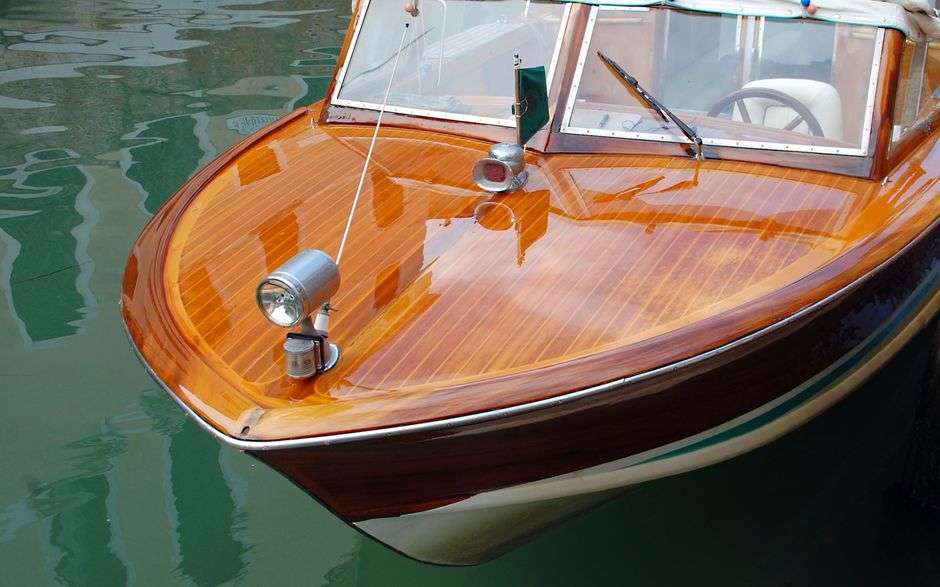
Among the thousands of center consoles and bay boats that crowd Gulf Coast waterways on a summer weekend, a certain 23-foot runabout stands out from a distance: high, sweeping bow, lapstrake hull, varnished wood trim, and rope inlay along the rub rail. It is the Caribiana Sea Skiff, and it is built — carefully, in small numbers — in Foley, Alabama.
From Trinidad to Foley
The boat’s story starts with Lynn Rabren, who brought the island-hopping skiff design from Trinidad to the United States more than twenty-five years ago. Rabren modernized the traditional wooden hull in fiberglass and spent two decades building a brand that Forbes once profiled as the kind of boat that made people ask questions at the dock. Around two hundred of the skiffs were sold over the years, from San Diego to Cape Cod, and the design earned a Wikipedia page and a devoted following among boaters who wanted classic lines with modern durability.
In 2022 the company changed hands. A new group of investors — Elmer Barnett, Paul Galusha, and early backer Joe Alan Sexton among them — purchased Caribiana and set up manufacturing in Foley, with every partner carrying at least a decade of history with the brand. “Lynn did a wonderful job building this boat and brand,” Barnett says. “I fell in love immediately.”
The Maracas
The current model, the Caribiana Maracas, keeps the Caribbean silhouette and updates the details. The helm is modern, the side seats sit slightly farther forward than on earlier versions, and an optional table mounts at the console for picnics and sandbar afternoons. A matching bimini top provides shade and rain cover, and the boat is powered by a white Suzuki 60 outboard, with a Suzuki 90 available for owners who want more margin. The lapstrake hull’s high bow, which sweeps back toward the transom, is not just styling: it lets the skiff slice through chop that would stop a flatter-bottomed runabout.
Each hull is finished in a custom color with high-grade wood trim, so no two arrive at the ramp quite alike. The first hull off the new Foley line was destined for Melanie Martin of Melanie Martin Interiors in Orange Beach, who was also tapped to help with fabric selection and interior accessories — a deliberate choice, says Galusha, on the theory that an interior designer makes a demanding first customer.
Beach boats, tenders, and day cruisers
What do people do with a 23-foot skiff that looks like it escaped from a 1960s resort dock? Owners describe the same short list: pulling up to a sandbar, beaching on a barrier island, running across the bay in style, and — for one owner of a 72-foot Viking — serving as a yacht tender in the Bahamas, where the design’s ancestry is most at home. The boat’s look does most of the marketing. Even in a crowded marina, a Caribiana draws comments before the engines are off.
Orders have come from farther afield than the Gulf. The company says calls arrive weekly from Cape Cod, Charleston, and Savannah, and the skiffs have historically sold all along the Eastern Seaboard. Plans call for a 31-foot model derived from the 23, and eventually a 34-foot fishing platform, but the current Maracas remains the order book’s centerpiece and can be ordered directly from the company.
Small-batch boatbuilding on Alabama’s Gulf Coast
Foley is better known for its outlet malls and its railroad museum than for fiberglass work, which is part of what makes Caribiana’s presence notable. Alabama’s boatbuilding industry is anchored by the large centers around Orange Beach and Bayou La Batre; a boutique builder turning out a hand-finished, customizable skiff adds a different note to the roster. The team’s plan is deliberately modest — steady production, careful hulls, and growth on the strength of the boat’s looks rather than volume discounts.
“It’s a work of art,” says Sexton, imagining afternoons on the water with his wife and two kids. That, more or less, is the pitch. The Caribiana is not the fastest, cheapest, or most practical boat at the ramp. It is the one people walk over to look at — and after twenty-five years, two owners, and a move from Trinidad by way of the Caribbean, that has turned out to be a business plan of its own.