

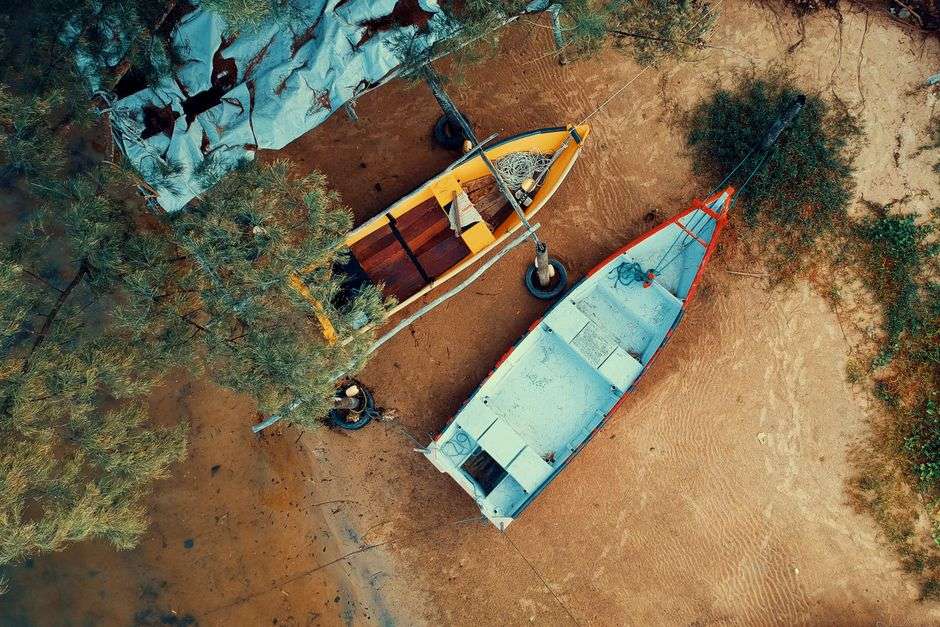
There is a line in “The Wind in the Willows” that generations of Gulf Coast boaters have taken as scripture: “Believe me, my young friend, there is nothing — absolutely nothing — half so much worth doing as simply messing about in boats.” Few vessels anywhere prove the point better than a 17-foot wooden skiff named Fishing Pole, built in a Mobile backyard in the 1950s and still floating on family hands in a fifth generation.
Trout Fishers Want a Better Boat
The story begins with a Mobile dentist and speckled trout enthusiast — allergic to trout, no less — who fished Dauphin Island waters before the bridge existed. In those days a trip meant loading outboard motor, gas tanks, trawl net, tackle and ice box into a car, driving to Cedar Point, renting a skiff and outfitting it from scratch. A run out to Sand Island was a full-day expedition.
Once the Dauphin Island bridge opened and Billy Goat Hole became a launch point, trailered boats changed everything, and the local trout crowd started comparing notes on what the perfect trout boat would look like. The wish list had a Gulf Coast pragmatism to it: a vee hull to handle chop without beating passengers to death, easy trailering, a live bait well, room to drag and store a 16-foot shrimp trawl net, and a decent fish-fighting cockpit.
Among the fishermen batting the idea around were Dr. William Rowell Sr., Dr. Johnny Pittman, Rone Negus, Harry Meyers Sr. and Harry Seals. Negus, a duck sneak builder in his off hours, listened — then designed and built a 17-foot wooden boat that met every requirement. The hull ran deep-Vee at the bow with a proud entry, then flattened out at the stern for stability and speed in calm water. The bench seat doubled as a live well, the floorboard behind it flipped over to reveal a bait-sorting box, and the trawl net, lines and boards stowed beneath the floorboards in the bilge.
Hull No. 2, Laid in Silverwood
Dr. Pittman bought the original Negus boat — a vessel his son Norman still owns and maintains, fittingly married into the family that commissioned its successor. The following year, the author’s grandfather commissioned Hull No. 2, the boat that would come to be known as Fishing Pole.
Negus laid the keel and ribs in the grandparents’ backyard in Silverwood, the midtown Mobile neighborhood near the Dew Drop Inn and the former Nixon Drugs. The grandfather, the author’s father Dr. Neal Rowell Sr., and uncle Dr. William (Billy) Rowell Jr. — also a dentist — finished out the hull and interior themselves, following Dr. Pittman’s boat as the pattern. While Hull No. 2 took shape, the uncle commissioned a sister ship whose hull was laid right beside it. The whole project happened sometime between 1955 and 1957.
From Twin Evinrudes to Ski Boat
Fishing Pole launched with twin 18-horsepower Evinrude short-shaft outboards. The flat stern added stability at rest, but as motors grew in power, the waves grew harsher. The originals gave way to Johnson 20s in the early 1960s, and in 1970 Negus himself raised the transom with a mahogany patch to accept one of the first three-cylinder Johnson 60-horsepower engines.
The repowered skiff doubled as a ski boat and became a familiar sight on Fowl River, where by the family’s count more than 100 people learned to ski in its wake — including the whole neighborhood crew from Flo Claire, the subdivision across from Weinacker’s Shopping Center on Government Street. Fishing gear came off the boat at noon and the River Rats water-skied, barefoot skied, tubed and disked all afternoon. No motor survived more than five years of that treatment.
A Winner in the Family
Fishing Pole was no mere pleasure craft. Bootsie Rowell, the author’s mother, landed three first-place fish at the Alabama Deep Sea Fishing Rodeo: a 17½-pound bonita in 1965, a 108-pound tarpon in 1970 and a 60-pound tarpon in 1975. All three Rowell brothers and the author took first-place fish in the Dauphin Island Young Anglers Tournament — today’s Roy Martin Young Anglers Tournament — including a first-place 29-pound king mackerel landed on a friend’s first-ever Gulf trip.
The shrimp catches made their own legends. After Hurricane Frederic boosted the shrimp population in Mobile Bay, opening day of the 1980 season sent a 19-year-old out into the Fowl River channel with a visiting cousin’s husband from Spain. Two drags produced 40 pounds of clean shrimp, a CB-radio argument about whether it could possibly be true, and a stunned father standing over an ice box that would not close.
Sinking Engines and a New Transom
The boat’s most dramatic day came in 1989, a week after a new 60-horsepower Johnson went on. A novice driver was ordered to full throttle in West Fowl River when the mahogany transom patch cracked horizontally, and the brand-new engine dropped to the bottom still attached to its control cables. A shouted SOS rallied strong-armed neighbors, who hefted the engine back into the boat; Johnson, unsure how to price a replacement power head for a motor that had drowned, covered it under warranty.
The new transom was fabricated by Stauter Boat Works on the Causeway and installed by father and son — making Fishing Pole, as the family tells it, a hybrid Negus/Stauter/Rowell. Repairs since have leaned on West Marine epoxy and liberal elbow grease, and the boat remains, in the old salt’s vocabulary, “pretty yar.”
The Real Origin of the Name
Most people assume the boat was named for the fishing. The truth is better. Dr. Neal Rowell — a physicist and astronomer, and famously frugal — fashioned a CB antenna from 108 inches of wire wrapped around a cane pole cut from the cane patch at the family’s Fowl River place, stuffing it into a vacant antenna hole in the family hunting vehicle, a 1963 two-door Rambler American. Fellow hunters started hollering “Here comes Fishing Pole!” whenever he rolled out of the woods, and the name stuck — to the man first, and to the boat forever after.
Today, five generations later, the grandchildren of the original builders’ grandchildren are boating aboard Fishing Pole. Nobody in the family claims to own her. The word they use is caretaker — which may be the highest compliment a 70-year-old backyard-built skiff can receive.