Judge Orders Full Mobile ARB Into Mediation Over Murphy USA Gas Station Appeal
A Mobile judge ordered all nine ARB members into mediation by late October in the two-year fight over a Murphy USA station at Broad and Government streets.
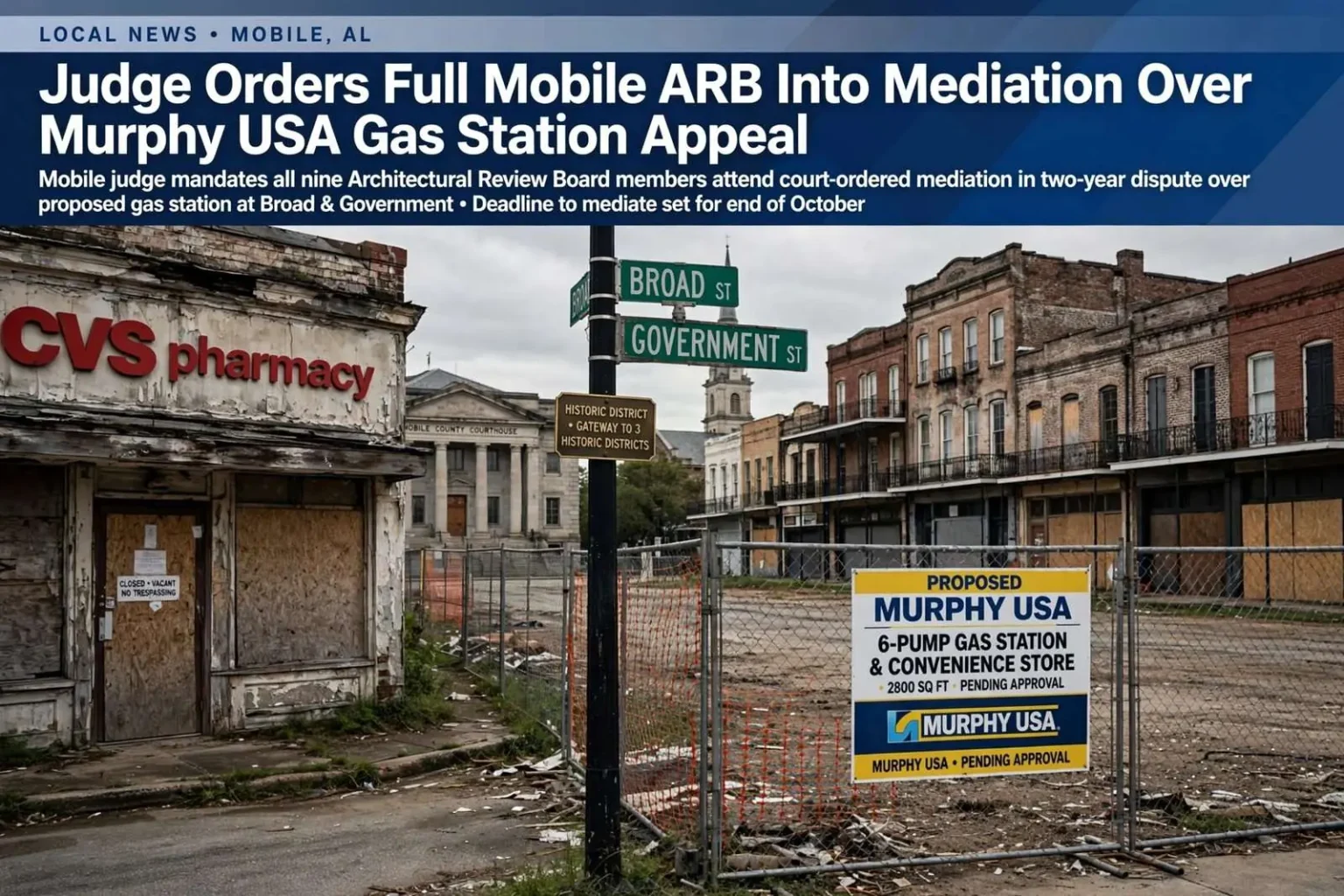
A Mobile judge has ordered every member of the city’s Architectural Review Board to attend mediation in the two-year legal fight over a proposed Murphy USA gas station at one of downtown’s most visible corners.
Rather than rule Friday on the city board’s motion to throw out the developers’ appeal, Circuit Court Judge Ben Brooks gave the two sides until the end of October to complete court-ordered mediation sessions — and made clear that everyone with the power to settle the case must be in the room.
“Everybody with settlement authority on the case, get them in the room,” Brooks said during a Friday afternoon hearing.
The project and the denial
Murphy USA plans to build a six-pump gas station and convenience store at the corner of Broad and Government streets, where a dilapidated CVS pharmacy has stood empty for years. The parcel sits at a busy entry point to three of Mobile’s historic districts, and any construction there requires a certificate of appropriateness from the Architectural Review Board, the city panel that enforces design standards in historic neighborhoods.
After the ARB voted down the building application in October 2024, Pan American Engineers, LLC, the project’s design firm, took the board to court, alleging the denial was “arbitrary and capricious, an abuse of discretion, and was not supported by any facts.”
Brooks sent the case to mediation in July and ordered both sides to appear in court Friday afternoon, Aug. 28. The board’s motion for summary judgment — its bid to have the appeal dismissed without a trial — was slated for discussion at the hearing, but the matter did not come up.
How many board members must show up?
Instead, Friday’s hearing turned on a procedural question with real consequences: whether all nine members of the ARB, or just a handful, have to attend the court-ordered mediation meetings.
Pan American attorney Jerome Speegle argued that partial attendance would defeat the purpose of mediation. “It’s useless to go to mediation if we’re going to have three people there,” Speegle said. “All the board members can appear and they can individually say and agree what they would vote on.”
Brooks sided with the developers. Mediations, he said, must be attended by anyone with authority to make a settlement and bring the case to a close. When the board’s attorney, Douglas McCoy, said it would be impossible to align the daily schedules of all nine ARB members, Brooks was unmoved.
“I can order them to be there,” Brooks said. “I have to order people to do things every week. It’s not personal.”
With that, Brooks ordered every member of the ARB to attend the case’s mediation and gave both sides until the end of October to hold the meetings and report back to the court.
‘Room for movement’
Brooks suggested during the hearing that he believes a compromise is possible. “There is room for movement” on the question of building a Murphy USA gas station at the prominent downtown intersection, he said, adding: “Cooler minds could prevail on both sides. Both sides need to be careful what you wish for. You may get it.”
Speegle declined to comment after the hearing. McCoy, speaking to reporters, suggested that Murphy USA could change the minds of outraged neighbors if the developers listen to their concerns and adjust the building’s design plan. McCoy noted the corner of Broad and Government is “a very prominent lot” that serves as a gateway to three different historic districts. The development could add other businesses to make it more consistent with the surrounding area, or even a sculpture installation, he said.
The board’s sharply worded motion
The ARB’s motion for summary judgment took an unusually personal tone, casting Murphy USA as a “bully” that falsely accused board members of unethical behavior and refused to adjust its design.
“It was not the ARB which declined trying to work with appellants for developing a gas station and convenience store design which would satisfy the ARB’s design review guidelines,” the motion reads. “Rather, it was the $2.74 billion annual revenue Murphy USA behemoth which had no respect or regard for any suggestion that it should be sensitive to the unique character of the historic district in which it was attempting to locate one of its stores.”
Pan American flatly objected to the motion in a one-page reply filing, and the dispute over the station has drawn attention from historic preservation groups that track ARB decisions downtown.
What mediation means for the project
Mediation is not a ruling, and nothing said in the sessions can be used against either side in court later. But a settlement reached there would end the litigation and could clear the way for a revised development plan — or a renewed denial. If no agreement emerges by the end of October, the parties will report back to Brooks, and the summary judgment fight resumes.
For the neighborhood groups that opposed the station’s original design, the order represents leverage: every board member will be present to hear concerns directly. For Murphy USA and its design team, it is a chance to present a revised plan without another denial. Either outcome, Brooks suggested, beats another round of motions.
Both sides are due back before the court after mediation concludes. If they reach no deal, the judge will decide the board’s dismissal motion — and the two-year fight over the corner of Broad and Government will head toward trial.
The mediation requirement itself dates to July 10, when Brooks first ordered Hygia, Inc. and Pan American Engineers into mediation with the board and appointed Charles Fleming to direct the discussions. That order required all parties and representatives with full settlement authority to be personally present throughout the mediation, directed the mediator to report to the court on the process’ status no later than Sept. 17, 2026, and set a status hearing for Sept. 18 — a schedule that has since given way to the extended mediation window ordered from the bench.
The underlying denial was unanimous when it came. All seven members of the Architectural Review Board voted down the application in October 2024, after residents of the adjacent historic districts objected that a gas station would be incompatible with the character of their neighborhoods. The proposal called for a 2,800-square-foot convenience store building that would have replaced the CVS pharmacy that has sat abandoned on the Broad and Government streets parcel for years.
Related coverage from South AL News
- Judge Orders Mediation in Downtown Mobile Gas Station Dispute
- Orange Beach Walks Away From $14 Million RV Park Deal That Once Carried a Pirate Show Dream
- Mobile Security Guard Arrested After Fatal Shooting at Dauphin Street Gas Station
- Prichard Couple Attacked With Tire Iron at Gas Station; Clerk Allegedly Refused to Call 911