

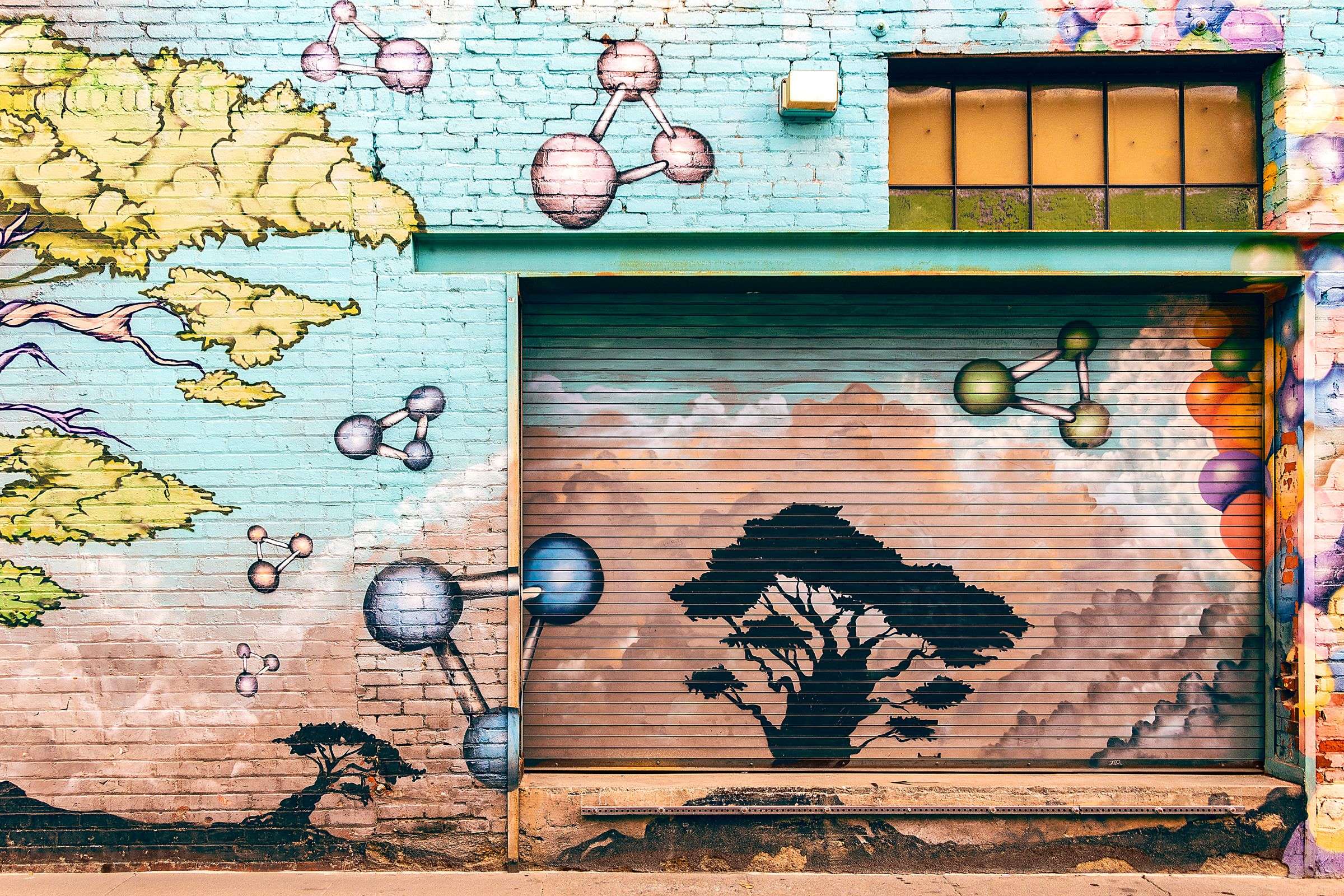
MOBILE, Ala. — The Demented Needle in Mobile hosted a collaborative art party Sunday night, turning a casual gathering into a live painting session that filled the shop with music and color. By the end of the evening, three canvases that had started blank carried the layered marks of dozens of hands — a snapshot of the city’s creative community in the informal, slightly chaotic setting where it does some of its best work.
Staff taped three blank canvases to the walls and invited anyone in attendance to pick up a brush and add to them. No sign-up sheet, no assigned sections, no jury: the invitation was open to everyone who walked in. The format transformed the shop from a place where people watch one artist work into a place where everyone works, with the canvases becoming a running conversation among strangers and friends alike.
The event ran on two simple rules: any addition to a canvas had to improve the piece, and once a painter was finished with a section, the brush had to be handed off to someone else. The constraints are small but powerful. Requiring each addition to improve the work forced painters to study what was already there before touching the surface — to read the room, so to speak, before speaking. The hand-off rule kept the brush circulating, so no single contributor could monopolize a canvas or steer it toward a private vision.
The result was a set of pieces built entirely through spontaneous collaboration, with no single artist controlling the outcome. That absence of authorship is the point of the exercise. Collaborative canvases have a long lineage in art practice — the technique of building a work from many uncoordinated hands dates back at least to the parlor games of the Surrealists, who passed drawings around a table and delighted in the unpredictable hybrids that emerged — and the same electricity was at work Sunday night: images assembled by consensus of accident, with each painter answering the last one’s marks.
Music filled the room
While the canvases filled in, a rotating group of local musicians kept the room going. Josh Ewing, of the band Phar Flecher, and Brandyn Ulmer, of Top of the Orange, played guitar together for much of the night — a pairing that itself followed the evening’s collaborative spirit, with two players from different projects finding common ground in real time.
Zach Depolo added violin to the mix, while Ashelea Penquite and Victoria Noll each played guitar and sang. The rotations kept the soundtrack shifting as the night went on, and the music did more than fill silence: a painting party needs a pulse, and the changing lineup gave the room one, matching the steady accumulation of paint on the walls with a steady accumulation of sound. The combination of live music and live art-making is a signature of the shop’s gatherings — an evening structured less like an event and more like a session, where the audience and the performers blur together.
A document of the process
Organizers said a time-lapse video capturing the canvases coming together over the course of the evening was expected to be released soon, giving those who missed the party a chance to see how the finished pieces evolved. Time-lapse has become the natural documentary form for collaborative work of this kind — it compresses hours of additions, overpainting and hand-offs into a few minutes, and it makes visible exactly what the rules were designed to produce: not one artist’s image, but a sequence of responses building on one another until the canvas resolves.
The video will also serve as the record of a night that, by design, produced no catalog and no attribution. The three canvases now carry every contributor’s hand without carrying anyone’s name, and the time-lapse is the only way to see how the layers accumulated — which marks came first, which paintings answered them, and where the pieces ended up once everyone had handed off.
The Demented Needle’s place in Mobile’s creative scene
The Demented Needle has built a reputation in Mobile as a gathering spot for the city’s tattoo, art and music scenes, and events like Sunday’s art party reflect the kind of informal, artist-driven programming that has become part of its identity. Tattoo shops have long occupied a particular role in creative communities — working studios by trade, they double as galleries, meeting halls and late-night salons for the artists who orbit them. In Mobile, where the creative community is spread across downtown studios, bars and festival stages, a shop that opens its walls to a crowd fills a real gap: it is a venue where nobody needs a booking agent, a gallery contract or a stage slot.
The shop’s dual identity is what makes an evening like Sunday possible. As a working studio, it has the supplies, the surfaces and the comfort with mess that a painting party requires; as a gathering spot, it has the crowd — the musicians, the painters, the regulars — that turns supplies into an event. The party format also inverts the usual relationship between shop and visitor: instead of coming to look at work on the walls, guests leave their own work on them.
Mobile’s creative scene has been growing along exactly these lines for years. The city’s art and music communities are tight-knit enough that a Sunday-night party draws players from multiple bands, painters from multiple studios and a crowd that follows both — and the collaborative format captures the scene’s character in miniature. The musicians on hand Sunday, drawn from Phar Flecher, Top of the Orange and the broader pool of local players, are exactly the circuit-crossing performers that the scene produces; the canvases, layered with the work of everyone present, are a fair portrait of it.
Why collaboration works as a party format
There is a reason collaborative painting has become a staple of creative gatherings. Making art alone in public is intimidating; making it as part of a moving crowd is liberating, because no single brushstroke carries the whole weight. The two rules the Demented Needle set — improve the piece, then pass the brush — do the work of both direction and etiquette, keeping the canvases moving forward while freeing every participant from responsibility for the final result.
For the painters involved, the format also produces something rare: work that no one can hang alone. The three finished canvases belong to the evening itself, and their value lies in the record of a community working together in real time. For the non-painters in the room, the entertainment was watching that record accumulate — one improvement, one hand-off, one layer at a time, with a violin or a guitar scoring every pass.
The time-lapse video, when it is released, will close the loop — a party whose evidence lives on three group-made canvases and a few minutes of accelerated footage. For a shop whose identity is built on the scenes it gathers, the evening was business as usual in the best sense: art made collectively, music made freely, and a room full of the people who make Mobile’s creative community what it is.
The Sunday-night format also reflects a practical truth about Mobile’s creative economy. Venues that host original music and original art are few relative to the talent pool, and the events that thrive are the ones that lower the barrier on both sides — no cover charge to deter a curious crowd, no curating process to deter a hesitant painter, no formal stage to intimidate a musician between projects. A party where the walls are the medium and the bands rotate freely suits a scene built on overlapping friendships and side projects, which is precisely what the Demented Needle’s gathering showed.
The instruments and brushes shared the evening in another way as well: both rewarded showing up. None of the musicians who played needed more than a guitar and a mic; none of the painters needed more than a brush and a spot on the canvas. The accessibility is deliberate, and it is what distinguishes an artist-driven party from a showcase. The Demented Needle’s events are structured so that the people in the room are the program — a model that depends on the shop’s reputation for drawing the right room, and one it has evidently earned across the city’s tattoo, art and music circles.
There is precedent for that reputation. Shops and studios that host this kind of programming become reference points for their scenes — the place a traveling musician asks about, the place a newcomer hears about from three different people. Sunday’s party was built on the same principle: a casual announcement, a taped-up canvas, a stocked table of brushes, and trust that the community would supply everything else. It did — in paint, in sound, and in a set of finished pieces that carry the fingerprints, literally, of everyone who came.
Organizers expect the time-lapse video to surface soon, and when it does it will give the wider scene a look at what the evening felt like from above: hours compressed to minutes, canvases blooming layer by layer, the crowd shifting with the music. Until then, the canvases hang as the party’s real output — three collaborative works from a night when Mobile’s tattoo shop turned art gallery turned concert hall did what it does best, and everyone was invited to do it too.