
Man killed in officer-involved shooting outside Harrison County courthouse
A man was fatally shot by a Harrison County deputy outside the Mississippi courthouse; the MBI is investigating the officer-involved shooting.
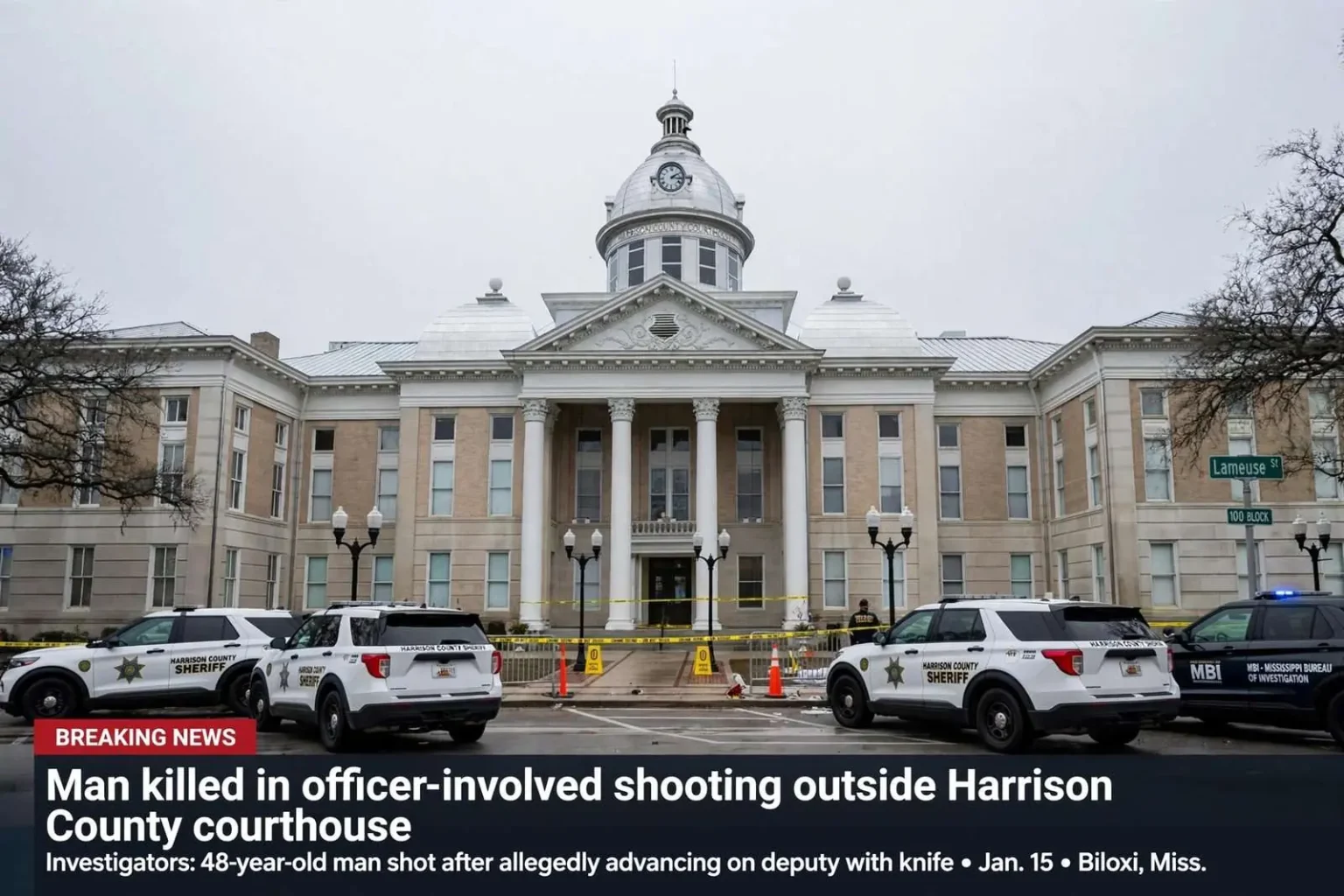
A man was shot and killed by a Harrison County sheriff’s deputy outside the Harrison County Courthouse in Mississippi earlier this year, according to the Mississippi Bureau of Investigation, which has taken charge of reviewing the encounter. Investigators said that as a deputy approached 48-year-old Reginald M. Johnson outside the courthouse on Lameuse Street, Johnson pulled a knife and began to advance on the deputy. The deputy discharged his service weapon, striking Johnson, who was pronounced dead at the scene.
The shooting occurred on Friday, Jan. 15, in the heart of downtown Biloxi, where the courthouse on Lameuse Street anchors a block of county government buildings and draws a steady stream of visitors on business with the courts. The deputy involved was injured and was taken to a local hospital, where he was treated and released, the MBI said. Authorities have not detailed the nature of the deputy’s injuries.
At the request of the Harrison County Sheriff’s Department, the MBI is investigating the officer-involved shooting. The handoff to a state agency follows standard practice in Mississippi for incidents in which local law enforcement officers use deadly force, placing the investigation in the hands of agents who have no operational connection to the department involved. Special agents, assisted by the MBI Crime Scene Unit, are gathering evidence as part of the ongoing investigation and will share their findings with the local District Attorney’s office when the work is complete.
How Mississippi Investigates Officer-Involved Shootings
The Mississippi Bureau of Investigation serves as the state’s lead agency for reviewing incidents in which officers shoot civilians. When summoned, MBI special agents take over the scene, interview witnesses, collect physical evidence and reconstruct the sequence of events — a process designed to produce an independent account of what happened that prosecutors can evaluate. The agency’s Crime Scene Unit handles the technical side, documenting the scene on Lameuse Street and processing any physical evidence recovered there.
Once the MBI completes its investigation, the findings go to the local District Attorney’s office, which decides whether the use of force was legally justified or whether charges should be pursued. That division of labor — state agents investigate, local prosecutors decide — is the framework Mississippi law provides for incidents of this kind, and it is the same process applied to officer-involved shootings across the state’s counties and municipalities.
Under Mississippi policy, state investigators do not identify the officers involved in such incidents while the investigation is active. The deputy’s name has not been released, and investigators have not indicated when the review will conclude. The policy reflects the state’s position that releasing an officer’s identity before the investigation ends can compromise the inquiry and expose the officer to risk before the facts are established.
The Scene in Downtown Biloxi
The courthouse where the encounter took place is a working seat of county government, housing courtrooms and clerks’ offices that bring lawyers, jurors, defendants and residents to Lameuse Street every weekday. An incident outside the building on a Friday in January unfolded in an area that normally sees heavy foot traffic from people conducting county business, and the presence of sheriff’s deputies in and around the courthouse is a routine feature of the block. What began as an approach by a deputy to a man outside the building escalated, in the account investigators have provided, when Johnson drew a knife and moved toward the deputy.
The MBI has released few details beyond that sequence, and investigators generally withhold a full public accounting until their work is finished. Witnesses to the encounter would have been interviewed by special agents in the days after the shooting, and the crime scene unit’s documentation — photographs, measurements, physical evidence — forms the record on which the District Attorney’s eventual review will rest.
What Happens While the Investigation Continues
For the Harrison County Sheriff’s Department, the referral to the MBI means the agency whose deputy fired the shots is not the agency deciding what happened. The sheriff’s department continues its own administrative track — typical in such cases — while the criminal review proceeds separately at the state level. The two processes serve different purposes: the MBI’s investigation addresses whether any crime occurred, while an agency’s internal review addresses whether its own policies and procedures were followed.
The District Attorney’s office, once it receives the MBI’s findings, will weigh the evidence against Mississippi’s legal standards for the use of deadly force by law enforcement. Prosecutors in these cases examine the threat the officer faced, the immediacy of that threat and the reasonableness of the response, using the investigative file the state agents assembled. The office can decline charges, present the case to a grand jury, or pursue charges directly, depending on what the evidence supports.
The timeline for such reviews varies with the complexity of the case. Investigators gather witness statements, forensic results and any available recordings before finalizing their report, and the District Attorney’s evaluation adds further time. Officials have not given a target date for concluding the investigation into the Jan. 15 shooting, and the MBI’s practice of withholding the deputy’s name remains in effect until the active investigation ends.
A Death Outside a Gulf Coast Landmark
The shooting added a fatal chapter to a public space that thousands of Harrison County residents pass through each week. The courthouse block on Lameuse Street sits among the historic buildings of downtown Biloxi, blocks from the waterfront, and the county’s court operations make it one of the busiest government sites on the Mississippi Gulf Coast. An officer-involved shooting at that location drew immediate attention from across the region, both for the death of Johnson and for the questions that follow any use of deadly force by an officer.
For the family of Reginald M. Johnson, the state investigation represents the official account of how a man died on a Friday morning outside a courthouse. Investigators have not described what brought Johnson to Lameuse Street that day or what prompted the deputy’s approach, and those details, if released, would come through the MBI’s report or the District Attorney’s review rather than through the initial statements that followed the shooting.
The case now sits where Mississippi law places it: with state agents assembling the evidence, a crime scene unit’s documentation forming the factual backbone, and a District Attorney’s office waiting on the findings that will determine what, if anything, the criminal justice system does next. Until that work concludes, the account of the Jan. 15 encounter — a deputy, a knife, an advance, a shot fired — stands as the outline of an incident whose full story remains under investigation.
The Agencies Behind the Response
The Harrison County Sheriff’s Department, whose deputy was involved, is the primary law enforcement agency for the county outside its incorporated cities, and it also provides security for the county’s courthouse operations. Deputies assigned to courthouse duty handle a daily flow of litigants, witnesses and members of the public, a role that places them in regular contact with people arriving for court appearances, some of them under significant personal strain. The encounter on Jan. 15 began as an approach in that setting, according to investigators’ account.
The Mississippi Bureau of Investigation, the agency now directing the review, operates within the state Department of Public Safety and maintains special agents and a dedicated Crime Scene Unit for exactly this kind of case. Its involvement at the request of the local sheriff’s department follows a pattern repeated across Mississippi whenever an officer’s use of deadly force results in a death, a structure intended to remove the investigation from the agency whose officer fired the shots.
The local District Attorney’s office completes the chain. As the prosecutorial authority for the judicial district that includes Harrison County, it will receive the MBI’s findings and determine the legal outcome — a decision that rests on the evidence the state agents collected at the scene on Lameuse Street, the witness statements gathered in the days afterward, and the forensic work documented by the Crime Scene Unit.
What Investigators Have Said — and What They Haven’t
The public record so far is a narrow one. Investigators have said the deputy approached Johnson, that Johnson pulled a knife and began to advance, and that the deputy fired his service weapon, striking Johnson, who was pronounced dead at the scene. They have said the deputy was injured and treated and released at a local hospital, and that the shooting happened on Friday, Jan. 15, outside the courthouse on Lameuse Street.
What remains unanswered is everything that surrounds that sequence: why the deputy approached Johnson, what brought Johnson to the courthouse block, whether any recording of the encounter exists, and what the crime scene documentation shows about distances and positions. The MBI does not typically release those details in stages; the agency’s practice is to complete its work and forward the file to prosecutors, with public disclosure coming through that process or through any subsequent court proceedings.
The policy shielding the deputy’s identity during the active investigation is part of the same structure. State investigators do not identify the officers involved in such incidents while the investigation is active, a rule that applies uniformly regardless of the circumstances. Once the review concludes and the District Attorney acts, more of the record may become public — but for now, the outline investigators released in the days after the shooting remains the extent of the official account of how a Friday morning outside the Harrison County Courthouse ended in a death.