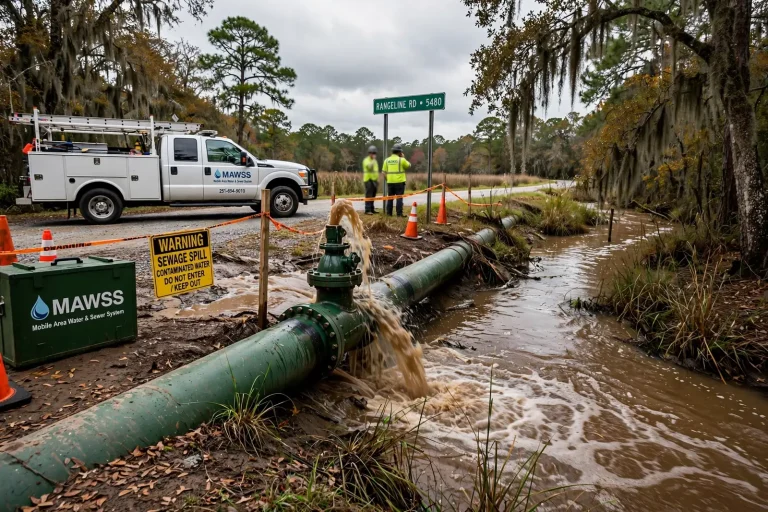
Failed Lift Station Valve Sends 4,200 Gallons of Wastewater Into Perch Creek in South Mobile
A failed lift station air release valve at 1601 Cedar Downs Drive spilled about 9,200 gallons of wastewater Nov. 8, with 4,200 gallons reaching Perch Creek, MAWSS said. Repairs are complete.
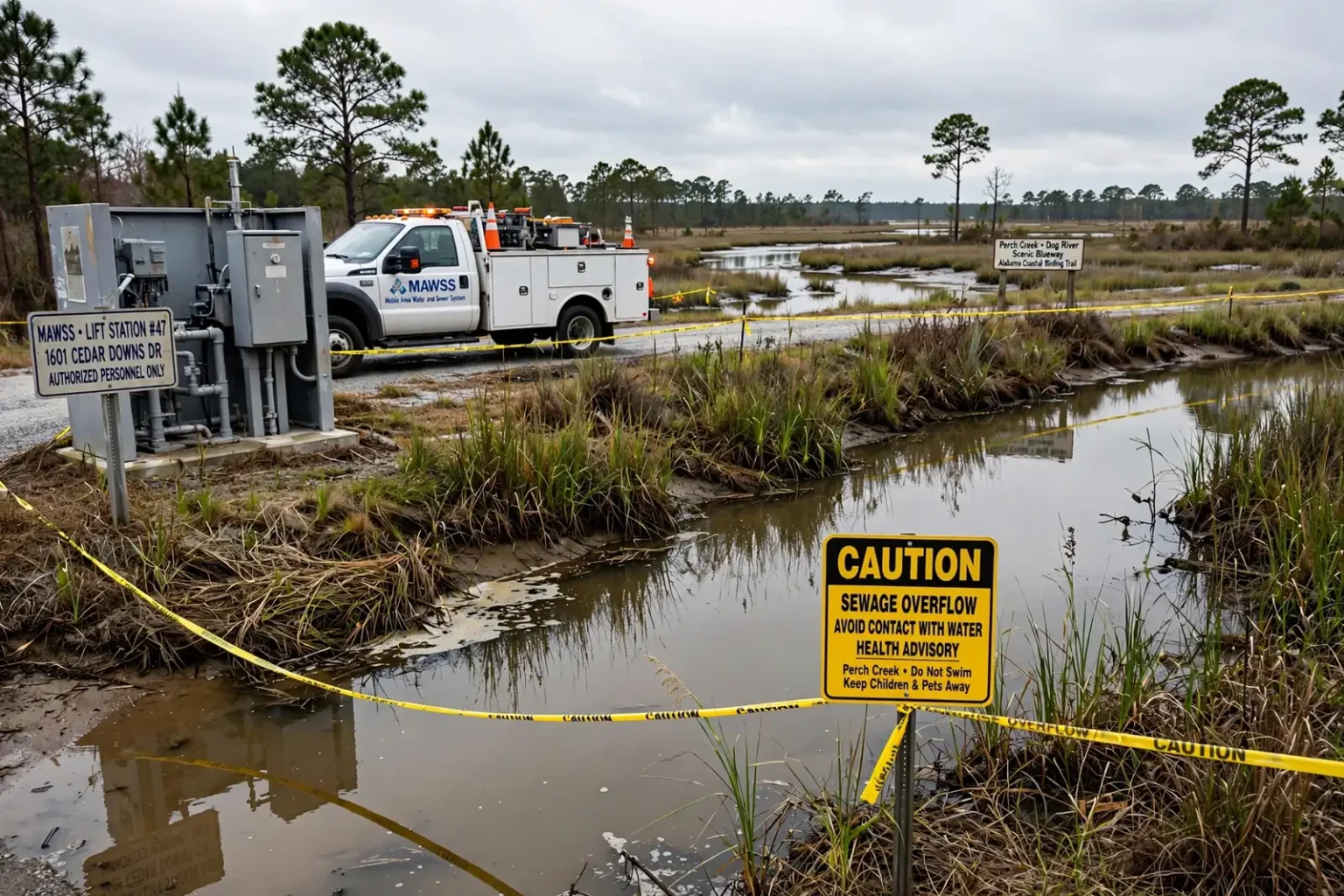
MOBILE, Ala. — A Perch Creek sewer overflow on Sunday, Nov. 8, released about 9,200 gallons of wastewater after an air release valve failed at a lift station, and roughly 4,200 gallons reached the south Mobile creek, according to the Mobile Area Water and Sewer System.
The overflow happened at 1601 Cedar Downs Drive and was reported by a resident, the utility said. MAWSS crews recovered about 5,000 gallons of the spilled wastewater before it could reach the creek.
The utility said the necessary repairs have been made and that it will take steps to prevent another overflow at the site. The spill is the second MAWSS has reported in three days that was blamed on a failed air release valve.
What happened on Cedar Downs Drive
Here is a quick look at the overflow, based on the information released by MAWSS:
- When: Sunday, Nov. 8, 2026
- Where: 1601 Cedar Downs Drive, Mobile
- Cause: Failure of an air release valve at a lift station
- Total overflow: About 9,200 gallons of wastewater
- Recovered by crews: About 5,000 gallons
- Reached Perch Creek: About 4,200 gallons
- Reported by: A citizen
- Status: Repairs completed; MAWSS says it will take steps to prevent a repeat at the location
MAWSS did not say how long the overflow lasted before it was stopped, or whether any water quality sampling of Perch Creek is planned.
Why a lift station valve matters
Much of Mobile’s sewer system relies on gravity to move wastewater downhill through underground pipes. Where the ground is too flat, or where wastewater has to be moved uphill toward a treatment plant, utilities use lift stations, also called pump stations, to push the flow along through pressurized pipes known as force mains.
Air release valves are a small but important part of that equipment. As wastewater is pumped, air and sewer gases can collect at high points in the line, reducing flow and putting extra strain on pumps and pipes. The valves are designed to vent that trapped air automatically while keeping the wastewater sealed inside. When one fails, wastewater under pressure can escape through the valve itself.
The Cedar Downs overflow follows a much larger spill on Friday, Nov. 6, when a defective air release valve at 5480 Rangeline Road sent about 56,250 gallons of wastewater into Rabbit Creek, as South AL News reported. MAWSS has not said whether the two failures are related.
About Perch Creek
Perch Creek is the largest of several small creeks and streams on the Mobile Peninsula, the narrow stretch of land along Dauphin Island Parkway between Dog River and Mobile Bay. Its headwaters begin more than two miles upstream, and the creek crosses Dauphin Island Parkway before joining Dog River, which in turn empties into Mobile Bay.
The lower creek runs through sensitive, tidally influenced marsh where the brackish water of the bay meets the fresh water of Dog River. Those wetlands help slow and filter stormwater from upstream neighborhoods before it reaches the bay’s fish nurseries, and they support wildlife ranging from wading birds and bald eagles to alligators and, at times, West Indian manatees.
The creek is also part of the Dog River Scenic Blueway, a paddling trail system, and the Perch Creek section of that blueway was added to the Alabama Coastal Birding Trail in 2018. Kayak and canoe launches at McNally Park give paddlers access to the creek.
The area is in the middle of a long-running city effort to improve public access to the water. The City of Mobile is working on the Perch Creek Preserve Parks District, a roughly 190-acre collection of parks on the peninsula that includes Perch Creek Preserve, McNally Park and the Ziebach area. The project builds on a 2019 master plan, and final draft master plans for several zones are expected in late 2026. In October, the Mobile City Council approved a $578,920 design contract for McNally Park waterfront improvements, including boat ramp repairs and channel dredging.
Health precautions from the county health officer
A sanitary sewer overflow happens when untreated or partially treated sewage escapes the sewer system before it reaches a wastewater treatment plant. That can happen at a manhole, a broken pipe, a pump station or a building cleanout. Sewage can carry bacteria, viruses and parasites that cause diarrhea, vomiting, skin infections and other illnesses.
Dr. Kevin Michaels, the Mobile County health officer, is reminding residents to take these precautions near the affected area:
- Avoid contact with affected water, soil and any obvious sewage.
- Keep children and pets away from ditches, creeks, flooded areas and standing water that may be contaminated.
- Do not swim, wade or fish in posted areas or in any water that looks or smells contaminated.
- If you do come into contact with water or soil that may be contaminated, wash your skin and clothing thoroughly with soap and clean water as soon as possible.
That last step is the most important one, according to the health officer’s guidance. Anyone who develops symptoms such as stomach illness or a skin infection after contact with water that may be contaminated should talk with a health care provider.
Paddlers, anglers and birders who use the Perch Creek section of the blueway may want to keep those precautions in mind for the next several days, particularly near the area downstream of the overflow.
A busy stretch for sewer overflows
The Perch Creek overflow is one of a string of sewer spills reported around Mobile County in recent weeks. MAWSS investigated an intermittent overflow into Halls Mill Creek near the Cypress Shores subdivision in October. Saraland reported a 900-gallon overflow that reached Norton Creek on Nov. 3, and the Bayou La Batre Utilities Board has reported overflows in Coden and on Shell Belt Road.
Utilities in Alabama are required to report sanitary sewer overflows to the Alabama Department of Environmental Management, which regulates wastewater systems under state and federal clean water rules. Public notices like the one issued for Cedar Downs Drive are part of that reporting process.
MAWSS, the public water and sewer utility for the city of Mobile and surrounding areas, is also weighing how to pay for its sewer system going forward. The utility has proposed a sewer rate increase that would add about $3.41 a month to a typical Mobile household bill starting in 2027, with a public hearing set for Nov. 18 and a board vote scheduled for Dec. 7.
How to report a sewer problem
The Cedar Downs overflow was spotted and reported by a resident, a reminder of how much utilities rely on the public to find problems quickly. The sooner a spill is reported, the sooner crews can stop it and recover wastewater before it reaches a creek.
Signs that may point to a sewer overflow include:
- Water or sewage bubbling up from a manhole cover, cleanout or valve box.
- A strong sewage odor near a creek, ditch or storm drain.
- Toilet paper or other debris collecting in a ditch or along a creek bank.
- Unusual noises, alarms or leaks around a lift station.
Residents who notice a possible sewer leak or overflow in the MAWSS service area can report it to MAWSS. People should stay away from the leaking sewage while waiting for crews to arrive and keep children and pets clear of the area.