Millry man killed in single-vehicle crash in Washington County
A 36-year-old Millry man died when his Dodge Challenger left the road and struck a tree and utility pole in Washington County, ALEA said.
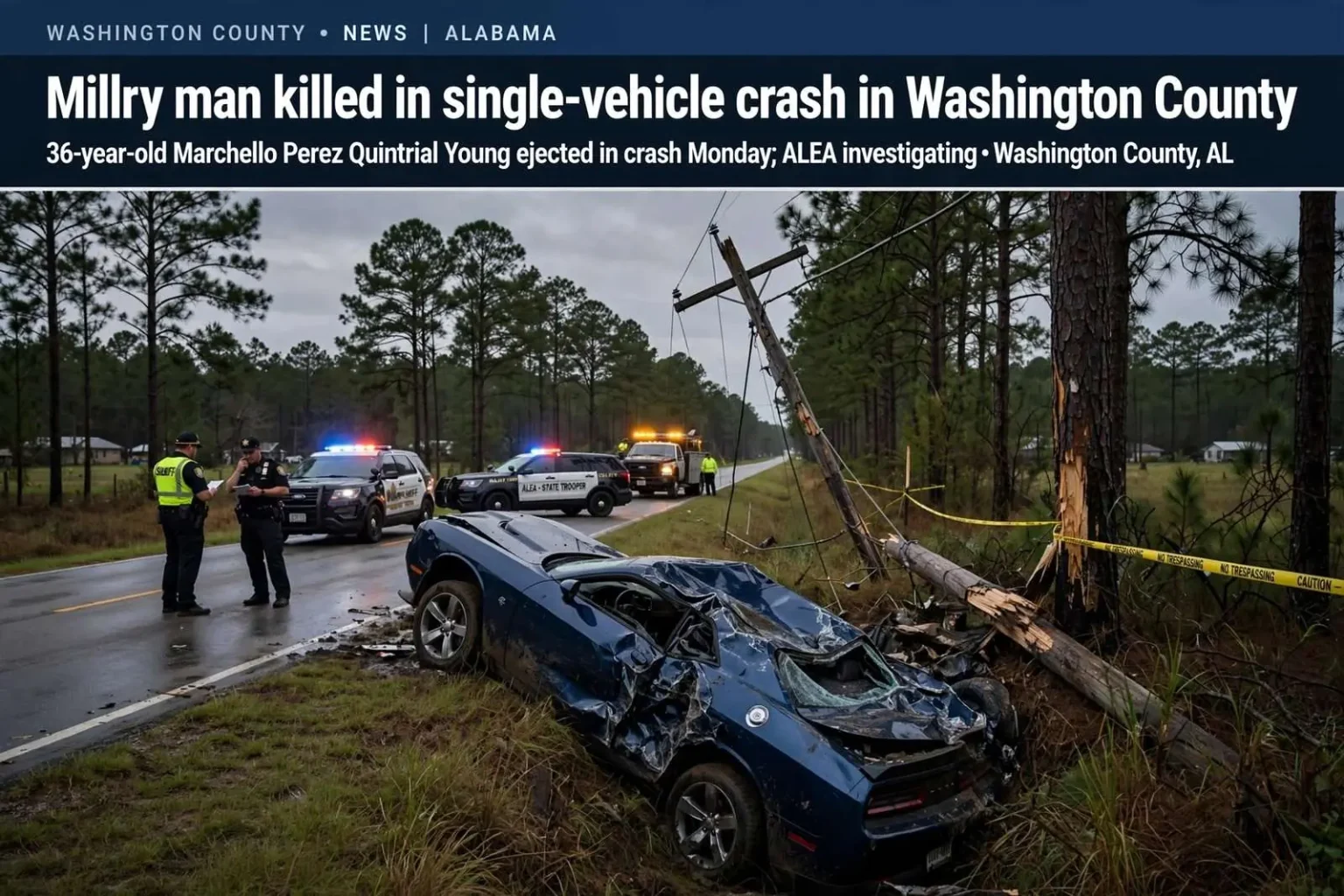
A Washington County man died in a single-vehicle crash Monday, according to the Alabama Law Enforcement Agency. ALEA said 36-year-old Marchello Perez Quintrial Young of Millry was driving a 2015 Dodge Challenger that left the roadway and struck a tree and a utility pole before overturning. Young, who was not wearing a seat belt, was ejected from the vehicle.
The sequence described by troopers, a departure from the roadway, impacts with a tree and a utility pole, and then an overturn, represents one of the most violent crash patterns investigators document on rural Alabama roads. Each stage added force to the collision, and because Young was unrestrained, the overturning Challenger offered him no protection against ejection. Troopers pronounced him dead as a result of the wreck, and the investigation into why the car left the road remained underway following the crash.
Washington County, stretching across southwest Alabama from the Mississippi line toward Mobile County, is a landscape of two-lane highways, timber roads and small communities, where residents routinely drive long distances between towns for work, school and medical care. Crashes on the county’s rural routes carry the risks that traffic safety officials have documented for decades: higher speeds on open stretches, sharp curves hidden by pine stands, soft shoulders, and the long response distances that separate crash scenes from hospitals in Mobile and Hattiesburg.
The Crash and the Response
When a vehicle strikes a utility pole, the crash sets more than a rescue in motion. Utilities serving Washington County must send crews to assess the pole and any downed lines before the roadway can be considered safe, and outages in the surrounding area are possible while repairs are made. Emergency responders arriving at a scene with a damaged pole must first confirm that no wires are hanging across the vehicle or the roadway, since energized lines can turn a rescue into a second casualty. That assessment shapes how quickly medical help can reach an injured driver.
For the investigation itself, ALEA’s Highway Patrol troopers measure and photograph the final positions of the car, the tree and the pole, then work backward through the physical evidence to establish speed, direction and the point where the vehicle first left the pavement. The Challenger’s condition after a double impact and a rollover will be examined for mechanical factors, and routine toxicology testing is standard in fatal cases. The completed report will document the contributing circumstances, and it becomes the official record the family and insurers will rely on in the weeks ahead.
Millry and the Communities Mourning
Millry sits in the northern part of Washington County, a small town where schools, churches and family ties connect residents across the surrounding rural districts. The loss of a 36-year-old resident, a man in the middle of adult life, lands hard in a community of that size, where funeral announcements travel quickly by word of mouth and social media. Neighbors and relatives in the Millry area will gather for services in the days ahead, and the crash will remain a topic of conversation long after the roadway has been repaired and the investigation file closed.
The death also resonates across the county’s network of volunteer fire departments and first responders, who answer wreck calls like this one on the area’s rural roads. In communities where responders often know the people they are called to help, fatal crashes carry a weight that lasts beyond the shift. Regional emergency medical crews face the added challenge of Washington County’s geography, with long transport distances to the trauma centers along the Interstate 10 corridor and the hospitals in Mobile.
Ejection and the Arithmetic of Restraints
Troopers’ finding that Young was ejected from the vehicle is the detail that traffic safety researchers return to most often in crashes of this type. Rollover crashes kill a disproportionate share of their unbelted occupants, and ejection is the mechanism behind a large portion of those deaths. A seat belt does not prevent a crash from happening, but it holds the occupant inside the structure engineered to absorb the impact, and it reduces the violent motion inside the cabin that causes fatal injuries in an overturn.
Alabama’s mandatory seat belt law requires drivers and front-seat passengers to buckle up, and the state’s child restraint statute extends protection to younger passengers with car seats and booster seats. Law enforcement agencies across southwest Alabama run periodic enforcement waves aimed at belt use, and ALEA troopers document restraint status in every fatal crash report, data that feeds the state’s highway safety planning. The findings from rural crashes like Monday’s are precisely the evidence state safety officials cite when they target rural counties for belt-use campaigns, engineering improvements such as rumble strips and chevron signage on curves, and public education about the consequences of leaving a belt unused on a short rural drive.
Rural Road Hazards in Washington County
The county roads and state routes around Millry pass through terrain that tests drivers year-round. Straightaways encourage speeds that become dangerous at the curves between them, and the shoulders along many stretches drop into ditches deep enough to trip a departing vehicle into a rollover. Timber harvesting adds heavy truck traffic to routes that were never designed for it, and after rain, the clay-based roadbeds slick quickly. Deer movements at dawn and dusk generate frequent swerving maneuvers, and drivers who overcorrect after drifting off the pavement account for a persistent share of rural fatalities in south Alabama.
State and county engineers have steadily applied the countermeasures proven to reduce run-off-road deaths: centerline and shoulder rumble strips that wake drifting drivers with sound and vibration, high-friction surface treatments on problem curves, clearer chevrons and advance warning signs, and mowing and drainage schedules that keep sightlines open. Funding constraints mean the work proceeds in priority order, but the corridors around Washington County’s communities have benefited from these programs over the years, and safety planners continue to rank rural routes against crash data when allocating the next round of improvements.
What Happens After a Fatal Rural Crash
The hours after a wreck like Monday’s involve a chain of official actions that families often learn about as they unfold. Troopers work the scene until the evidence is documented, then arrange for the vehicle to be recovered and the roadway cleared. The Washington County coroner’s office handles the official pronouncement and the notifications that follow, and an autopsy is standard in ejection fatalities to document the cause of death. The crash report itself is prepared from the trooper’s field notes and measurements, and copies are made available to the family through ALEA once the investigation is complete.
Utility crews face their own duties after a pole strike. Beyond restoring any service interrupted by the crash, the utility inspects the pole’s structural condition, since a car impact can weaken a pole enough to fail days or weeks later. Replacement and repair costs from vehicle strikes are typically recovered from the at-fault party’s insurance, another of the administrative threads that follow a serious crash through the months after the scene is cleared.
A Recurring Toll on Rural Southwest Alabama
Washington County’s crash history mirrors that of its neighboring rural counties, where fatal wrecks occur at rates that outpace the metro corridors along Interstate 10. Safety officials attribute the gap to a combination of factors that compound one another: longer emergency response and transport times, higher travel speeds, lower belt-use rates, and the simple fact that rural residents log more miles per driver than their urban counterparts. State highway safety plans have singled out rural run-off-road and rollover crashes as priority categories for that reason, directing grant money toward the counties where the data shows the risk is concentrated.
Local institutions absorb the consequences as well. School systems in Millry and across the county provide grief counseling resources when a student loses a parent, and churches organize meal trains and travel assistance for funeral gatherings spread across long distances. In a county of roughly sixteen thousand residents, a single fatal crash touches classrooms, workplaces and congregations simultaneously, and the community support structures that respond are among the strengths rural Alabama counts on in weeks like this one.
For drivers across Washington County and the surrounding counties, the crash is a local entry in the ledger that state safety officials track every year. The recurring lessons from wrecks of this pattern are unglamorous but consistent: slow down on unfamiliar rural curves, watch for deer in the low-light hours, respect the soft shoulders on two-lane roads, and buckle every belt on every trip, however short. None of those habits can restore what the Millry community lost Monday, but they remain the surest protection available for the drivers who travel these roads every day.