Two Killed in Two-Vehicle Crash on U.S. 84 Near Silas in Choctaw County
State troopers say a Millry man and a Silas woman died when their pickup collided with a tractor-trailer on U.S. 84 near Silas in Choctaw County.
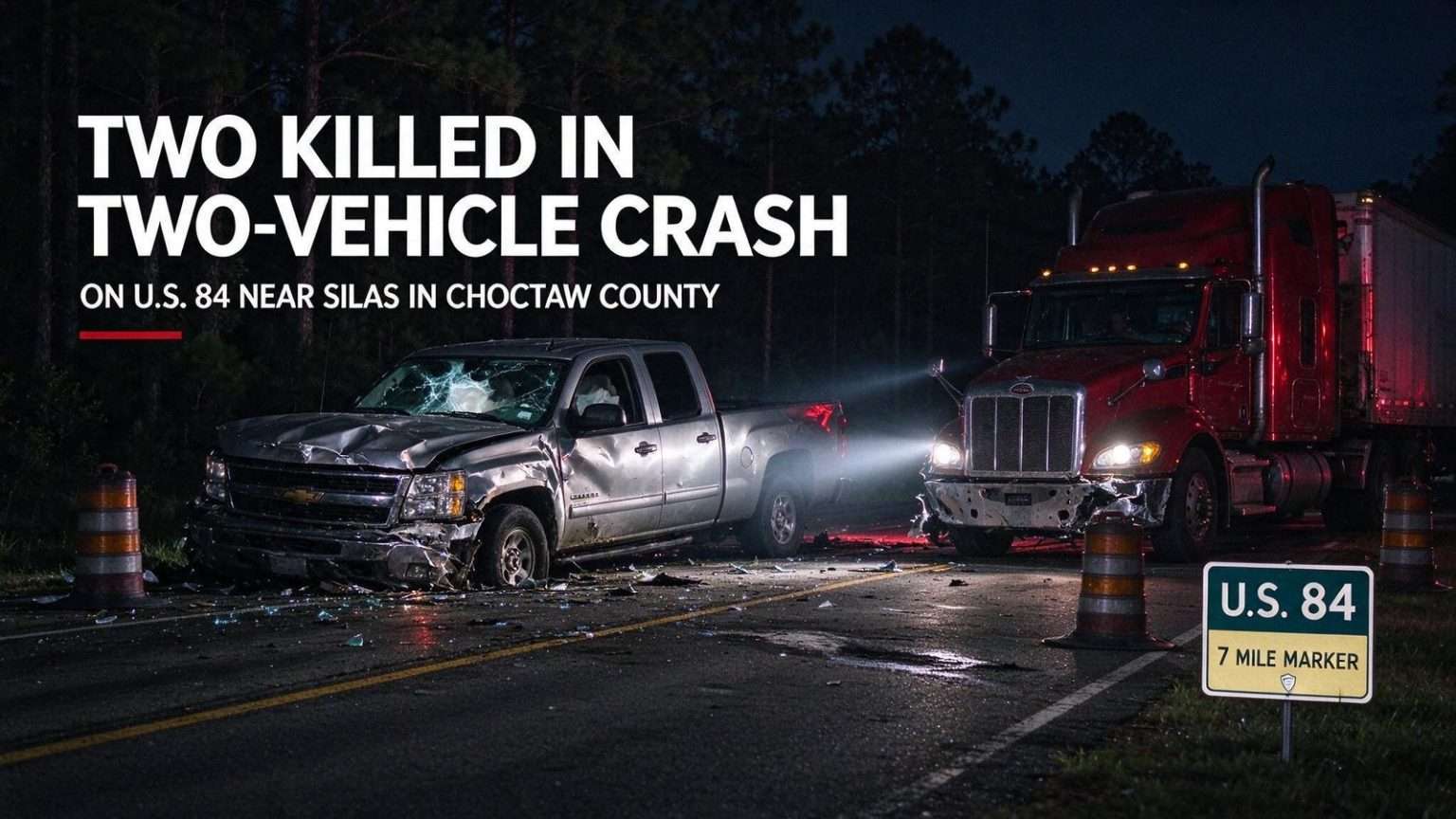
A two-vehicle crash on U.S. Highway 84 in Choctaw County has claimed the lives of two people, according to the Alabama Law Enforcement Agency. Troopers said the crash happened around 8:35 p.m. Thursday, Feb. 18, near the 7 mile marker on U.S. 84, about one mile west of Silas — a stretch of rural highway where darkness descends completely and traffic moves fast between the small communities that dot west Alabama’s pine belt.
Clifford Johnson, 58, of Millry was killed when the 2011 Chevrolet Silverado he was driving collided with a 2007 Peterbilt driven by Will Pittman Jr., 56, of Waynesboro, Mississippi. Tiesha Grayson, 23, of Silas, a passenger in the Silverado, was also killed in the crash. The collision joined a pickup truck and a commercial tractor in the kind of violent meeting that rural highways produce when two vehicles of vastly different mass occupy the same point of pavement at the same moment.
The victims’ hometowns traced the geography of the region: Johnson from Millry, a Washington County town a short drive from the Choctaw County line, and Grayson from Silas itself, the small Choctaw County community beside the crash site. Pittman, the truck’s driver, was from Waynesboro, Mississippi, just across the state line to the northwest — a reminder that U.S. 84 carries commercial traffic across state boundaries as a matter of daily routine.
The Highway Where It Happened
U.S. 84 serves as a main east-west corridor connecting small communities across west Alabama and into Mississippi. The highway threads through some of the least densely populated country in the state — Choctaw, Washington and Clarke counties — linking towns like Silas, Grove Hill and Thomasville on its Alabama stretch before continuing into Mississippi toward Waynesboro and points beyond. For residents of the small towns along its path, the road is both the main street and the only practical route to jobs, medical care and commerce in larger communities.
That dual character shapes the highway’s risks. U.S. 84 in rural west Alabama is largely a two-lane road, carrying a mix of local traffic, commuters and heavy commercial trucks — including the log trucks, gravel haulers and long-haul rigs that serve the region’s timber and agricultural economy. A Peterbilt like the one in the Thursday night crash represents that freight traffic, and encounters between passenger vehicles and commercial tractors are among the deadliest kinds of crashes rural highways see, simply because of the difference in weight and stopping distance.
Night adds its own hazards. At 8:35 p.m. in mid-February, the stretch of U.S. 84 near the 7 mile marker would have been entirely dark, lit only by vehicle headlights. Rural darkness conceals driveways, curves and slow-moving vehicles, and it demands the full attention of drivers traveling at highway speed. What specifically brought the Silverado and the Peterbilt together at that mile marker remained under investigation as troopers worked the scene and interviewed those involved.
The Victims
Clifford Johnson, 58, had lived in Millry, the Washington County community known for its annual spring gathering that draws visitors from across the region. At 58, he belonged to the generation of rural Alabamians who have spent their lives on these highways — roads they know turn by turn, driven thousands of times between home and work, church and town. His death, on a road he surely knew well, underscored how suddenly the familiar can turn fatal.
Tiesha Grayson, 23, of Silas was a passenger in the Silverado, and her death at so young an age sent grief through a small community where everyone knows everyone. Silas is a town of a few hundred residents strung along the highway at the edge of Choctaw County, and a crash a mile from town is, in every practical sense, a local event — the wrecked vehicles and emergency lights visible to neighbors, the victims mourned in the same church pews and classrooms the community shares.
Will Pittman Jr., 56, of Waynesboro, Mississippi, drove the Peterbilt involved in the collision. Commercial drivers along the U.S. 84 corridor cross the Alabama-Mississippi line routinely, and Waynesboro — the seat of Clarke County, Mississippi, just west of the state line — sits directly on the highway’s western reach. No charges or citations were reported at the time, and troopers said no further information was available as the investigation continued.
How Fatal Crashes Are Investigated
Troopers with ALEA’s Highway Patrol Division continued to investigate the crash and said no further information was available. The phrase covers a methodical process: accident reconstruction specialists measure and photograph the scene, calculate speeds and points of impact from physical evidence, inspect both vehicles, and attempt to determine what sequence of actions and conditions brought them together. In crashes involving commercial trucks, investigators also examine the tractor’s mechanical condition and the driver’s hours of service, the federal rules that govern how long commercial drivers may operate without rest.
The results of such investigations take time. Findings — fault, contributing factors, whether charges are warranted — may emerge weeks or months after the wreck, after reports are completed and, in some cases, reviewed by prosecutors. What troopers could confirm in the immediate aftermath was the essential outline: two vehicles, a collision near the 7 mile marker west of Silas around 8:35 p.m. Thursday, Feb. 18, and two people dead.
The Highway Patrol Division is the arm of the Alabama Law Enforcement Agency responsible for traffic enforcement and crash investigation on the state’s rural highways and interstates. Created in ALEA’s 2015 consolidation of state law enforcement functions, the agency merged the old state troopers with other public-safety bodies, and its troopers handle the serious crash investigations across counties like Choctaw that lack the resources to reconstruct fatal wrecks themselves.
The Region’s Toll on Rural Roads
West Alabama’s rural highways consistently rank among the state’s most dangerous miles. The combination of two-lane roads, high speeds, heavy commercial traffic, darkness and long distances between emergency services produces fatality rates that outstrip the urban interstates, and evening hours are overrepresented in the statistics. Head-on and angle collisions between vehicles traveling in opposite directions — the classic rural crash — account for a disproportionate share of deaths.
Communities along U.S. 84 know the pattern from experience. The highway has claimed lives at regular intervals for generations, and each fatal wreck renews the local conversation about passing zones, lighting, speed and the simple fact that neighbors must drive the same stretch where others have died. The crash near Silas entered that long local ledger: two more names — a 58-year-old man from Millry and a 23-year-old woman from Silas — added to a highway’s quiet toll.
The Communities Left Behind
The crash’s human geography extended across two counties and a state line. Millry, Johnson’s hometown, sits in neighboring Washington County close to the Choctaw County line, a small town whose residents drive U.S. 84 and its feeder roads daily for work and commerce. Silas, Grayson’s home, lies directly on the highway, and the crash site a mile west of town sat within sight of the community it touched. Waynesboro, Mississippi, Pittman’s hometown, lies along the same corridor to the northwest, connected to the crash scene by the very highway the two vehicles shared.
In towns of this size, a fatal crash is never an abstraction. The victims’ names circulate through churches, schools and workplaces within hours, and the emergency responders who worked the scene — volunteer firefighters and medics from the surrounding communities — are neighbors of the people they served that night. Rural Alabama’s emergency system depends on such volunteers, who leave their homes on winter evenings to close a highway and work a wreck, then return to routines that now include the memory of it.
The loss of a 23-year-old and a 58-year-old within the same wreck compounds a community’s grief with questions that have no satisfying answers in small towns. Grayson’s generation grew up together in a place where a class photo includes nearly everyone her age; Johnson’s decades in Millry gave him a lifetime of connections across Washington and Choctaw counties. One collision, near one mile marker, reached both.
The Highway’s Role in Rural Life
U.S. 84’s importance to west Alabama is difficult to overstate. It is the corridor that carries residents to regional medical care, connects the timber economy’s mills to their markets, and brings the commercial traffic that keeps small-town businesses stocked. When the highway closes for a crash — as it does whenever a wreck requires investigation — the detours for local traffic stretch down county roads that were never designed for the volume, and communities feel the disruption immediately.
The road’s east-west alignment also makes it a route of passage for the region’s working drivers. Log trucks run it between the woods and the mills; commercial tractors like the Peterbilt in Thursday’s crash haul freight between Mississippi and the Alabama interior; residents commute along it between the small towns and the larger employment centers at its ends. That mixture of traffic types — passenger cars, pickups and heavy trucks sharing a two-lane road at highway speed — is the essential risk of the corridor, present in every mile marker.
Safety improvements along rural highways like U.S. 84 arrive slowly and unevenly. Passing lanes appear at intervals; warning signs mark the worst curves; and state highway engineers study segments with elevated crash histories. But the fundamental geometry of a two-lane road through dark countryside cannot be legislated away, which is why rural safety advocates emphasize behavior — speed, attention, seat belts, patience behind slow vehicles — as the front line of prevention on roads like the stretch near Silas.
What the Investigation Will Address
As troopers completed their scene work, the questions any serious crash investigation addresses remained open: the speed and position of each vehicle, the point and angle of impact, the visibility conditions, the mechanical condition of the Silverado and the Peterbilt, and the sequence of movements that brought them together in the dark. The commercial vehicle’s involvement brings additional documentation — the driver’s logs, the tractor’s maintenance records, the cargo — into the investigative file as a matter of course.
None of that process was visible to the communities waiting for answers, only its markers: the closed highway, the troopers’ vehicles with their lights sweeping the dark, and the official statements that confirmed the deaths and promised nothing further. ALEA’s no-further-information posture in the immediate aftermath is standard practice, preserving the integrity of findings that will be released when the investigation supports them.
For now, the confirmed facts stand: Clifford Johnson, 58, of Millry, and Tiesha Grayson, 23, of Silas, died when the 2011 Chevrolet Silverado Johnson was driving collided with a 2007 Peterbilt driven by Will Pittman Jr., 56, of Waynesboro, Mississippi, around 8:35 p.m. Thursday, Feb. 18, near the 7 mile marker on U.S. 84, about one mile west of Silas. Troopers with the Highway Patrol Division continued their work, and two west Alabama communities — and one across the state line — began the long arithmetic of grief that follows every fatal mile marker on the region’s highways.