Mobile Reaches $7.1 Million Settlement With BP Over Oil Spill Losses
The city of Mobile has agreed to a $7.1 million settlement with BP to resolve claims of lost tax revenue tied to the 2010 Gulf oil spill disaster.
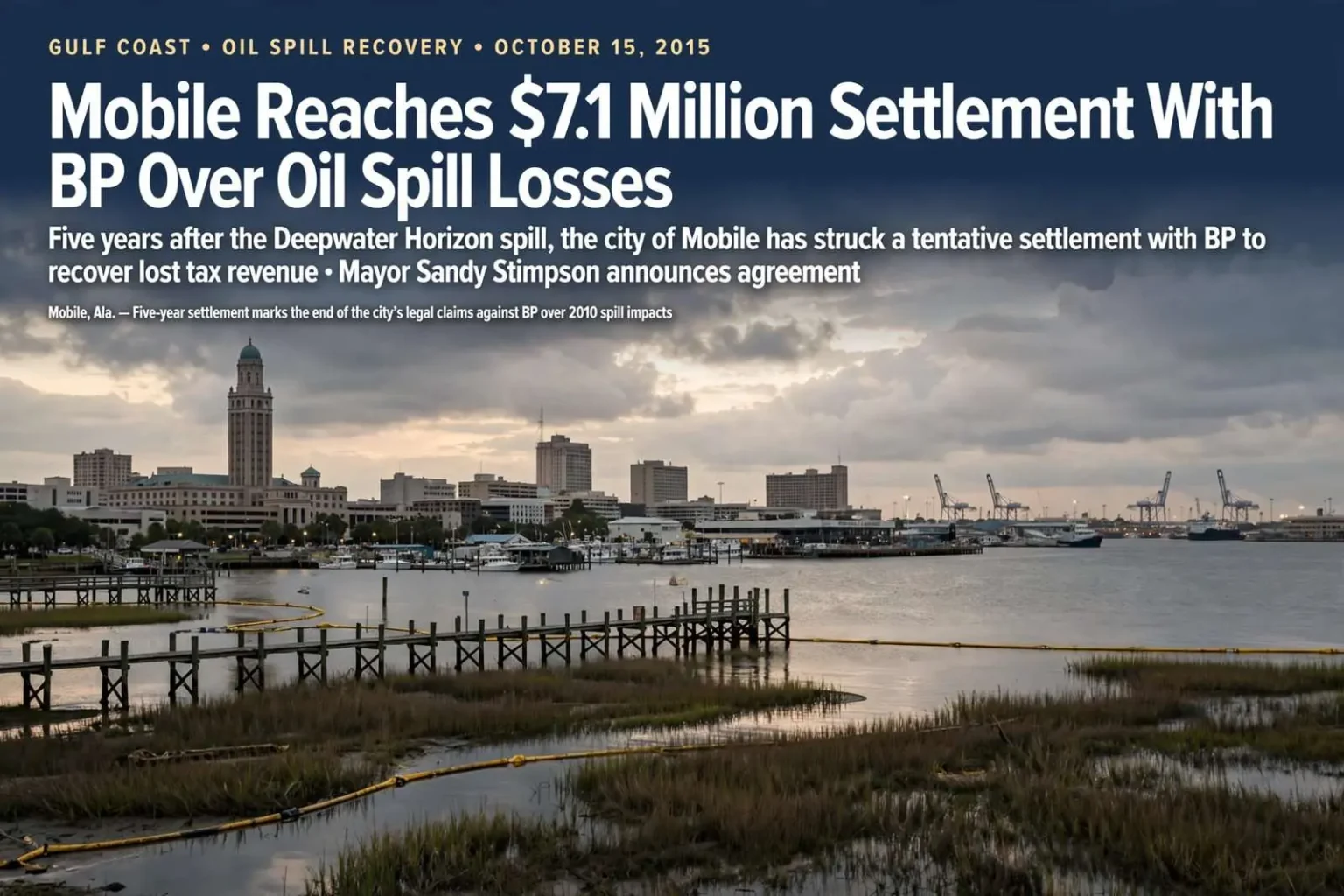
Five years after the Deepwater Horizon disaster fouled the Gulf Coast, the city of Mobile has struck a tentative $7.1 million settlement with BP to resolve claims that the spill cost the city tax revenue. Mayor Sandy Stimpson announced the agreement, which joins hundreds of similar settlements reached between BP and Gulf Coast municipalities in recent weeks as the oil giant worked to close out remaining claims tied to the 2010 spill. For a city that spent the summer of 2010 watching the crisis unfold just offshore, the settlement converted five years of uncertainty into a concrete figure — and formally marked the end of another stage in the region’s longest-running recovery.
After attorney’s fees and other expenses are deducted, the city expects to net roughly $4.7 million from the deal. “The oil spill had a devastating effect on the entire Gulf Coast, and this settlement is an important step in the ongoing recovery process for our citizens,” Stimpson said in announcing the agreement, adding that officials view it as a fair resolution that avoids the cost and uncertainty of further litigation. The alternative — years of additional court proceedings against a corporate legal apparatus that BP had assembled to manage thousands of claims — carried no guarantee of a better outcome, and city officials concluded that a negotiated figure served residents better than a prolonged fight.
City officials said the settlement funds are expected to be disbursed within roughly a month of the announcement. Mobile has not detailed exactly how it plans to allocate the money, though other Gulf Coast municipalities that reached similar settlements have used the funds for infrastructure repairs, environmental restoration projects and general budget needs tied to spill-related economic disruption. Whatever the city chooses, the money arrives unencumbered by the strict categories that governed much of the earlier BP compensation machinery, giving city officials flexibility that earlier claim payments never offered.
The Disaster Behind the Claims
The 2010 spill, triggered by an explosion on BP’s Deepwater Horizon drilling rig, sent millions of barrels of oil into the Gulf of Mexico over several months, disrupting fishing, tourism and shipping activity throughout the region. The April 20, 2010 explosion killed 11 workers on the rig and set off the largest marine oil spill in American history, one that federal investigators later estimated at nearly five million barrels before the Macondo well was sealed in July 2010. For 87 days, oil flowed into Gulf waters while containment efforts played out on national television and weather-driven currents pushed the contamination west toward Alabama’s coastline.
Coastal Alabama, including the Mobile Bay area, saw tourism and seafood industries take a significant hit as oil reached area beaches and waterways. Tar balls and oily sheen appeared along the barrier beaches, harvests of oysters and shrimp were curtailed, and the fishing grounds of Mobile Bay and the Gulf were subject to closures that rippled through docks, processors and restaurants. Dauphin Island, the barrier community guarding the bay’s entrance, saw its summer tourism economy effectively collapse during the crisis months, and hotels and condominium operators across coastal Alabama reported waves of summer cancellations as visitors changed plans or stayed away entirely.
The economic damage extended inland in ways that were harder to see but just as real. Mobile’s economy is tied to the water through the Port of Mobile, the shipbuilding and repair industry, tourism traffic passing through to the beaches, and the restaurants and retailers that serve both visitors and the seafood trade. As images of oiled coastline dominated the news through the summer of 2010, businesses far from the shoreline reported slowed activity, and the tax collections that follow economic activity — sales taxes and lodging taxes above all — declined accordingly.
How the Municipal Claims Took Shape
In the years since, municipalities across the Gulf Coast have pursued legal claims against BP to recover lost tax revenue tied to reduced economic activity during and after the spill. The claims grew out of a massive court-supervised settlement structure that BP agreed to in 2012 to resolve private economic and property damage claims, administered with an office and framework that processed hundreds of thousands of claims from businesses and governments across the Gulf states. When that framework could not resolve every category of loss, remaining claimants — including local governments — moved into litigation in federal court in New Orleans, where they faced the prospect of years of proceedings and appeals.
Mobile’s settlement reflects the city’s assessment of losses tied specifically to reduced sales and lodging tax collections during the crisis and its aftermath. Those two revenue streams are the bellwether taxes of a tourist economy: lodging taxes fall first when reservations vanish, and sales taxes track every canceled dinner, unfilled gas tank and foregone fishing charter. Documenting a decline attributable to the spill rather than to the broader post-recession economy required years of analysis, which is one reason municipal settlements arrived on a different timeline than the individual and business claims that had begun paying out years earlier.
A Broader Wave of Settlements
The agreement adds to a broader wave of Gulf Coast settlements that collectively total billions of dollars as BP worked through remaining claims from state, county and municipal governments. The company’s total liability for the disaster — from the earlier claims programs through environmental penalties under the Clean Water Act and the Natural Resource Damage Assessment — has been estimated in the tens of billions of dollars, making the Deepwater Horizon spill the costliest in history by any measure. Municipal settlements like Mobile’s were small pieces of that ledger, but for the individual cities they represented the last significant recovery available through the legal process.
The pattern of the final settlements reflected BP’s incentive to close its books. Rather than litigate each government’s claim to a verdict, the company offered negotiated figures that gave municipalities certainty and gave BP a final accounting of its spill-era obligations. Hundreds of governments, from small coastal towns to major cities, signed on in the final wave, and the settlements’ proceeds have since appeared in municipal budgets across four states in forms ranging from beach renourishment to fire trucks to debt reduction.
For Mobile, the settlement also arrived alongside the city’s own recovery narrative. The five years between the spill and the settlement saw the port continue its expansion, aerospace manufacturing grow at the Brookley complex, the restoration of Gulf State Park facilities advance on the eastern shore, and new tourism infrastructure — including the long-anticipated GulfQuest National Maritime Museum on the downtown waterfront — move toward opening. A city whose tax base had been dented by the spill’s bad publicity was, half a decade later, in the middle of a broader resurgence, and the settlement funds land in that stronger fiscal context.
What Recovery Looks Like Half a Decade Later
By the time the settlement was announced, the visible signs of the spill had largely faded from Alabama’s coast. Beaches were clean, fisheries had reopened, and tourism marketing campaigns funded with early BP money had worked for years to remind potential visitors that the coast was open. Restoration projects funded through early restoration agreements had begun rebuilding oyster reefs, marsh habitat and dunes. But the deeper economic story — the businesses that never reopened, the fishing families that scaled back, the reputation effects that lingered — took far longer to settle, and the tax revenue losses that Mobile pursued were part of that slower, less visible ledger.
The city’s $7.1 million figure, and the roughly $4.7 million it expects to keep, is best understood against that backdrop: a compensation for documented revenue losses, not a restoration fund, and a fraction of the cost the spill imposed across the region. For Mobile residents, the practical meaning is modest but real — a one-time addition to municipal resources arriving five years after the crisis, closing the city’s claims without further expense.
The agreement closes out one more chapter of the long recovery process that began when oil first began washing ashore in the spring of 2010. With the settlement, Mobile joins the long roster of Gulf Coast communities that have converted their spill losses into final payments, and the city’s years-long thread of BP litigation ends where the region’s began: with a community still defined by the Gulf, still paying for the disaster in ways large and small, and still finding in negotiated settlements the practical end of a recovery that no amount of money ever fully completes.
How the city ultimately uses the money will be watched, if quietly, by the same constituency that followed the litigation: the businesses and workers who lived through the spill summer. Municipal leaders across the coast have generally steered such funds toward purposes with a visible connection to the recovery — waterfront and drainage work, park and beach amenities, marketing that supports the tourism economy, or simply restoring budget reserves that absorbed the losses when tax collections dipped. Mobile has said only that it has not detailed its allocation, leaving the final decisions to budget deliberations that will follow the money’s arrival within the month.