Mobile County Murder Case Returns to Court After Sentence Reversal
A Mobile County capital murder case is headed back to court after an appeals ruling voided the defendant's death sentence over how his defense was handled.
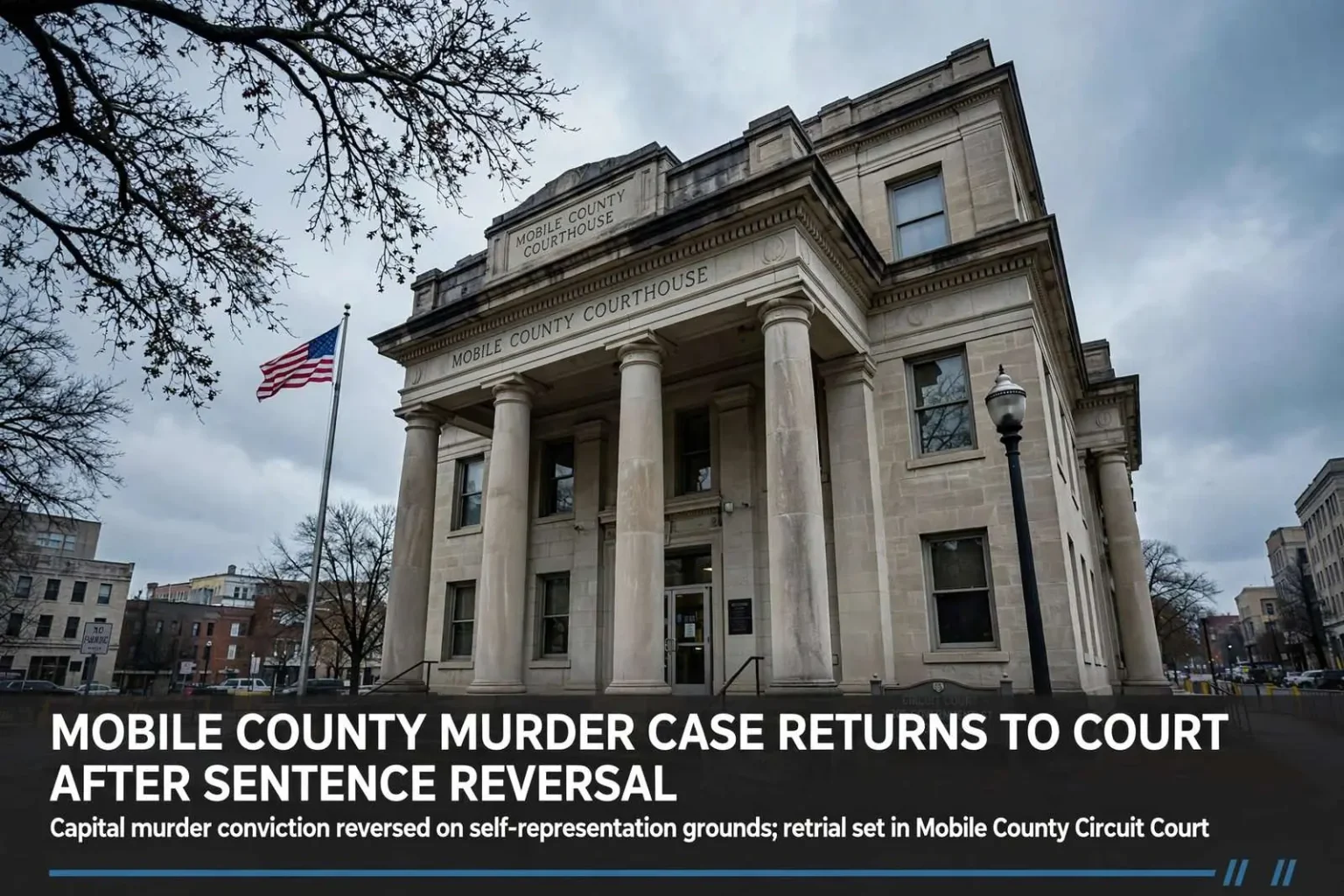
A capital murder case in Mobile County is returning to court after the Alabama Court of Criminal Appeals threw out a death sentence handed down in 2013, ruling that the trial judge overstepped his authority in how the defendant’s legal representation was handled. The reversal returns to the trial stage one of Mobile’s most closely watched capital cases and reopens the constitutional question at its center: what happens when a defendant wants to represent himself and a judge disagrees.
Carlos Edward Kennedy was convicted of raping and killing 69-year-old Zoa White inside her Mobile home in June 2010. Investigators said blood evidence, along with a palm print and fingerprint recovered from the scene, matched Kennedy. White, a former real estate professional, had also been active in state politics, having volunteered for a gubernatorial campaign and later worked for a state economic development agency.
The crime shocked the neighborhood where White lived and drew sustained local coverage, both for the brutality detailed in prosecutors’ evidence and for the victim’s prominence in the city’s business and political circles. The physical evidence tying Kennedy to the scene — blood, a palm print and a fingerprint — formed the backbone of the state’s case in the first trial and remains the foundation of the prosecution’s position going forward.
The self-representation fight
Kennedy had asked to represent himself at trial, but the presiding judge at the time appointed an attorney over his objection, citing concerns about Kennedy’s capacity to prepare an adequate defense in a complex capital case. The appeals court found that decision was not within the judge’s authority to make, and the case must now be retried in Mobile County Circuit Court.
The ruling turns on a right that most Americans have heard of but few trials test: the Sixth Amendment’s guarantee of self-representation, affirmed by the U.S. Supreme Court in the 1975 case Faretta v. California. A defendant who knowingly and voluntarily waives counsel generally must be allowed to conduct his own defense, even in a capital case. Courts may insist that the waiver be intelligent and may protect the record with standby counsel, but they may not simply substitute a lawyer for a defendant who refuses one — which is essentially what the appeals court concluded happened here.
Capital prosecutions, with their aggravating-circumstance findings, penalty phases and voluminous motions practice, are among the most complex proceedings in American law, which is why judges are often reluctant to allow self-representation in death penalty cases. The appeals court’s decision makes clear that the difficulty of the case does not itself authorize a judge to override a valid waiver — the inquiry must rest on the defendant’s competency and the voluntariness of his choice, not on the court’s assessment of the wisdom of that choice.
Where the case goes from here
The Alabama Attorney General’s office chose not to appeal the reversal, and prosecutors say they intend to move forward quickly. Mobile County’s district attorney’s office has said the evidence against Kennedy remains strong and that officials are prepared to pursue the case again, including the possibility of another death sentence if he is convicted a second time.
Kennedy remains in custody while the case proceeds. A status hearing was set before a Mobile County Circuit Court judge to determine next steps, including how Kennedy’s request to represent himself will be handled going into the new trial. That hearing will effectively decide the same fight that produced the reversal, this time with the appeals court’s guidance on the record: a judge may question Kennedy at length to establish that his waiver of counsel is knowing and voluntary, and may appoint standby counsel to assist if asked, but cannot force a lawyer on him if the waiver holds.
The practical questions at the new hearing are substantial. A defendant acting as his own attorney in a capital case must manage jury selection, cross-examination of forensic witnesses, objections during testimony and the two-phase structure of a capital trial, in which the same jury that convicts then hears evidence on whether death is the appropriate sentence. Judges typically warn defendants invoking the right about the hazards of self-representation, and the warnings become part of the record that any future appeal will review.
The victim remembered
White’s death in June 2010 reverberated through the Mobile circles she moved in. A former real estate professional who had volunteered for a gubernatorial campaign and later worked for a state economic development agency, she combined a business career with a genuine interest in Alabama politics, and friends described an engaged, community-minded presence in her neighborhood. Her killing — inside her own home — became one of the cases that Mobile County prosecutors cited in discussing the county’s violent crime burden during that period.
The physical evidence assembled by investigators was central to the first prosecution’s speed: an arrest, an indictment and a trial culminating in a 2013 death sentence within roughly three years of the crime. That timeline reflected both the strength of the forensic case and the priority the office placed on it. It is the same evidence prosecutors now say will carry a second trial, with the advantage — and the burden — of everything the first trial revealed about how it plays before a Mobile County jury.
What the appeal means for the docket
The case has drawn attention in the Mobile legal community both for the underlying crime and for the unusual procedural history, which centers on a defendant’s constitutional right to self-representation balanced against courts’ obligations to ensure a fair trial. Legal observers say the retrial could take months to reach, given the scheduling realities of capital litigation — the defense preparations, expert witness coordination and jury logistics that even a straightforward capital case requires, complicated here by a defendant who may conduct his own defense.
Self-representation in Alabama courts
Kennedy’s case is a rare example of the self-representation issue reaching a capital post-conviction outcome in Alabama, but the underlying right comes up regularly in trial courts across the state. Defendants invoke it for reasons ranging from distrust of appointed counsel to a desire to control their own narrative, and trial judges handle a steady stream of waiver hearings to sort genuine, competent choices from confused or manipulative ones. The distinction matters because a defective waiver — like a defective conviction — is the kind of error appellate courts catch years later, forcing exactly the kind of retrial Mobile County now faces.
The Court of Criminal Appeals, based in Montgomery, reviews every Alabama death sentence automatically, which is how the 2013 conviction came under scrutiny in the first place. That mandatory review is one reason capital cases produce long appellate histories: even cases without claimed errors receive a full examination of the record, and issues like the one in Kennedy’s case surface within the first round of appeals rather than after decades of habeas litigation.
The view from the courthouse
Within Mobile’s legal community, the case has become a teaching example of procedural discipline in capital litigation. Prosecutors who watched the first trial understand that the evidence will again be the center of the case; defense lawyers understand that the appeal has reset the clock on a conviction they argued was compromised from the penalty phase backward. Both sides now operate under an appellate ruling that constrains the trial judge’s discretion — a rarity that makes the retrial required reading for Alabama lawyers who follow capital procedure.
For White’s family, the reversal restarts a process they had every reason to believe was finished. The 2013 sentence had closed one chapter of a case that began with a 911 call in June 2010; four years later, they face another trial, another jury and another round of testimony about the last moments of a mother, friend and colleague. Victims’ advocates note that reversals on procedural grounds — as opposed to doubts about the evidence — are among the hardest outcomes for families to absorb, precisely because the facts of the crime are not in dispute.
What happens next will unfold in a Mobile County Circuit courtroom, under the shadow of an appellate decision that made the law on self-representation in Alabama capital cases clearer than it was before. The evidence that convicted Carlos Edward Kennedy once remains in the state’s hands. The question the new trial will answer is the one the first one never properly reached: whether the defendant will stand at the defense table alone.
The answer will shape far more than one defendant’s trial. If Kennedy again insists on representing himself and the waiver is found valid, Mobile County will host one of the region’s rare truly pro se capital defenses — a proceeding watched closely by judges and lawyers statewide for how the court manages the balance between a defendant’s constitutional autonomy and the state’s obligation to run a trial worthy of the ultimate penalty it seeks.