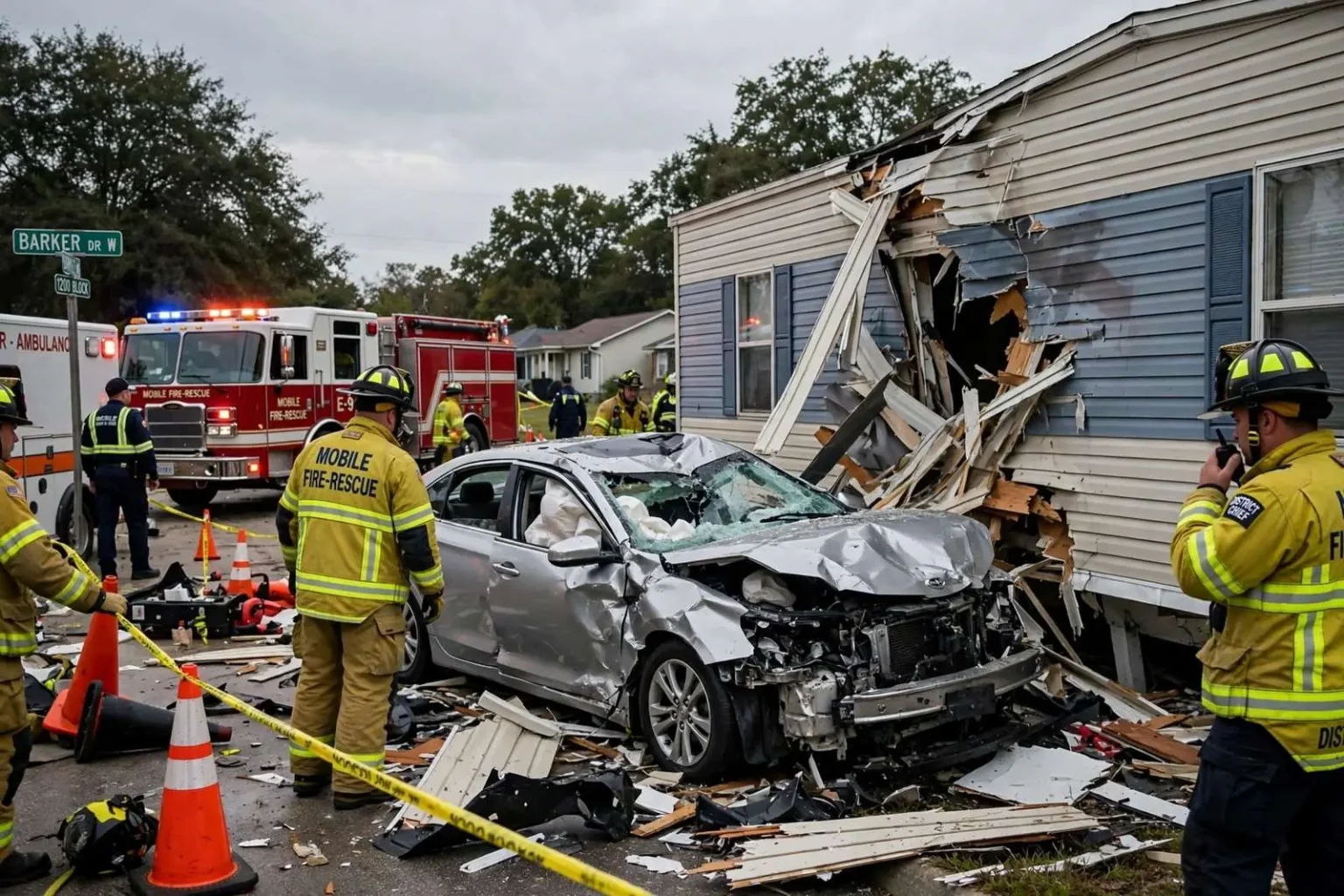
A stretch of Barker Drive West in Mobile turned into an emergency scene on a recent Friday afternoon after a car left the roadway and slammed into a nearby house, leaving six people injured and prompting a large response from Mobile Fire-Rescue Department crews.
According to fire officials, the call came in just after 1 p.m. reporting that a vehicle had struck a residence in the area between Barker Drive South and Tanner Street, a quiet residential corridor on the western side of the city. What began as a report of a pedestrian being struck quickly escalated as crews arrived and found the more serious situation of a car having crashed directly into a home.
Mobile Fire-Rescue dispatched a substantial contingent of personnel and equipment to the scene, including two fire engines, three rescue units, a private ambulance service and a district chief to oversee the response. The scale of the deployment reflected the uncertainty crews faced in the first minutes after the crash, when the number and severity of injuries were still being sorted out.
Medical personnel ultimately transported six people to area hospitals for treatment. As is common in the immediate aftermath of a fast-moving incident like this one, the specific conditions of those injured were not released at the time, leaving neighbors and passersby to watch as crews worked the scene along the residential street.
Incidents in which vehicles leave the roadway and strike houses are relatively rare but not unheard of in Mobile’s residential neighborhoods, where many homes sit close to two-lane streets without the buffer of curbs, sidewalks or deep setbacks found in newer subdivisions. When a driver loses control at speed, there is often little separating the road from a home’s exterior wall.
For residents along Barker Drive West and the surrounding blocks, the crash served as a stark reminder of how quickly an ordinary afternoon can turn chaotic. The multi-unit fire response, together with the arrival of a private ambulance to supplement on-scene medical care, underscored how seriously first responders treated the potential for serious injury once they learned a home had been struck rather than simply a person on foot.
Mobile Fire-Rescue Department did not immediately detail whether structural damage to the home required further inspection or whether any residents inside the house were hurt in addition to those in or near the vehicle. As with many rapidly evolving emergency calls, full details of what caused the vehicle to leave the roadway were not confirmed in the hours immediately following the crash.
Mobile is the county seat of Mobile County in southwest Alabama and the state’s only saltwater port. Situated where the Mobile River meets Mobile Bay near the northern Gulf of Mexico, the city has long served as a commercial and cultural gateway between Alabama and the wider Gulf Coast. Founded in 1702 as Fort Louis de la Louisiane and ruled in turn by France, Britain, and Spain before joining the United States in 1813, Mobile carries a layered heritage distinct from the rest of the state.
Today Mobile anchors a metropolitan area spanning Mobile County and neighboring Baldwin County, and it remains a center for shipping, aerospace, healthcare, and higher education in the region. Its downtown and waterfront have seen sustained revitalization, while historic neighborhoods preserve architecture from its colonial and antebellum past. The city’s identity is shaped as much by its working port and industrial base as by its festivals and food culture, making it a frequent focal point for news about growth and change in southern Alabama.
Healthcare in the Mobile area is anchored by several hospital systems and provider networks that serve patients across southwest Alabama, the Gulf Coast, and into parts of Mississippi and Florida. Large employers in the sector include regional health systems operating hospitals, clinics, and specialty centers, alongside university-affiliated providers.
Access to care, the financial health of nonprofit hospitals, and the integration of behavioral and physical health are ongoing priorities. As in many parts of the country, local healthcare institutions navigate workforce shortages, changing reimbursement models, and the particular demands of serving both dense urban neighborhoods and far-flung rural communities.
The ties between healthcare and the local economy are strong. Hospitals are among the region’s largest employers, and decisions about service lines, expansion, or closure reverberate through surrounding neighborhoods, making health-system news a staple of regional journalism.
The economy of the Mobile region is diversified across shipping and logistics, aerospace and shipbuilding, healthcare, tourism, and manufacturing. The Port of Mobile is one of the nation’s busiest seaports and a cornerstone of the local and state economy.
Major employers in aviation and defense contribute to a skilled workforce, while economic-development organizations aim to attract investment and jobs through incentives and infrastructure improvements. Small businesses, from restaurants to professional services, form the backbone of neighborhood commerce.
The health of the regional economy is a frequent subject of public discussion and reporting. Workforce development, recruitment of industry, and the fortunes of local retailers all feed into a broader picture of how the Gulf Coast competes and adapts in a changing national economy.
Local journalism serves as the connective tissue of communities like those across South Alabama, informing residents about government, schools, public safety, and the events that shape daily life. Outlets covering Mobile and Baldwin County help hold institutions accountable and give voice to neighborhood concerns larger media may overlook.
In an era of shifting advertising revenue and the rise of digital platforms, community news organizations have had to adapt how they gather and deliver information. The persistence of regional reporting remains important for civic engagement, particularly on issues such as coastal development, education, and local governance that directly affect residents.
The relationship between a local newsroom and its community is reciprocal: readers supply tips, context, and a sense of what matters, while the reporting provides a shared record of decisions and events. That loop is essential to a well-informed public.
Baldwin County sits directly east of Mobile County across Mobile Bay and is the largest county in Alabama by land area. It encompasses the Eastern Shore communities of Daphne, Fairhope, Spanish Fort, and Foley and stretches south to the beaches of Gulf Shores and Orange Beach along the Gulf of Mexico.
Long among the fastest-growing counties in the state, Baldwin blends suburban development near the bay with tourism-driven coastal economies. Its proximity to Mobile and its position on the Eastern Shore make it a recurring subject of regional news covering growth, infrastructure, schools, and the balance between development and coastal preservation.
Mobile Bay is a shallow estuary in southern Alabama where freshwater from the Mobile, Tensaw, and other rivers mixes with saltwater from the Gulf of Mexico. It is among the largest estuarine systems in the United States and supports commercial and recreational fishing, shipping through the Port of Mobile, and wetlands that buffer the coastline from storms.
The bay’s Eastern Shore, in Baldwin County, includes Daphne, Fairhope, and Spanish Fort, while the Western Shore lies in Mobile County. Its ecology and economy have guided settlement for centuries, and the bay figures in regional debates over development, navigation, and conservation. Events on either shore are routinely covered as part of the interconnected life of the Mobile metro area.
The Gulf of Mexico borders Alabama’s southern edge and defines much of the state’s coastal identity. Alabama’s Gulf coastline, centered on Dauphin Island, Gulf Shores, and Orange Beach, supports a tourism industry built around beaches, charter fishing, and marine recreation, while offshore waters host shipping lanes and energy interests.
The Gulf’s warm, shallow shelf and exposure to hurricanes make weather and disaster preparedness recurring concerns for communities from Mobile to Baldwin County. The marine environment also underpins commercial seafood harvests that have sustained Gulf Coast families for generations, tying the region’s economy and culture closely to the water.
Alabama is a state in the southeastern United States bordered by Tennessee, Georgia, Florida, the Gulf of Mexico, and Mississippi. Often called the Heart of Dixie, it spans Appalachian foothills in the north and flat coastal plains in the south. Its largest cities include Birmingham, Montgomery, Huntsville, and Mobile.
Alabama’s history encompasses Indigenous roots, Spanish and French colonial settlement, a cotton-plantation economy, the Civil War and Reconstruction, and the Civil Rights Movement of the 1950s and 1960s, followed by a shift toward manufacturing, aerospace, and technology. Local news across the state frequently reflects this mix of tradition and change.
The Federal Bureau of Investigation is the principal investigative arm of the United States Department of Justice, tasked with protecting the country against terrorist threats, foreign intelligence operations, cyber attacks, and major criminal activity. Established in 1908, the bureau operates a network of field offices across the country, each responsible for federal law-enforcement matters within its region.
Field offices such as the one serving Mobile work closely with state and local agencies, reflecting the bureau’s reliance on partnerships rather than unilateral action. The director, appointed by the president and confirmed by the Senate, sets national priorities that cascade down to individual offices handling everything from counterterrorism to public-corruption and civil-rights investigations.