Mobile Held Community Briefing on Africatown Welcome Center Progress at Robert Hope Center
The City of Mobile briefed residents on the continued progress of the Africatown Welcome Center, a project designed to serve as a gateway to one of the country's most significant cultural and historical destinations.
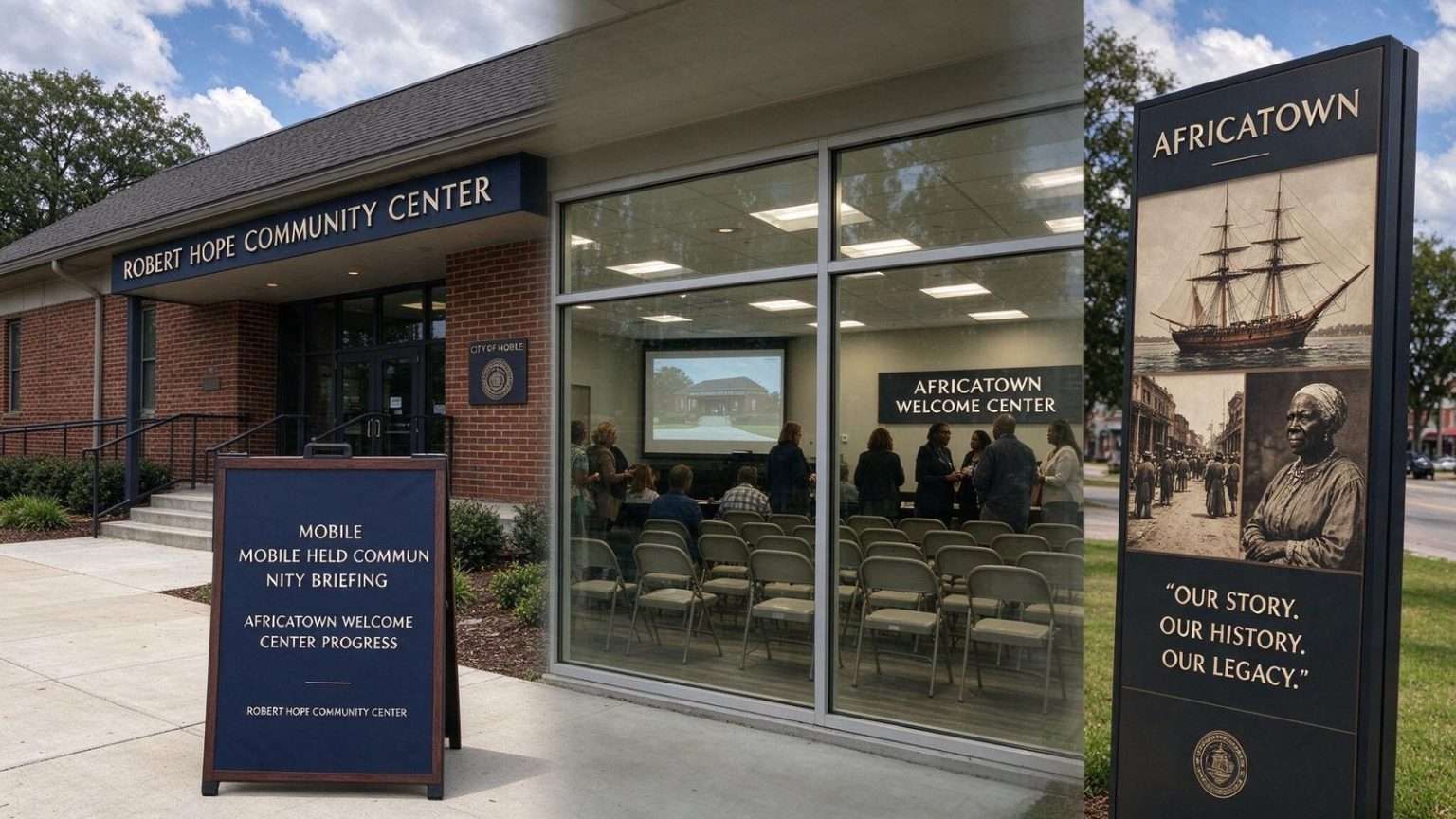
The City of Mobile invited residents, community stakeholders, and interested visitors to an informational meeting at the Robert Hope Community Center to receive an update on the continued progress of the long-anticipated Africatown Welcome Center, a project designed to serve as a gateway to one of the country’s most historically and culturally significant destinations.
A Gateway to Africatown’s Story
The Africatown Welcome Center is designed to give residents and visitors a solid starting point for understanding the community’s history before exploring its other cultural and historical sites. Planned features include photographs and other artifacts intended to orient visitors and guide them toward additional points of interest throughout Africatown, a community founded by Africans who survived the Clotilda, the last known ship to bring enslaved people to the United States, decades after the transatlantic slave trade had been outlawed.
Africatown’s history has drawn renewed national attention in recent years, particularly following the 2019 discovery of the Clotilda’s wreckage in the Mobile River, a find that confirmed long-held oral histories passed down by descendants of the community’s founders. That discovery accelerated interest in preserving and interpreting Africatown’s story for a wider audience, a goal the Welcome Center project is intended to help advance by giving the community a formal, dedicated space to tell that story on its own terms.
City Officials on the Project’s Significance
“The City of Mobile remains committed to working alongside residents, community leaders, and partners to ensure the Africatown Welcome Center reflects the history, culture, and spirit of this extraordinary community,” Mayor Spiro Cheriogotis said in announcing the briefing. “We are excited to give the community an update on this project and where it stands. We ask anyone interested in learning more about this project to join us.”
City representatives were on hand at the Robert Hope Community Center briefing to share project updates directly with attendees and to outline ways community members can stay involved as the project moves forward. Officials framed the meeting not simply as a one-way progress report, but as an opportunity for residents to learn how they might play an active role in preserving and sharing Africatown’s story for future generations, rather than leaving that responsibility solely to city staff and outside planners.
Why Community Input Matters for This Project
Projects tied to historically significant, descendant-connected communities like Africatown carry particular sensitivity around who controls the narrative and how a community’s story gets told to outside visitors. City officials have repeatedly emphasized community involvement in the Welcome Center’s development, a reflection of broader conversations in heritage tourism and historic preservation about ensuring that descendant communities retain meaningful voice and ownership over how their history is presented, rather than having that story shaped primarily by outside institutions or purely commercial tourism interests.
The Robert Hope Community Center, located at 850 Edwards Street, has served as a hub for civic engagement in the Africatown area and was a natural setting for a briefing aimed at gathering resident input alongside sharing official project updates.
Part of a Broader Investment in Africatown
The Welcome Center briefing came amid a period of broader municipal investment in the Africatown area. The city’s proposed Fiscal Year 2027 budget, unveiled separately by Mayor Cheriogotis, includes continued financial support for Africatown initiatives, including funding tied to the Welcome Center’s roughly $5.1 million total cost. That budgetary commitment signals that the Welcome Center is viewed by city leadership not as an isolated project, but as part of a sustained, multi-year investment in Africatown’s infrastructure and visibility.
City officials have not announced a firm opening date for the completed Welcome Center, but the continued briefings and budget commitments suggest the project remains an active priority for the current administration. Residents interested in future updates or opportunities to get involved are encouraged to follow announcements from the City of Mobile and community organizations active in Africatown.
The Clotilda’s Discovery Changed Everything
Africatown’s national profile rose dramatically following the 2019 discovery of the wreckage of the Clotilda in the Mobile River, a find made by researchers working with the Alabama Historical Commission after years of searching based on oral histories passed down through generations of the community’s founding families. The Clotilda is the only known intact vessel from the American slave trade to have been definitively identified, and its discovery provided physical confirmation of a story that had circulated for more than a century without documentary or physical proof beyond community testimony.
That confirmation transformed Africatown from a community whose founding story rested primarily on oral tradition into one with a verified archaeological record, drawing renewed interest from historians, journalists, and heritage tourism organizations nationally and internationally. The Welcome Center project fits directly into that post-discovery moment, giving the community a formal space to present its own history to the wave of new visitors and researchers the Clotilda find has attracted, rather than leaving that narrative work entirely to outside institutions or media coverage.
\n
Balancing Preservation With Community Priorities
\n
Descendant communities connected to historically significant sites frequently navigate a tension between welcoming increased outside attention and protecting the community’s autonomy over how its story gets told and monetized. Africatown’s descendant community has been vocal in recent years about wanting development and tourism initiatives, including the Welcome Center, to benefit current residents directly rather than functioning purely as an attraction that draws visitor spending without corresponding investment in the neighborhood’s housing, infrastructure, and economic opportunities. City officials’ repeated emphasis on community meetings and resident involvement in the Welcome Center’s planning reflects an effort to address those concerns directly, positioning the project as a collaboration with the community rather than a top-down development imposed on it.
The Clotilda’s Illegal Voyage
The history the Welcome Center is designed to introduce visitors to begins with one of the more infamous episodes in the final years of the American slave trade. The United States banned the importation of enslaved people from Africa in 1808, more than half a century before the Civil War ended slavery itself, making any subsequent transatlantic slaving voyage to American shores a federal crime. The Clotilda’s 1860 voyage to Mobile, carrying more than 100 captive West Africans, defied that ban outright, undertaken as what historians have described as something close to a wager among Mobile-area businessmen over whether such a voyage could still be pulled off decades after it had been outlawed. To avoid detection and prosecution, the ship’s owners had the vessel burned and sunk in the Mobile River shortly after the captives were unloaded and dispersed among plantations and households across the region, an attempt to destroy the physical evidence of the crime that succeeded for roughly a century and a half. That deliberate destruction is part of why the wreck’s eventual identification in 2019 carried such significance: it recovered physical evidence of a crime its perpetrators had gone to considerable lengths to erase entirely from the historical record.
From Bondage to a Self-Governing Community
Africatown’s founding story begins after the Civil War, when the Clotilda’s survivors, freed by emancipation but without the means to return to West Africa, pooled their resources to purchase land north of Mobile and establish a community governed largely on their own terms. Founders retained elements of West African language, customs, and social structure even as they built new lives in the American South, creating a community with a distinct cultural identity that set it apart from surrounding areas and that has persisted, in diminished but still recognizable form, through descendants living in the area today. That founding narrative — a community built directly by survivors of an illegal slave voyage, rather than one that emerged more gradually or anonymously from the broader post-emancipation Black community in the South — is a significant part of why Africatown has drawn the level of historical and academic interest it has, both before and especially after the Clotilda’s physical confirmation in 2019.
Heritage Tourism’s Growing Interest in Descendant-Led Sites
The Welcome Center project also reflects a broader shift within American heritage tourism toward sites that center the perspectives and direct involvement of descendant communities rather than presenting difficult historical subject matter primarily through outside institutional narration. Historic sites connected to slavery across the South have increasingly moved toward interpretation that foregrounds enslaved people’s and their descendants’ own experiences and voices, a shift that has reshaped exhibit design, staffing, and community partnership models at museums and historic sites nationally over roughly the past decade. Africatown’s situation is distinctive within that broader movement because it involves a still-living, geographically intact descendant community rather than a historic site whose original community has long since dispersed, giving city officials and planners a direct, ongoing relationship with the people whose family history the Welcome Center is meant to interpret, rather than relying solely on archival research or academic consultation.
Funding the Long Arc From Discovery to Welcome Center
The years between the Clotilda’s 2019 discovery and the current push to complete a Welcome Center illustrate how long the path typically runs between a major historical find and the physical infrastructure built to interpret it for the public. Turning an archaeological or historical discovery into a functioning visitor destination generally requires securing capital funding, commissioning exhibit design, coordinating with descendant communities on how the story should be told, and often assembling money from multiple sources — municipal budgets, state historic preservation funds, and private or philanthropic grants aimed specifically at underrepresented history projects. Mobile’s approach of folding Welcome Center funding into its regular municipal budget process, alongside continued public briefings updating residents on the project’s status, reflects one common model cities use to sustain long-running heritage projects that can otherwise lose momentum once the initial wave of national media attention around a discovery fades. That sustained institutional commitment, paired with the kind of direct community engagement the Robert Hope Community Center briefing was designed to provide, is often what determines whether a historically significant discovery translates into lasting public infrastructure or remains, years later, still an unrealized ambition.
Building Details and the Road to Opening
At an earlier community meeting attended by roughly two dozen residents, city officials including public works director Shonnda Smith laid out more of the project’s concrete details. The 8,000-square-foot welcome center is being built with million in RESTORE Act funding, following a groundbreaking in May 2025, and sits across Bay Bridge Cutoff Road from the Old Plateau Cemetery. Smith told attendees that construction would be complete by the end of September, and that the center could open as early as the end of the year — with one caveat: the timing depends on community members sharing their mementos and memorabilia with the city.
The building’s design and purpose were shaped through half a dozen community meetings in recent years, which established it as a place where tourists can be introduced to Africatown and where neighbors can gather. Smith described the facility as now being in the collecting stage, saying the city needs access to the stories and the pictures that will fill its exhibit spaces with Africatown’s own account of its history, from the 110 Africans brought to Mobile on the Clotilda in 1860 to the present day.
Some Residents Felt Left Out
Not everyone at the meeting was satisfied with the city’s process. Community members Cleon Jones and Ruth Ballard said the city had not solicited input from Africatown residents about the interior exhibits before the meeting. This is the first time we are hearing it, Jones said. Nobody’s asked me what I think.
Mayor Spiro Cheriogotis responded that the city’s goal has been to build the welcome center residents asked for in the previous five community meetings, and described the center as a living, breathing thing — an interior that will change over time, more of the area’s front porch than a museum. We are committed to talking with the community so this can be something the community is proud of, he said, adding that while the welcome center can never be everything for Africatown, it can be the jumping off point.