Mobile Council Weighs New Rules to Protect Downtown Oak Trees
After nine oak trees were cleared for a new downtown hotel, Mobile city leaders are exploring stronger rules to keep it from happening again.
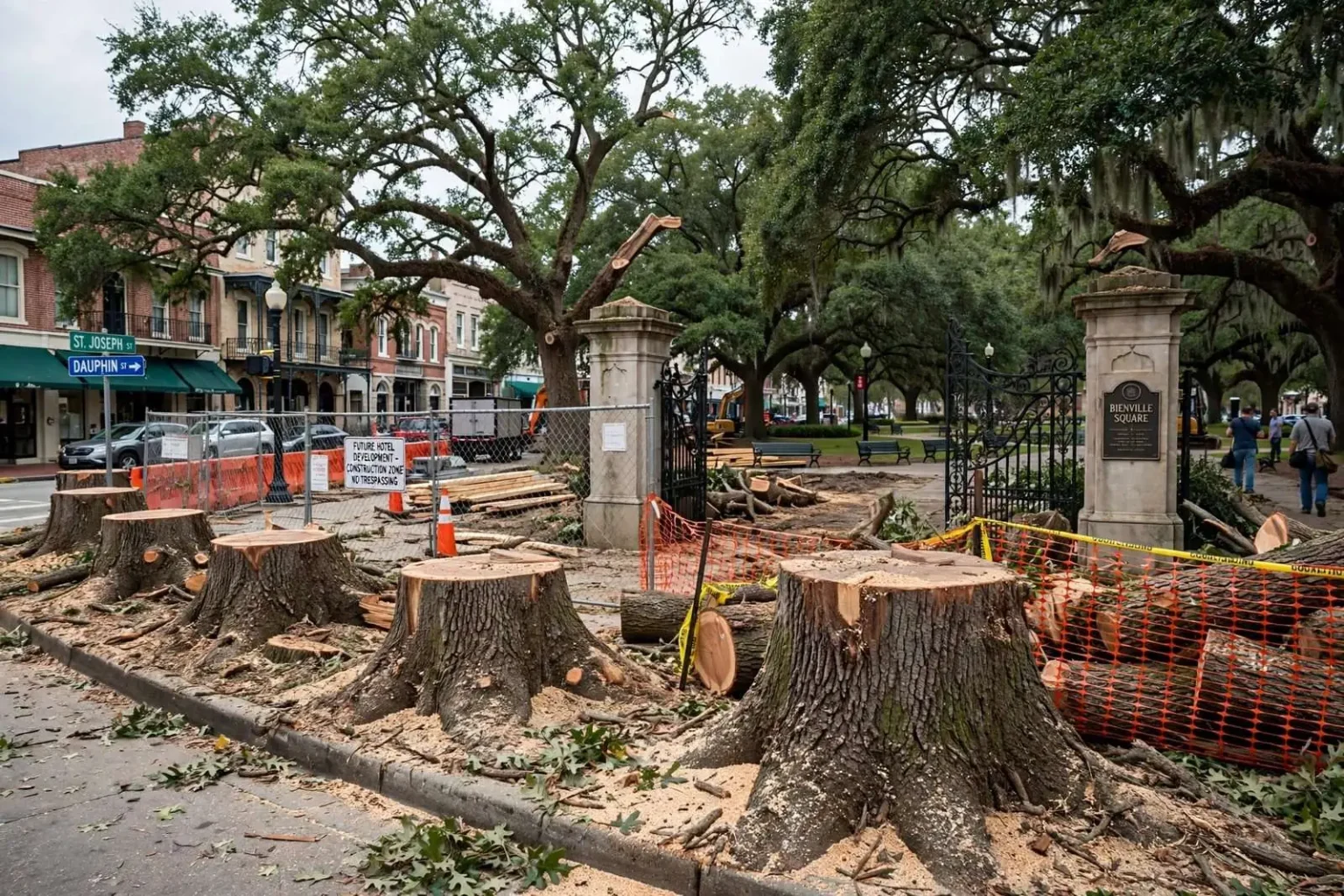
The removal of nine mature oak trees near Bienville Square in downtown Mobile has prompted city leaders to reexamine how such decisions get approved, with council members now looking at ways to tighten protections for the city’s tree canopy. The trees, which had shaded the blocks just north of the historic square for decades, came down with little advance public discussion, and the silence that surrounded the work has proved as troubling to preservation-minded residents as the loss itself.
The trees were cleared roughly two weeks ago from a site just north of the square to make way for a new hotel development. The project is part of a wave of private investment that has reshaped downtown Mobile in recent years, bringing new restaurants, apartments, and lodging options to a district that sat largely dormant for a generation. But the hotel site’s most visible feature, to neighbors and passersby, was the row of mature oaks that gave the block its sense of place, and their removal transformed the corner almost overnight.
The move drew sharp criticism from nearby residents, some of whom placed blame squarely on city officials for allowing it to happen without more scrutiny. For people who live and work downtown, the episode crystallized a longer-standing worry: that Mobile’s celebrated tree canopy, repeatedly invoked in promotional materials and civic pride campaigns, has few real protections when private development arrives. Several speakers at the council’s most recent meetings made that argument in personal terms, describing walks past the trees that are no longer possible.
City Councilman Levon Manzie, whose district includes downtown, said he is working with the council’s attorney and the mayor’s administration on potential fixes. The effort aims not at blocking the hotel, which has already been approved and has cleared its site, but at making sure the next project of its kind cannot repeat the sequence that played out near Bienville Square: a permit issued, a chainsaw run, and a public finding out only after the limbs were already stacked on the curb.
Two Ideas Under Discussion
Ideas under discussion include routing future tree-removal requests through the Mobile Tree Commission for review and possibly expanding the boundaries of the city’s historic districts to cover more downtown properties. Both concepts exist in the city’s framework already; the change Manzie is pursuing would give them teeth in situations where, today, a property owner can clear mature trees without a public hearing at all.
“What we would like to see is all of those kinds of requests be routed through our tree commission,” Manzie said, describing a process in which removals of significant trees would land before the body charged specifically with stewarding the city’s urban forest rather than being handled as a routine permitting matter. A routing requirement of that kind would give residents notice, create a written record of decisions, and allow alternatives, such as redesigning a site plan to save particular trees, to be weighed before removal rather than mourned after.
The second idea reaches further. Adding that bringing more of downtown under historic-district status would mean far more properties face the same level of design scrutiny already applied within existing districts, where details as small as paint colors and fence heights are reviewed. In those districts, proposed exterior changes go before a review board in public sessions, and the scope of what gets examined extends beyond the buildings themselves to site features that contribute to a street’s historic character, including landscaping and mature plantings.
The hotel site sits just outside the boundary of one of downtown’s existing historic districts, meaning it wasn’t subject to that layer of review. That line on the map, invisible to most people walking down the street, is what allowed the project to move forward with tree removal on its own schedule. A handful of blocks in one direction would have placed the property inside a district where the decision would have drawn public attention months earlier, and that geography is precisely what expansion proponents want to erase.
Residents have argued the same level of attention given to approving the building’s design should have extended to preserving the mature trees on the property. The distinction they describe is hard to defend in principle: a city that requires a developer to justify materials, massing, and facade details a few blocks away asked nothing about nine oaks that had stood for decades. In practice, the trees fell through the gap between two systems of review, each reasonable on its own terms, neither covering the property in question.
Bill Boswell, president of a recently revived historic neighborhood association, was among those who addressed the council directly this week, saying the incident exposed gaps in the city’s permitting and planning process. His appearance reflected the renewed energy of neighborhood organizations in and around downtown, groups that had gone dormant in years past and have reorganized as new residents and investment have returned to the city center. Those associations have become an increasingly consistent presence at council meetings, tracking agenda items that affect the historic core.
He urged council members and the mayor’s office to work with residents to prevent similar losses in the future, calling the city’s oak canopy one of downtown’s most valuable assets. The argument Boswell and others made was economic as much as sentimental: shade, street character, and the visual identity of Mobile’s oldest neighborhoods are precisely the qualities that draw visitors and buyers downtown, and every mature tree removed is an asset that took generations to grow and cannot be purchased or quickly replaced.
Manzie, for his part, has framed the emerging proposals as a matter of closing administrative loopholes rather than adding new burdens. The discussion with the council’s attorney concerns what authority the city already possesses and how it can be applied, while the conversations with the mayor’s administration touch on how the planning and permitting departments would implement any new review step. That division of labor matters, because an ordinance that adds review without adding staffing or clear standards tends to create delays without producing better outcomes.
The Mobile Tree Commission’s Role
The Mobile Tree Commission has long existed as the city’s designated body for matters involving the urban forest, advising on the health of the canopy and the care of trees on public property. What the current debate would change is the commission’s reach: today its input is most consequential for public property and streetscapes, while a private development can remove trees on its own land with no appearance before the commission at all. Routing requests through the commission would extend a layer of expertise, and publicity, to exactly the situations where the public currently has none.
Advocates for the change point out that review does not have to mean prohibition. A commission examining a tree-removal request can approve it as presented, require mitigation such as replacement plantings, or work with an applicant to adjust a site plan so that significant trees survive construction. Cities across the Gulf South have adopted versions of that model, requiring permits for the removal of trees above a certain size and pairing the permits with replacement standards, on the theory that a canopy takes a century to form and a morning to clear.
The stakes are considerable in Mobile specifically. The city’s live oaks are among its most recognizable features, celebrated in everything from tourism campaigns to the Mardi Gras season, when masqued figures pose beneath the same sprawling limbs that frame Oakleigh Garden District streets and the avenues around Bienville Square. Live oaks grow slowly and live for centuries in the right conditions, which means the trees removed near the square cannot be replicated within any planning horizon that matters to the people who enjoyed them.
Why the Canopy Draws Such Feeling
Bienville Square itself is one of Mobile’s oldest public spaces, a park donated to the city in the nineteenth century and named for the French colonial founder of the city. Squares like it were laid out as the lungs of the original street grid, and the mature trees that surround them are a large part of what makes the blocks nearby desirable addresses. When a development rises at the edge of such a square, its relationship to that landscape is not incidental to its value; it is a substantial portion of the value.
Tree canopies also perform quiet infrastructure work that becomes apparent only in their absence. Along the Gulf Coast, where summer heat is punishing and rainfall arrives in heavy bursts, a mature oak shades pavement that would otherwise radiate heat into the evening, slows stormwater runoff that would otherwise rush toward the streets, and buffers wind. Engineers and planners increasingly treat urban trees as components of drainage and cooling systems, and their loss carries costs that show up in utility bills and street maintenance budgets rather than in any single invoice a developer pays.
What Comes Next for the Hotel Site and the Ordinance
For the hotel project, the debate arrives too late to change what has already been cleared. Construction on the site north of Bienville Square is expected to continue, and no proposal before the council would apply retroactively to a permit that was lawfully issued. The nine oaks are gone, and the replacement plantings that might eventually soften the block will take decades to approach the scale of what stood there. What remains in the city’s hands is the next application, and the one after that.
The council’s options are likely to take shape over the coming weeks as Manzie’s conversations with the council attorney and the mayor’s administration produce draft language. Routing significant tree removals through the Mobile Tree Commission could be accomplished through changes to the city’s permitting procedures, while any expansion of historic-district boundaries would follow the formal process for designating such districts, including notice to affected property owners and public hearings. Both paths would give downtown residents something they did not have in this instance: a scheduled moment, in advance of the chainsaws, to ask questions and propose alternatives.
The broader question the episode raises is how a city markets itself on its canopy while leaving private property largely outside the system that protects it. Mobile has built an identity around its oaks, from the squares of the original grid to the garden districts south of Government Street, and that identity has measurable value in tourism, property values, and quality of life. The council’s pending decisions will determine whether that identity is treated as an inheritance to be stewarded or a marketing phrase to be invoked after the trees are already down. Residents who filled the council chamber in recent weeks have made clear which answer they prefer, and the revived neighborhood associations that pressed the point say they intend to keep watching the agenda until the fix is adopted.