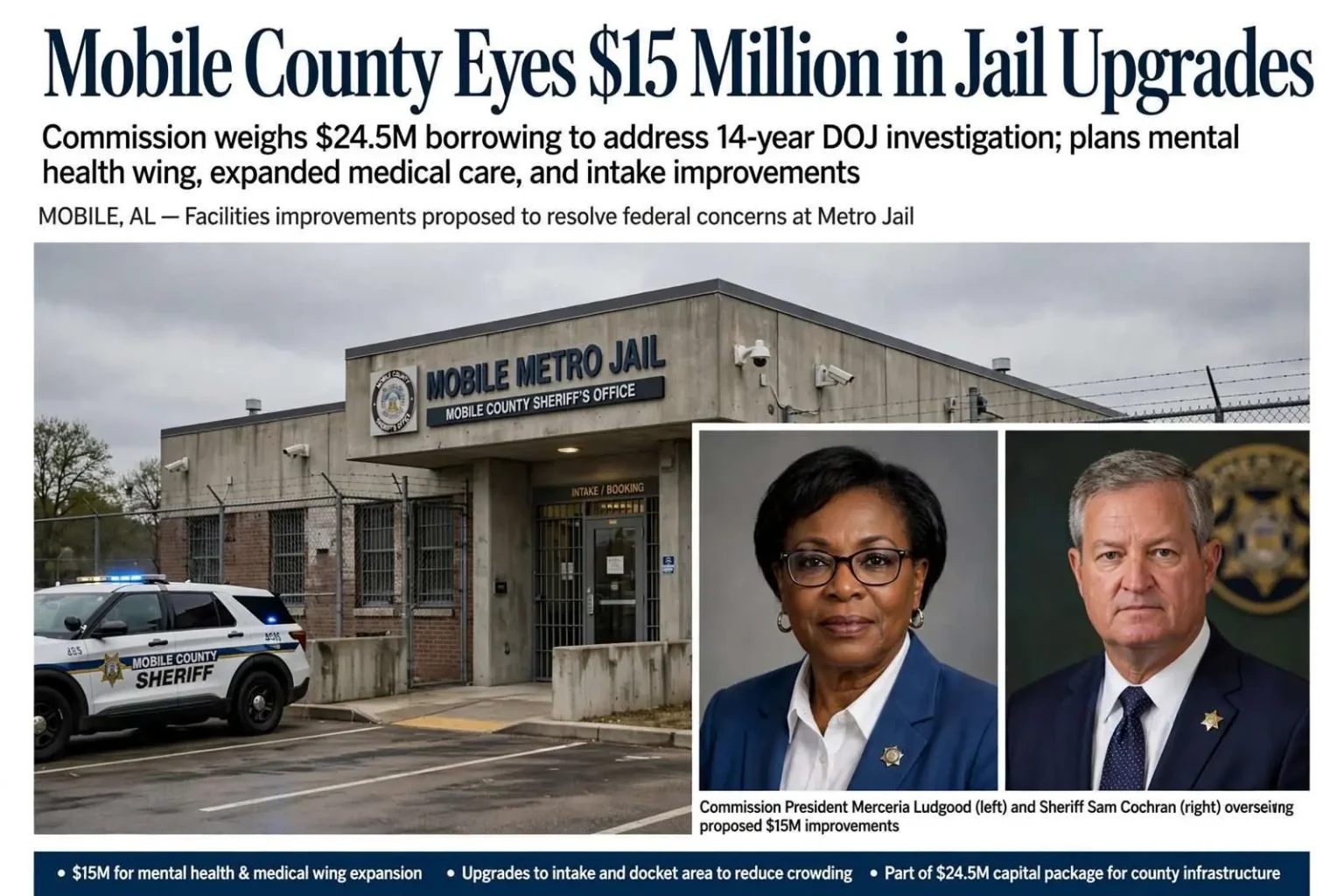
The Mobile County Commission is weighing whether to borrow $24.5 million for capital projects, with the bulk of that money earmarked for improvements to Mobile Metro Jail aimed at resolving a Department of Justice investigation into the facility that has dragged on for 14 years. The deliberation places the county’s long-term finances alongside one of its most persistent institutional challenges: a downtown jail whose shortcomings have been under federal scrutiny since the early 2000s.
Commission President Merceria Ludgood said the county plans to direct $15 million toward addressing deficiencies identified in a 2015 audit by the National Institute for Jail Operations. The audit gave county officials an outside, itemized accounting of what the aging facility lacks, and the proposed borrowing package represents the county’s most substantial response to it. County officials said in a statement over the summer that they were working with Sheriff Sam Cochran to implement recommended physical improvements, including upgrades to the areas that handle inmates’ mental health and medical needs.
“Our priorities are to expand our existing medical wing to include a designated mental health wing and to add more cells for inmates with mental health issues,” Cochran said. “We also want to expand the docket room and our intake area. We think those can be done at the same time.” Grouping the projects together, he argued, would allow the county to get the most from a single construction mobilization rather than paying to disrupt jail operations repeatedly over several years.
The intake and docket areas are the jail’s front door, handling every person booked into custody and every movement toward court. Crowding there ripples through the rest of the facility, slowing processing, extending waits, and adding pressure on officers assigned to manage the flow. Expanding those spaces addresses problems that deputies and inmates alike confront daily. Bookings that back up late at night cascade into the next morning’s docket, and officers end up supervising held populations in spaces never intended for the volume the jail now sees.
Mental illness and the county jail
Statewide cuts to mental health services have left county jails like Metro absorbing a growing share of the burden for housing mentally ill individuals, Cochran said, sometimes forcing corrections officers to isolate those inmates in cells originally designed to hold multiple people. A dedicated mental health wing, he said, would free up that capacity and give officers a purpose-built setting for inmates whose needs go beyond routine custody.
The pattern Cochran describes is not unique to Mobile County. As state hospitals have closed beds over recent decades, Alabama’s county jails have become, by default, among the largest holders of people in mental health crisis, often with no clinical staff on hand and little option but segregation. Sheriffs across the state have lobbied legislators for treatment funding, arguing that jails were never designed to serve as psychiatric facilities and that the mismatch endangers both inmates and staff.
For the county, a mental health wing is partly a capacity question and partly a liability one. Inmates in crisis who cannot be properly monitored are at elevated risk of self-harm, and the county has already confronted the cost of gaps in observation — the camera overhaul now underway included, by the county’s own account, coverage of the very cells used for suicide watch.
Cameras, crowding, and a contractor
The county has already spent $1.7 million this year replacing Metro’s security camera system, which hadn’t been updated since the 1980s and was missing coverage in key areas, including cells used for inmates on suicide watch. The overhaul brought the facility’s monitoring into the modern era, replacing equipment that predated not only digital recording but, in places, the color television era.
Cochran pointed to a significant drop in Metro’s average inmate population in recent years as one factor that has eased earlier DOJ concerns about overcrowding. A smaller daily population reduces strain on everything from cell space to medical clinics, and it gave the county room to plan renovations without having to house displaced inmates elsewhere.
He also credited the county’s decision to bring in outside contractor NaphCare to manage inmate health care as a step that addressed longstanding complaints about medical services at the jail. Contracting health care to a specialized provider is a common approach among large jails, shifting clinical staffing and protocols to a company whose sole business is correctional medicine. For a facility that had drawn federal criticism over health services, the change was one of the more visible operational responses.
A 14-year federal investigation
Many of the deficiencies now being addressed through these capital projects mirror concerns the DOJ first raised when it opened its investigation into the jail in 2003. As recently as 2009, the agency described the facility’s mental and physical health services as “grossly” and, at times, “constitutionally” inadequate. Federal civil-rights investigators hold authority over jails and prisons under a statute that lets the Justice Department sue when confinement conditions violate constitutional protections against cruel and unusual punishment.
Cochran, who took office after the investigation began, said many of those issues have since been resolved, but the federal inquiry remains open 14 years later. “They have attempted to get us to accept some type of consent decree, which I have opposed each and every time based on the advice of our attorneys,” Cochran said. “We’ve taken the stance that we’re not in violation of any constitutional standards. They’ve not brought any kind of lawsuit against us, but we have agreed to work with them, and they’ve since taken many of their concerns off the table.”
A consent decree is a court-enforced agreement in which a facility submits to judicial oversight, often for years, with compliance reports and the threat of contempt proceedings for missed deadlines. Rejecting one keeps the county out of court-ordered management but leaves the investigation open — and leaves the county bearing the burden of demonstrating, on its own timetable, that conditions meet constitutional standards.
Paying for the fixes
While Cochran said resolving the DOJ investigation was not the primary motivation behind the planned renovations, he said he would welcome that outcome, even if the necessary improvements have to be completed in stages given budget constraints. “What the county is doing is a big help, but at the end of the day, they only have so much money,” Cochran said. “We’re doing the best we can with the money that’s available to us.”
The proposed borrowing would compete with the rest of the county’s capital wishlist. A $24.5 million bond question touches roads, buildings, and drainage across a county that must also fund schools through a separate system and maintain a sheriff’s office that patrols unincorporated areas. Commission members have to weigh the jail’s federal exposure against every other claim on the county’s borrowing capacity, and the debate over the package has tracked those competing priorities. Ludgood and her colleagues will also be mindful that borrowing costs money: debt service on the package will claim a slice of future budgets for years after the construction dust settles.
Staging the jail work offers a middle path: the most urgent projects — the mental health wing, the medical expansion, and the intake and docket improvements — move first, while later phases follow as funds allow. That sequencing, county officials indicated, matches the priorities laid out in the 2015 audit and lets each completed stage serve as evidence of good faith if federal officials are assessing the county’s progress.
What it means for Mobile County
For residents, the spending fight is easy to overlook and hard to escape. Metro Jail holds people from every municipality in the county, and its conditions shape costs that flow back to local governments through inmate housing fees, insurance, and litigation exposure. A jail that passes federal muster is also a jail less likely to impose a consent decree’s mandated spending on future commissions.
The stalemate’s length — an investigation that began in 2003 still unresolved 14 years later — has made Mobile County a case study in how slowly such matters can move when a facility negotiates rather than litigates. Other Alabama jurisdictions have accepted federal settlements that imposed years of oversight; Mobile’s gamble has been that voluntary cooperation and visible improvement can achieve the same result without a judge’s involvement.
The capital package now before the commission is, in effect, the latest installment of that argument. If the borrowing is approved and the mental health wing, medical expansion, and intake improvements are built, the county will be able to point the Justice Department to new construction where old complaints once stood. Whether that is enough to close out a file first opened when flip phones were new remains the question the sheriff, the commission, and federal investigators will answer together in the years ahead.