Mobile County’s Absentee Ballot History Looms Over National Mail-In Voting Debate
As the 2020 presidential election approaches, a national fight over mail-in voting has drawn new attention to Mobile County's own history of absentee ballot controversies, including a lopsided 2013 legislative runoff and a federal probe into ballots bound for a mayoral race.
The debate over whether to expand mail-in voting ahead of the 2020 presidential election has become one of the most contentious issues of the year, intertwining public health concerns, partisan politics and the reliability of the U.S. Postal Service. In Alabama and across the country, the argument has split largely along party lines, with proponents casting expanded absentee and mail voting as a safe alternative to crowded polling places during the coronavirus pandemic, and opponents warning it opens the door to ballot tampering and fraud.
Supporters of broader mail-in voting argue it removes barriers for voters who cannot easily get to the polls, whether because of work schedules, health concerns or lack of transportation. Some states have gone so far as to mail ballots automatically to every registered voter, without requiring a request first. Oregon, Colorado and a handful of others had run all-mail elections for years, and their officials reported few documented fraud problems, which became a central talking point for expansion advocates during the pandemic.
Critics counter that flooding mailboxes with ballots, without safeguards, creates opportunities for people to vote on behalf of others or for campaigns to pressure voters while “helping” them fill out ballots at their doorstep. Much of the concern nationally centers on the Postal Service’s ability to handle a surge in ballot volume. Mailing operations of any size are vulnerable to delays and mishandling, and moving tens of millions of ballots within a tight election-season window would be a significant logistical undertaking for an agency that has faced scrutiny over service reliability in recent years.
The arguments arrived with particular force in Alabama, where absentee voting had always been treated as a narrow exception to in-person balloting rather than a routine alternative. State election officials spent the summer of 2020 urging voters who were worried about the coronavirus to use the state’s existing absentee process — applying early, submitting the required identification and returning ballots promptly — while resisting calls to adopt the broader automatic-mail systems gaining attention elsewhere.
How Alabama Handles Absentee Ballots
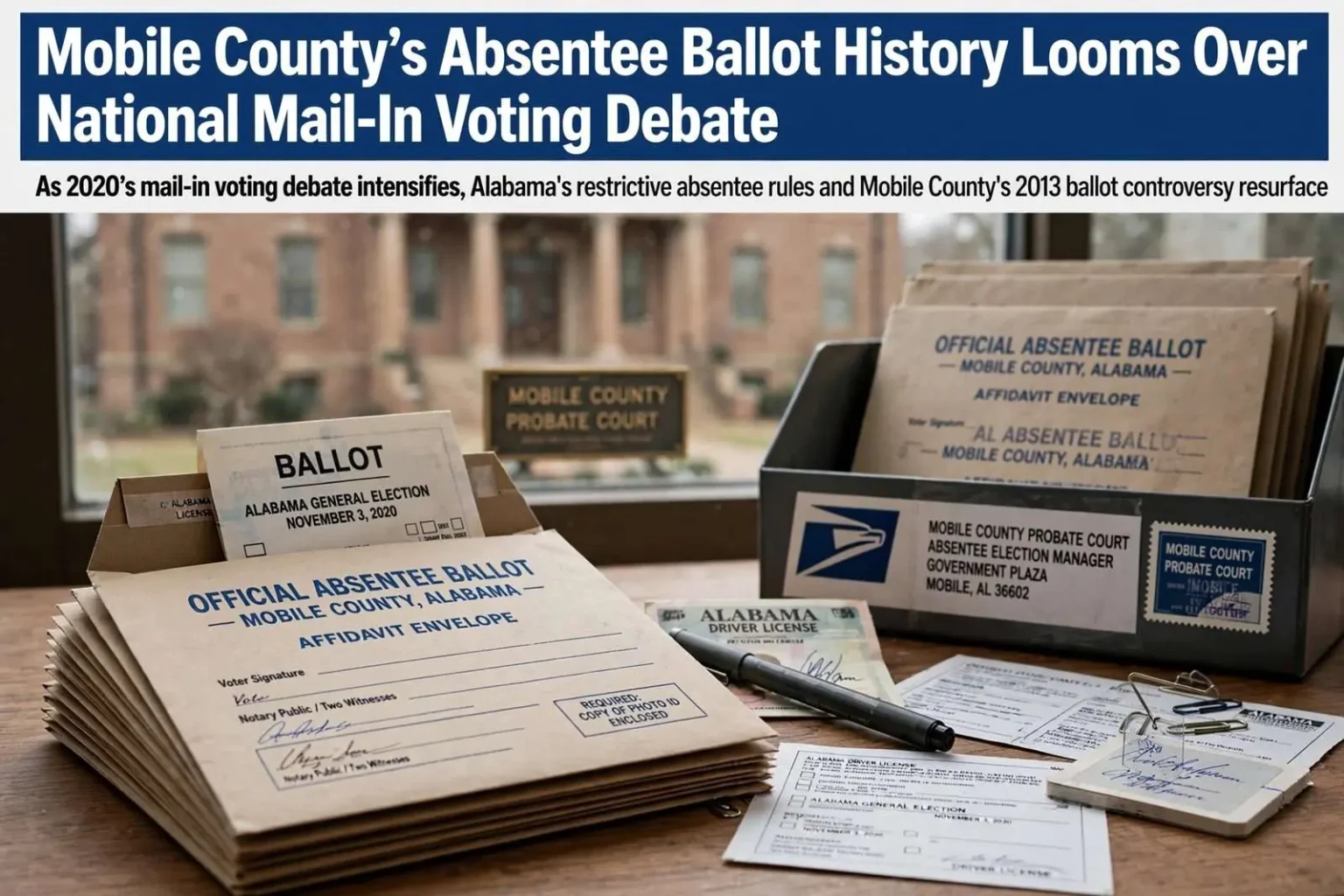
Alabama’s rules for absentee voting remain more restrictive than the all-mail systems some other states have adopted. Voters here must request an absentee ballot rather than receive one automatically, and state law requires absentee voters to submit a copy of a photo ID along with their ballot and have the ballot either notarized or witnessed by two adults.
Those requirements faced a legal challenge earlier in 2020, with plaintiffs citing pandemic safety concerns, but the U.S. Supreme Court intervened over the summer to keep the ID and witness requirements in place, overturning a lower court ruling that would have suspended them for the duration of the health emergency. The justices’ order came over the dissent of the court’s more liberal members and left Alabama’s rules untouched for the November election, making the state one of the stricter venues in which pandemic-era voting litigation played out.
Under the existing process, a voter applies to the local absentee election manager — in Mobile County, an office operating under the probate court’s election machinery — stating a qualifying reason such as being out of the county on Election Day, illness, physical disability or, as of 2020, the voter’s own judgment about the risks of voting in person during the pandemic. The ballot must then be returned with the affidavit envelope properly executed, and any defect in the paperwork can disqualify the ballot. Election officials in both parties describe the process as workable but deliberately layered with checks.
Defenders of the requirements argue those layers are precisely what keeps Alabama’s absentee system honest. Each signature, notarization and witness line creates a record that can be examined if a question arises, and the requirement that the voter — not a campaign worker — request the ballot establishes the voter’s intent before a ballot ever leaves the courthouse. Opponents of loosening the rules point out that every state that has moved to automatic mail voting had to build in replacements for those checks, such as signature matching and ballot tracking, and that Alabama has no comparable infrastructure in place.
The 2013 House District 97 Lesson
Locally, the concept of “vote harvesting” tied to absentee ballots is not a hypothetical worry for Mobile County — it has a documented history. In a 2013 runoff election for the Alabama House District 97 seat, Democratic candidates Adline Clarke and Karlos Finley finished nearly even in votes cast at the polls, but Clarke captured 153 of the 160 absentee ballots submitted, roughly 96 percent, a margin that proved decisive.
The arithmetic was stark enough to become a case study in state political circles. Election Day voters divided their support almost evenly between two well-known candidates from prominent Mobile families, yet the absentee column, totaling only a few hundred ballots out of thousands cast, delivered the nomination to Clarke by a wide margin. Her campaign said at the time that workers had gone door-to-door helping residents get signed up to vote absentee, an operation that was legal on its face but that demonstrated how a disciplined absentee program can outweigh everything that happens at the precincts.
The runoff was the decisive round of a special-election fight for a seat that had long been safely Democratic, and both campaigns understood that turnout in a low-profile summer election would be small enough for targeted programs to control the outcome. With the general election effectively preordained by the district’s registration, the Democratic runoff was, in practical terms, the whole race.
The lesson drawn locally was about scale. No one alleged that thousands of ballots were stolen; the winning margin was built from roughly 150 mail ballots, the kind of total that a few dozen door-knockers with applications can generate in the neighborhoods where absentee use is highest. Multiply that pattern across precincts in a close race, election observers note, and the courthouse column becomes the race.
The Mayoral Race Flashpoint
Later that same year, the imbalance of absentee ballots again became a flashpoint during Mobile’s mayoral race between then-incumbent Sam Jones and challenger Sandy Stimpson. Postal inspectors opened an inquiry after a couple was spotted delivering tubs of absentee ballots to be mailed the day before the election.
Both campaigns, mindful of what had unfolded in the Clarke-Finley race, worked to build up their own absentee ballot totals, and each ultimately banked a substantial number of votes cast by mail once the count was finished. The inquiry by postal inspectors, who examine matters involving the mail system, underscored how close to the line organized ballot collection could sit: delivering stacks of completed ballots for mailing was not itself a crime, but the image of tubs of ballots arriving at a post office on the eve of an election became a lasting illustration of why the practice troubled election officials.
Stimpson went on to defeat Jones that August, ending a generation of his family’s hold on the mayor’s office, and the absentee episodes faded from headlines — until the 2020 national debate over mail voting revived them. Longtime local political watchers found the connection almost self-explanatory: Mobile had already run the experiment that other states were contemplating, and its results were still cited in courthouse conversations whenever absentee reform came up in Montgomery.
What Change Would Mean Locally
Even with those safeguards, election observers note that absentee ballots have historically been the point in the process where campaigns push hardest to gain an edge, whether through organized ballot-collection efforts or door-to-door assistance that toes the line between helping voters and influencing them. Alabama law bars campaigning within a set distance of a polling place on Election Day, but no comparable restriction governs a campaign worker’s visit to a voter’s home to discuss an absentee ballot.
The asymmetry is the crux of the reform argument. At a precinct, the polling place itself is a neutral zone patrolled by poll watchers and inspectors, and the act of voting happens in public view behind a booth. In a living room, the same act happens with no witness except whoever brought the application, and the law’s protection depends entirely on the paperwork — the voter’s own signature, the notary or two witnesses — rather than on anyone watching the vote being cast.
That is why the safeguard requirements the Supreme Court left in place drew such attention. The witness and notarization rules, whatever their burden on voters, are the only external check on what happens between the application and the return envelope. Removing them during the pandemic, argued the officials who defended the rules, would have replaced a documented system with an unobserved one in the very year that organized absentee programs had shown what they could do in a close Mobile County race.
As more states weigh sending ballots to all registered voters this fall, Mobile County’s past absentee ballot disputes are being cited locally as a cautionary example of how even a small number of harvested votes — multiplied across precincts — can tip a close race. Election officials and political observers say the closer the presidential contest is nationally, the more likely accusations of irregularities, on either side, become part of the post-election fallout regardless of the outcome.
For Mobile County’s election workers, the practical preparation for November looked much as it always had, only larger: processing a heavier flow of absentee applications, verifying identification copies and witness signatures, and explaining to voters why the paperwork matters. The county had learned through its own recent history that the integrity of an election can rest on a few hundred envelopes, and 2020 promised more envelopes than any year before it.