

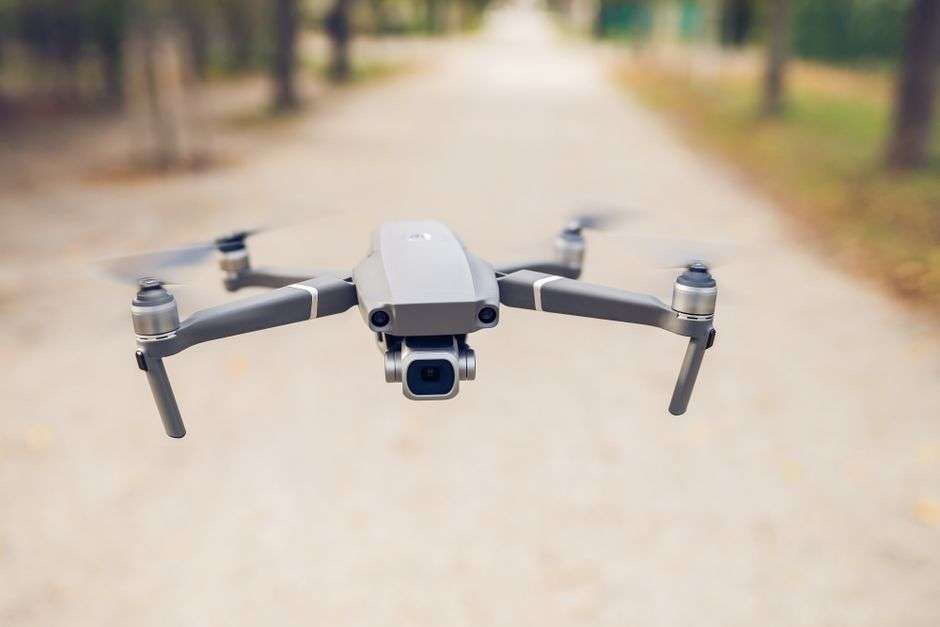
The city of Mobile has launched a drone surveillance program to monitor parks, special events and other areas in the name of public safety — and the aircraft it chose look nothing like the hobbyist quadcopters most residents have seen buzzing around backyards.
The program, which city officials said began in May, features a Fotokite system: a tethered drone physically connected to a ground station. The city will deploy the devices during events and in city parks, and Mobile Director of Public Safety Curtis Graves said they could be used in other areas as well.
What a Tethered Drone Actually Is
Unlike conventional drones, a Fotokite flies on a reinforced cable that anchors it to a powered ground station. The tether supplies continuous power and data, which changes the operational math entirely: the aircraft can stay aloft for hours rather than the 20 or 30 minutes a battery allows, it cannot wander into restricted airspace or crash into a crowd, and the live video feed travels over a hardwired connection that cannot be intercepted wirelessly.
The system is designed for simplicity. Deployment is essentially one button — the drone launches, holds position and lands autonomously, with no certified pilot required under the public-safety aviation rules that govern tethered systems. The tether caps the flight altitude at roughly 45 meters, below the thresholds that trigger more demanding Federal Aviation Administration requirements.
The result is persistent, stationary aerial overwatch: a camera in the sky that stays up for hours, watching a crowd or a corridor, rather than a drone that has to land every few minutes to swap batteries.
Why Mobile Bought It
City officials say the goal is situational awareness, not surveillance of private life.
“This new technology isn’t meant to invade anyone’s privacy,” Curtis Graves, the city’s public safety director, said in the press release announcing the program. “Instead, it gives our first responders an additional tool to assess large events in real-time and the ability to monitor parks and other areas while aggressively pursuing our public safety efforts.”
According to the city, the technology will help reduce emergency response times to incidents. “By deploying this tethered Unmanned Aerial System (UAS), the Department of Public Safety aims to improve emergency responder times, increase incident command visibility, and enhance overall safety for both first responders and the community,” the release stated.
Mayor Spiro Cheriogotis said the drones will prove especially useful during events that draw big crowds — and Mobile has no shortage of them, from Mardi Gras parades that pack downtown streets to festivals, football Saturdays and riverfront celebrations.
“Drones have proven to be useful tools for agencies around the country, especially where big crowds are present,” Cheriogotis said. “With a number of events throughout our city that draw large crowds, it is imperative that we protect citizens and visitors any way we can. This is a cost-effective way to enhance what we’re already doing to help keep the public safe.”
The National Trend — and the Privacy Debate
Mobile is part of a fast-growing national trend. Departments across the country have adopted tethered drones for overwatch at festivals, disaster scenes and standoffs, precisely because the systems deploy in under a minute and stay aloft for hours without a dedicated pilot.
Free-flying drones present a different set of challenges: trained pilots, battery limits, airspace restrictions and the risk that the aircraft itself becomes a hazard in chaotic environments. The tether eliminates those problems — it keeps the drone exactly where the incident commander wants it, powered indefinitely from the ground.
The privacy questions are real, though. Civil liberties organizations have long cautioned that persistent aerial surveillance can chill ordinary activity in public spaces, and agencies adopting the technology typically pair it with written policies limiting its use — specifying when drones fly, what is recorded, how long footage is kept and who can access it. Mobile’s officials have emphasized that the system is event- and incident-driven rather than a roaming surveillance net.
The city has not detailed its data-retention policy for the footage, nor the specific rules governing when a drone is launched outside of scheduled events. Those policies will shape how the program is received as it becomes a routine part of public safety operations.
What It Means on the Ground
For first responders, the immediate utility is line of sight. A camera 150 feet above a festival gives an incident commander a view no ground unit can match — spotting a medical emergency in a dense crowd, tracking a missing child, or seeing a disturbance forming before it becomes a fight. In parks, a drone can watch miles of pathways with a single operator.
For the city, the system represents a comparatively low-cost entry into aerial operations: no pilots to certify, no aircraft to insure and maintain in the conventional sense, and no complex airspace waivers for the altitudes involved.
Whether residents embrace it or push back will depend on how the program is used — and how transparently. The drones began flying in May, and city officials say the public will see them most often where the crowds are biggest.