

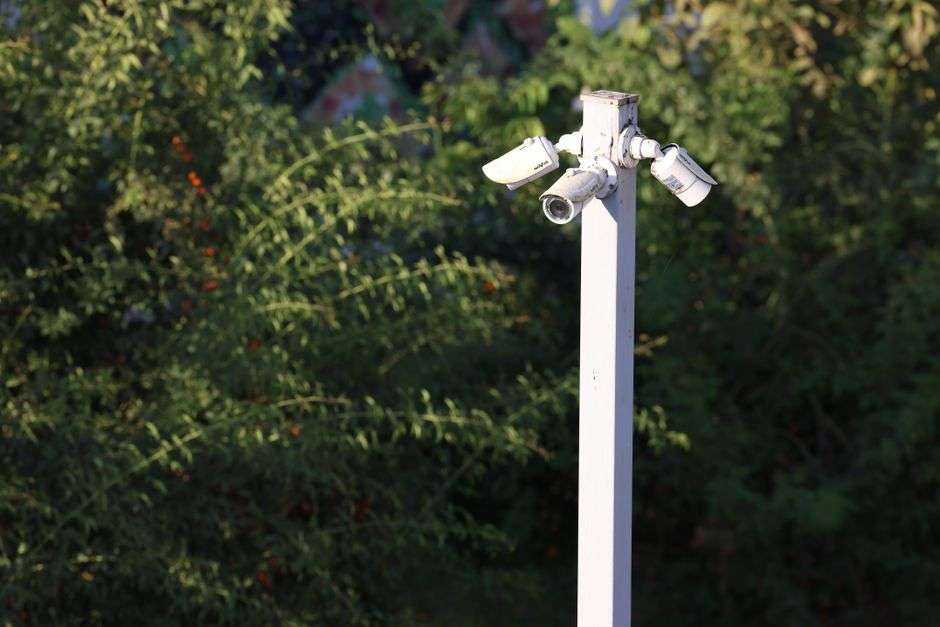
Is a pole-mounted camera a neighborhood guardian or an unblinking eye? Across Mobile and Baldwin counties, that question has moved from privacy forums to city council chambers, as solar-powered license plate readers — most of them made by Georgia-based Flock Safety — proliferate along the Gulf Coast and draw scrutiny from residents, civil liberties advocates and elected officials alike.
The devices are hard to miss once you know what to look for: jet black cameras perched atop tall posts or mounted to utility poles, quietly photographing every vehicle that passes. Flock says its cameras help law enforcement in more than 6,000 communities. “We believe that with advanced technology, hard-working law enforcement officers and transparent community engagement working together, we can seriously impact crime,” the company states in its own fact sheet.
Others see something very different. The American Civil Liberties Union has alleged that Flock and other manufacturers of automated license plate readers “are quietly trying to build a nationwide mass surveillance system,” using the devices to monitor and record citizens’ movements without a warrant. National reporting this year has catalogued officer misuse of the systems, and the backlash has been substantial enough that dozens of agencies across the country have canceled, suspended or refused Flock contracts this year alone.
The Texas case that changed the conversation
Worries about the devices’ public safety value intensified in April, when a Texas police officer was indicted on charges that he used his town’s license plate reader system to track a woman with whom he previously had a relationship. The case became a national touchstone in the debate over who watches the watchers — and what stops an officer with search access from using a surveillance network for personal reasons.
Similar abuse allegations have surfaced elsewhere. Former U.S. senator Doug Jones, now the Democratic nominee for governor, said at an Aug. 12 town hall in Montgomery that the cameras are being abused to track people in personal disputes, including one Alabama case in which an officer accessed the system to track his ex-girlfriend.
“I’m an old law enforcement guy,” Jones said. “I’m an old federal prosecutor, and I can see some benefit to having things like that. The problem we’ve got right now is that I don’t think there’s adequate guardrails there.”
Jones said agencies using the technology should reevaluate their policies, and that he views the issue as primarily a local matter. “We need to pull back and let, I think, right now every city, every county ought to reevaluate their use of these cameras and decide for themselves and put these things in place,” he said. “They have some purpose. They have some value, but they are getting abused.”
More than 300 readers around Mobile Bay
DeFlock Maps, a website that catalogs the locations of Flock and other surveillance cameras based on user-submitted data, shows more than 300 automated license plate reader cameras across Mobile and Baldwin counties. Users have identified roughly 45 cameras in Mobile and more than 100 in Baldwin County, with approximately 96 located between Foley and the beaches.
Not every camera pinned on the map is what it appears to be. A drive through Llanfair, Dauphin Acres and Midtown Mobile turned up a dozen cameras flagged as Flock devices — and only the three clustered around the parking lot of the Lowe’s on the East Interstate 65 Service Road were actually made by Flock. The others are made by other manufacturers and serve different purposes.
The City of Mobile and the Mobile Police Department said the city has not purchased or installed Flock cameras, but declined to explain the purpose of other cameras installed at major intersections along Dauphin Street, Government Street and Airport Boulevard. MPD spokesman Blake Brown would say only that the department has worked with ProTecVideo, a Stockton-based surveillance company, and that the Mobile City Council was poised to approve a $695,000 contract with the company.
“The city uses ProTecVideo as part of the technology supporting our public safety operations,” Public Safety Director Curtis Graves said in a statement. “The system helps improve situational awareness and provides another resource to assist law enforcement with responding to and investigating incidents. For public safety and operational reasons, we don’t discuss specific locations, coverage areas or the technical capabilities of the system.”
District 4 Councilman Ben Reynolds confirmed the city’s Gulf Coast Technology Center uses license plate readers as part of its public safety measures. Alabama Department of Transportation spokesman James Gordon said some of the cameras seen in Midtown and downtown belong to the statewide highway agency and are used for real-time traffic detection and research, and do not permanently record video of motorists. Alabama Power Company did not respond to a request for comment after an anonymous source suggested the company has installed cameras on its utility poles and allowed locals to access recordings for a fee; Alabama Public Service Commission Chairwoman Cynthia Almond also did not respond.
Gulf Shores embraces the network
The story is different in Gulf Shores, where the city has deployed dozens of Flock cameras since the spring. An April post on the city’s Facebook page announced the activation of at least 87 Flock cameras in the coastal community.
“These cameras are another tool in the way we deliver law enforcement services to the community,” Police Chief Dan Netemeyer said in a statement included with the post. “If a threat is connected to a school, the system alerts police immediately, including any license plates associated with that threat.”
The city pointed to an early success — officers said they used the Flock system to find an elderly woman who had been reported missing from home while driving toward Florida. The post assured residents that the system “is not government overwatch” and comes with limits on access and data storage. A fact sheet posted on Gulf Shores’ website states the cameras do not operate in a live feed and do not use facial recognition, that a valid incident number and documented investigative reason are required for officers to query the system, and that data is stored for 30 days before being permanently deleted. “The Gulf Shores Police Department maintains exclusive ownership of all captured data,” the page reads. “Flock Safety provides the hardware and cloud platform infrastructure, but retains zero claim of ownership over customer data.”
“These cameras are a great force multiplier,” Netemeyer said. “Thank you for trusting us and allowing us to protect your community.”
Pushback in Gulf Shores
Not everyone in the beach town is convinced. Ty Pitman, a Gulf Shores native who graduated from high school this year and now studies cybersecurity at Middle Tennessee State University, has organized local opposition to the cameras. When he spoke to the Gulf Shores City Council in July, Mayor Robert Craft defended the technology. “We found it is a very effective response for our police to be able to find issues and problems and track it,” Craft said. “It is a very important enforcement tool.”
Pitman told the council the cameras carry liabilities of their own, citing instances of cameras autonomously tracking pedestrians, zooming in on children’s faces, and allowing web users to delete recordings or spy on citizens. Craft asked him to email the information he had compiled. Pitman said he has not received a reply from Craft or other city officials.
Other residents echoed the concern when the council met on Aug. 10. “We know what these can do. We know how they can be used. We know it is an invasion of privacy,” resident Vicki Brown said. “We’ve not given you permissions. It’s not like we are not willing to support our police staff. We are. We are not willing to open up our lives to the government looking in on what we do every day.”
Resident Cheryl Cave said she appreciated that the department has a zero-tolerance policy for officers abusing the system, but argued it is only a matter of time before that policy is tested. “You have a system in place; somebody is angry with their neighbor, their spouse, their friend, whomever, and they decide to go and see where their comings and goings are,” Cave said. “Consider removing these cameras. They are going to be used for nefarious purposes. It’s not if, it’s when.”
Pitman said surveillance for public safety has value, but that more work is needed before the technology benefits the public. “There is definitely a line, and Flock is crossing that line,” he said. “Once more research and development is done and we get the right people to make it and implement it, it could be used for good and could be implemented well.”
Where the Mobile City Council stands
Mobile has no current plans to add Flock cameras, and council members who discussed the issue pointed to the same core question: what happens to the data. Reynolds said access controls matter more than the cameras themselves. “It comes down to the data,” he said. “In order for the public to feel safe from illegal searches, I think there must be a very strict process with layers of protection for access to the data.” Private companies collecting data on the government’s behalf “is frankly just a bad idea,” he added, saying the way Flock currently operates “is just trouble.”
District 5 Councilor Beau Fleming and District 6 Councilor Josh Woods generally concurred. District 1 Councilor Cory Penn said the city should consult residents and other municipalities that use Flock before drafting any proposal. Council President Gina Gregory said the debate raises bigger questions about how many technologies already surveil residents daily.
“In the future, we’re going to have to have some kind of conversation about these. I don’t think they are going away,” Gregory said. “If we’re going to do something, I think we ought to make sure they are doing what they are supposed to do, and that is protecting the citizens and not invading somebody’s privacy.”
The council has recently voted to let the city purchase surveillance drones, which members said will not be used for spying or invading privacy. Council President C.J. Small and District 2 Councilor Samantha Ingram did not return requests for comment.
A statewide political issue
The debate has reached Alabama’s governor’s race, where both major-party nominees have addressed the cameras in recent weeks. Republican Tommy Tuberville, speaking at an Aug. 19 event in Huntsville, called the cameras useful if properly managed. “If you can control the Flock cameras, my thoughts would be they’re very beneficial,” he said. “But if you’re not going to use them the right way … I don’t think it’s worth it.”
In comments to a regional news website the next day, Tuberville said he supports law enforcement but understands the privacy concerns. “A tool this powerful needs rules written by Alabamians, not by a tech company in Atlanta,” he said. “We should be able to track and prosecute criminals while protecting our citizens.”
Jones, for his part, has called for local agencies to reevaluate their safeguards. Between the two candidates, one thing is clear: the black cameras on the poles are not going away, and the argument over who gets to look through them is only beginning.