University of South Alabama Mobile
Mobile Doctor at Ground Zero Recalls Treating First Responders for Three Weeks After 9/11
Dr. John McMahon, a University of South Alabama emergency physician and former Mobile Fire Rescue medical director, deployed with a Disaster Medical Assistance Team to Lower Manhattan and ran a clinic at the foot of Ground Zero.
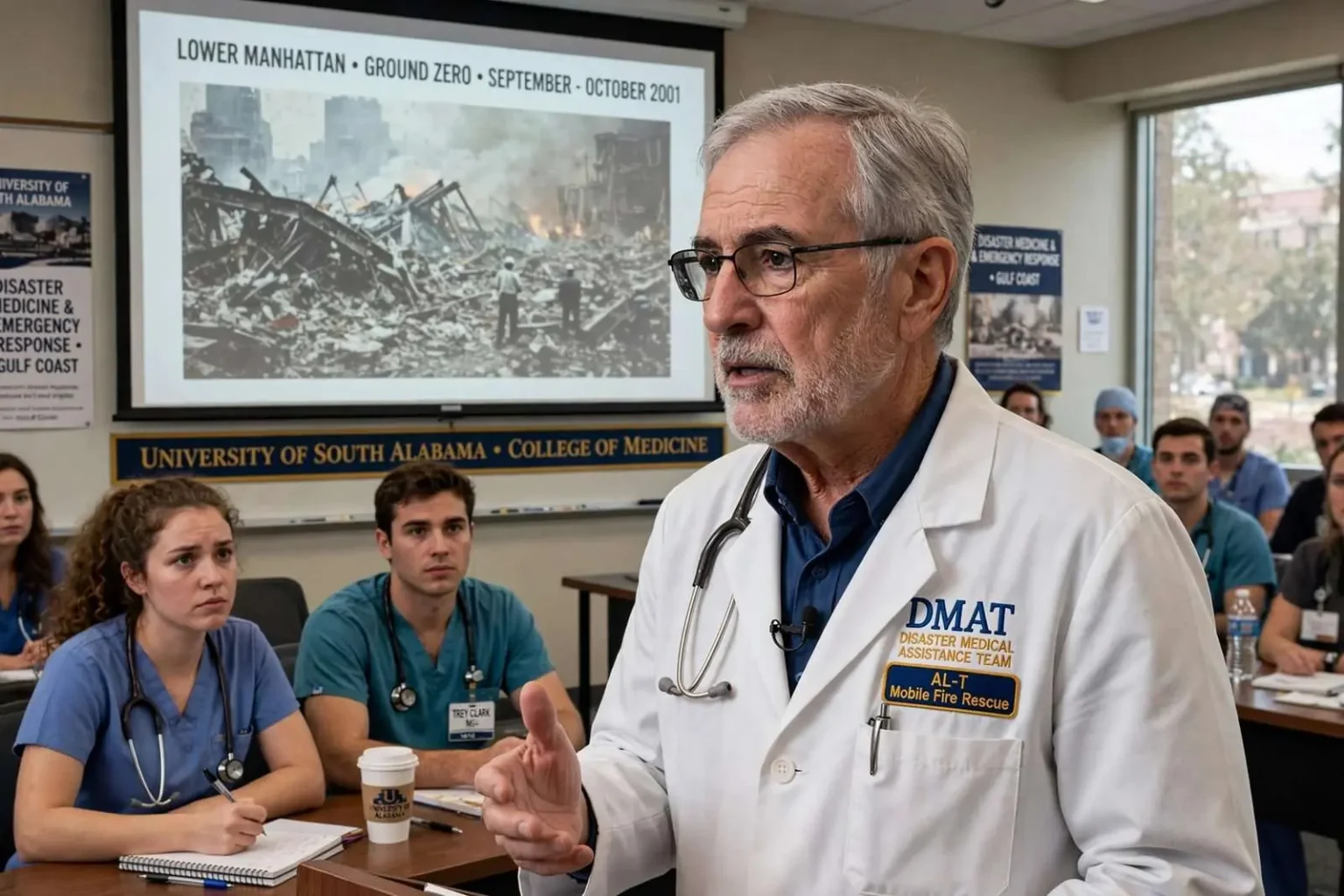
Twenty-five years after the Sept. 11, 2001, terrorist attacks, a Mobile doctor at Ground Zero during the recovery has been telling the story again — this time to a room full of medical students and emergency medicine residents who were not alive when it happened.
Dr. John McMahon, an emergency room physician at the University of South Alabama and the former medical director of Mobile Fire Rescue, was part of a Disaster Medical Assistance Team that deployed to Lower Manhattan in the immediate aftermath of the attacks. Forty members of Gulf Coast fire departments were activated within moments of the second plane striking the Twin Towers. Their assignment was to support the New York City first responders who were working to recover bodies from “the pile,” the vast field of wreckage left by the collapse of the two 110-story buildings.
McMahon helped establish a medical clinic in a burned-out deli at the foot of Ground Zero. From there, he and his team treated the injuries of first responders for nearly three weeks, working in respirators, hard hats and specialized jumpsuits to shield themselves from the debris and toxins suspended in the air.
A Phone Call Two Minutes Later
The activation came almost instantly. McMahon described the sequence in plain terms when he spoke to University of South Alabama medical students and emergency medicine residents about the deployment.
“The second plane hit the South Tower, and my phone rang two minutes later, and I was told that they knew it was a terrorist attack and that we were on first out, one of the teams to come up, and the FAA ended up shutting down civilian air traffic.”
That detail — a physician in Mobile, Alabama, learning within two minutes of the second impact that his team was on the roster to go north — captures how the national disaster response system is meant to function. Teams are pre-identified, pre-equipped and pre-assigned to a rotation. When something happens on a scale no local jurisdiction can absorb, the phone rings.
The Federal Aviation Administration’s shutdown of civilian air traffic that morning was the first nationwide ground stop in American history. It grounded thousands of aircraft and, for teams accustomed to being flown to disasters, complicated the logistics of getting to New York at all.
What a Disaster Medical Assistance Team Is
Disaster Medical Assistance Teams, generally shortened to DMATs, are the field medical units of the National Disaster Medical System. They exist because catastrophic events routinely overwhelm the medical capacity of the places where they happen, and because a hospital that is itself damaged, flooded or without power cannot treat the people the event just injured.
The teams are made up largely of civilian volunteers who hold regular jobs the rest of the year — emergency physicians, nurses, paramedics, pharmacists, respiratory therapists, mental health professionals, communications specialists and logistics personnel. They train together locally and are organized on a regional basis, typically anchored to a particular state or metropolitan area. Mobile’s participation, drawn from Gulf Coast fire departments, follows that pattern.
When a team is activated, its members are brought on as intermittent federal employees for the duration of the deployment. That status matters more than it sounds: it allows professional licenses issued in one state to be recognized wherever the team is sent, so a physician licensed in Alabama can lawfully practice at a disaster site in New York or California without the months of paperwork that would ordinarily require.
Teams are built to arrive self-sufficient. A deploying DMAT brings its own cache of medical supplies, pharmaceuticals, shelter and power, on the assumption that the community it is entering has nothing to spare — no beds, no fuel, no clean water and no ability to feed extra mouths. The standard planning benchmark is that a team should be able to operate without outside support for roughly the first three days.
The System Behind the Teams
The National Disaster Medical System is a federally coordinated partnership designed to handle medical surge in a disaster. It has three broad functions: deploying medical personnel into the field, moving patients out of a disaster area to hospitals elsewhere in the country, and providing definitive care at participating hospitals that agree to accept those patients.
The system dates to the mid-1980s and was originally conceived partly around the possibility of mass casualties from overseas conflict. Over the decades it has been used far more often for hurricanes, floods, tornadoes, wildfires and disease outbreaks. Its administrative home has shifted more than once — it was folded into the Department of Homeland Security after 2003 and later returned to the Department of Health and Human Services — but the field structure has remained recognizable throughout.
DMATs are not the only component. The system also fields Disaster Mortuary Operational Response Teams, which handle fatality management, victim identification and family assistance, and veterinary teams that care for animals in disaster zones. At the World Trade Center site, the fatality management side of the work was enormous and ran for months.
Working the Pile
The environment McMahon’s team worked in was unlike a conventional disaster scene. The collapse of the towers created a debris field of steel, pulverized concrete, glass and building contents that burned underground for weeks. Recovery crews worked in shifts around the clock, in unstable footing, over voids that could open without warning.
The medical need generated by that operation was constant and specific. Recovery workers came off the pile with lacerations, puncture wounds, crush injuries, burns, sprains, eye injuries from airborne particulate and severe respiratory irritation. Many needed rehydration. Many needed to be persuaded to stop working long enough to be treated at all — a documented characteristic of that response, in which firefighters and police officers searching for colleagues resisted leaving the site.
Setting up a clinic in a burned-out deli was a practical solution to a practical problem: a treatment point had to be at the foot of the site, close enough that a worker could reach it in a couple of minutes and get back. That is the logic of field medicine. You do not bring the patient to the hospital; you put the care where the people are.
The protective equipment McMahon described — respirators, hard hats, specialized jumpsuits — reflects what was understood at the time about the hazards. The dust that coated Lower Manhattan contained pulverized concrete, glass fibers, asbestos from older building materials, heavy metals and combustion products, and it was highly caustic. Not everyone at the site wore respirators consistently, and the long-term health consequences of that exposure became one of the defining aftereffects of the attacks.
The Long Tail of Ground Zero
In the years that followed, responders and recovery workers began developing chronic sinus and respiratory conditions, asthma, gastroesophageal reflux disease, interstitial lung disease and, later, a range of cancers at elevated rates. The pattern became widely enough recognized that Congress created a dedicated federal program to monitor and treat the exposed population, along with a compensation fund for those with certified conditions. Tens of thousands of responders and downtown residents, workers and students have enrolled.
That later chapter has changed how the anniversary is observed within the emergency services and medical communities. The number of responders who have died of illnesses linked to their time at the site has continued to climb over the decades, and those deaths are now commonly counted alongside the losses of the day itself.
Passing It On at the Medical School
McMahon’s audience for the retelling was a group of University of South Alabama medical students and emergency medicine residents — the next cohort of physicians who will staff the region’s emergency departments, respond to hurricanes on the Gulf Coast and, in some cases, join disaster teams themselves.
His framing of the work was straightforward.
“I’ve done emergency medicine for over 40 years and spent years helping people on their worst day. And that’s what we were trying to do,” McMahon said.
He emphasized to the students how significant a role Disaster Medical Assistance Teams play when a disaster strikes, and stressed that physicians can be called on to help at any moment.
Trey Clark, a fourth-year medical student, said the message registered.
“Growing up hearing about it, you know, and hearing doctor McMahon’s story, it’s really incredible. It’s eye-opening and eye-opening to the fact that as physicians and future physicians, we’re in a position where we have to be able to lead, and whether it’s, you know, Grandma fell down or 9-11 or Covid, you know, we have to be in a position where we can step up and take charge, and we need to.”
Clark’s list — a grandmother’s fall, a terrorist attack, a pandemic — is a reasonably precise description of the range an emergency physician is expected to cover. The common thread is not the scale of the event but the requirement to take charge of a situation that has not organized itself.
Why This Matters on the Gulf Coast
For south Alabama, the disaster medicine lesson is not abstract. The region sits in one of the most hurricane-exposed corridors in the United States, and local hospitals, fire departments and emergency management agencies have repeatedly had to plan for the possibility that their own facilities will be damaged while demand for care spikes. Mobile’s participation in the national disaster medical structure means the same personnel who might deploy elsewhere are also the ones who would be working here.
The University of South Alabama occupies a central place in that picture. Its medical school trains physicians who overwhelmingly stay in the region, and its health system operates the area’s principal teaching hospital and trauma services. When an emergency medicine resident in Mobile hears a first-person account of a three-week deployment to Ground Zero, the transfer of knowledge is direct and practical, not commemorative.
He Would Go Again
A quarter-century on, McMahon says he still regards the assignment as an honor. Asked about the prospect of another call, he said that despite everything he saw in Lower Manhattan in 2001, he would go again without hesitation.
That answer is, in its way, the entire argument for the system he served in. Disaster medical teams work because a large number of ordinary clinicians agree in advance to leave their homes and practices on short notice for someone else’s catastrophe. The commitment is renewed one person at a time, and on the 25th anniversary of the day that tested it hardest, a Mobile emergency physician spent an afternoon making the case for it to the people who will be asked next.