Mobile Infirmary Canine Teams Join Security Staff to Calm Tense Moments and Prevent Workplace Violence
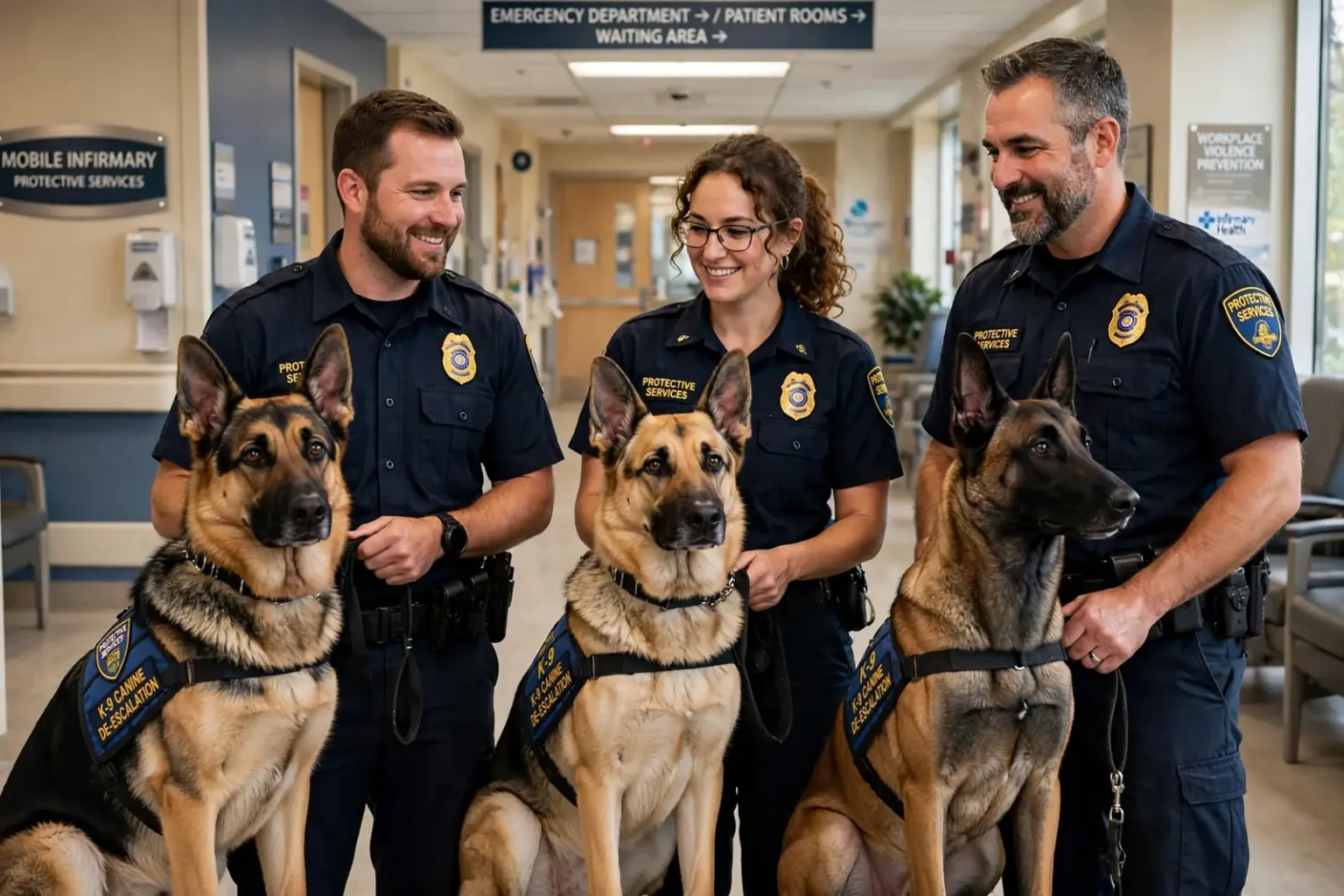
Three young dogs, Cayde, Star and Pete, will join Mobile Infirmary’s Protective Services department in November as canine de-escalation teams aimed at preventing workplace violence.
MOBILE, Ala. — Mobile Infirmary canine teams will begin working alongside the hospital’s security officers in November, as three young dogs and their handlers join the Protective Services department in an effort to calm tense situations before they turn into conflicts. The hospital says the program is part of its broader strategy to prevent workplace violence and help patients, families and employees feel safe.
The new canine de-escalation teams will partner with Protective Services officers when emotions run high, according to hospital officials. Rather than relying solely on uniformed officers, the approach uses a friendly dog to ease tension, build rapport and encourage cooperation early, before a situation escalates.
Meet Cayde, Star and Pete
The three dogs are all about a year old. Cayde and Star are German shepherds, and Pete is a Belgian Malinois. Both breeds are known for intelligence, trainability and a strong bond with their handlers, which is why they are widely used in police, military and service work.
Their handlers bring nearly four decades of combined experience and have completed training in canine-assisted de-escalation, hospital officials said. The teams will interact with patients, visitors and employees throughout the hospital.
Steve Saflin, director of Protective Services for Infirmary Health, said the dogs give security staff a new way to connect with people.
“Feeling safe is an important part of the care experience, whether you’re a patient, a family member or a member of our team,” Saflin said. “These dogs give us another way to connect with people and help put them at ease.”
Saflin said the goal is to change how people view hospital security.
“We want people to see our Protective Services team as a resource they can turn to, and these canine teams will help us build those connections in a very natural way,” he said.
How canine de-escalation works
De-escalation is a set of communication techniques used to reduce agitation and defuse potential conflict without physical force. In a hospital, those situations can arise in many places: a crowded emergency department waiting room, a family receiving difficult news, a patient who is confused, frightened or in pain, or a visitor frustrated by long waits.
A calm, well-trained dog can change the tone of an encounter. People who might be defensive when approached by a security officer are often more willing to talk when a dog is present, and the animal can give everyone a moment to pause. Hospital officials said the canine-assisted approach is meant to lower tension, build trust and encourage cooperation.
Each dog works as part of a team with a specific handler, and that pairing matters. Handlers learn to read their dog’s body language and to judge when an encounter is a good fit for the animal’s presence, while the dogs learn to stay calm and focused in busy, noisy and unpredictable settings. The handlers’ training in canine-assisted de-escalation is designed to combine those skills with the communication techniques security officers already use.
The program is also meant to make Protective Services more approachable day to day. By having the teams interact regularly with patients, visitors and staff, the hospital hopes people will be more comfortable asking security officers for help when they need it, officials said.
Why hospitals are focused on workplace violence
Workplace violence is a persistent concern in health care. Federal data from the U.S. Bureau of Labor Statistics have shown that workers in health care and social assistance account for a large majority of nonfatal workplace injuries caused by violence nationwide. Nurses, emergency department staff and security officers are among those most often affected.
The issue has drawn increasing attention from regulators and accrediting bodies. The Joint Commission, which accredits most U.S. hospitals, put new workplace violence prevention requirements into effect in January 2022. Those standards call on hospitals to run workplace violence prevention programs, analyze incidents, and train staff in de-escalation and response.
Hospitals have responded with a mix of tools, including staff training, panic buttons, visitor management systems and more visible security. Canine programs are one of the newer additions. Some health systems around the country have used dogs as part of their security operations for both their calming presence and their ability to help officers engage with people in a non-confrontational way.
About Mobile Infirmary and Infirmary Health
Mobile Infirmary is the flagship hospital of Infirmary Health, a nonprofit health system that also includes Thomas Hospital in Fairhope and North Baldwin Infirmary in Bay Minette, along with outpatient clinics and other services across southwest Alabama. Founded in 1910, Mobile Infirmary is one of the largest hospitals in the state, and its Protective Services department provides security for patients, visitors and employees across its campus.
The canine program comes during a period of other changes at the hospital. Earlier this month, Mobile Infirmary named Navy veteran Mary Tabor its chief nursing officer.
What patients and visitors can expect
Starting in November, people at Mobile Infirmary may see Cayde, Star or Pete making rounds with their handlers. Hospital officials said the teams will be present to interact with people throughout the facility and to support Protective Services officers when a situation calls for a calmer approach.
As with any working dog, visitors should ask the handler before approaching or petting one of the dogs. Anyone at the hospital who feels unsafe or needs help can contact a Protective Services officer or any member of the hospital staff.
The canine teams do not replace the hospital’s existing security measures. Instead, they add another option for officers, one that hospital officials hope will help many difficult moments end with a conversation rather than a confrontation.
Hospital leaders say the goal is simple: a safer environment where patients can focus on healing, families can focus on their loved ones and employees can focus on providing care.