Olin Chlorine Leak Alarm Sounds Twice in a Week, McIntosh Neighbor Wants Answers
A McIntosh resident who lives across Highway 43 from the Olin plant says she heard chlorine leak alarms Sunday and Thursday and is asking the company for a community meeting on what the alarms mean.
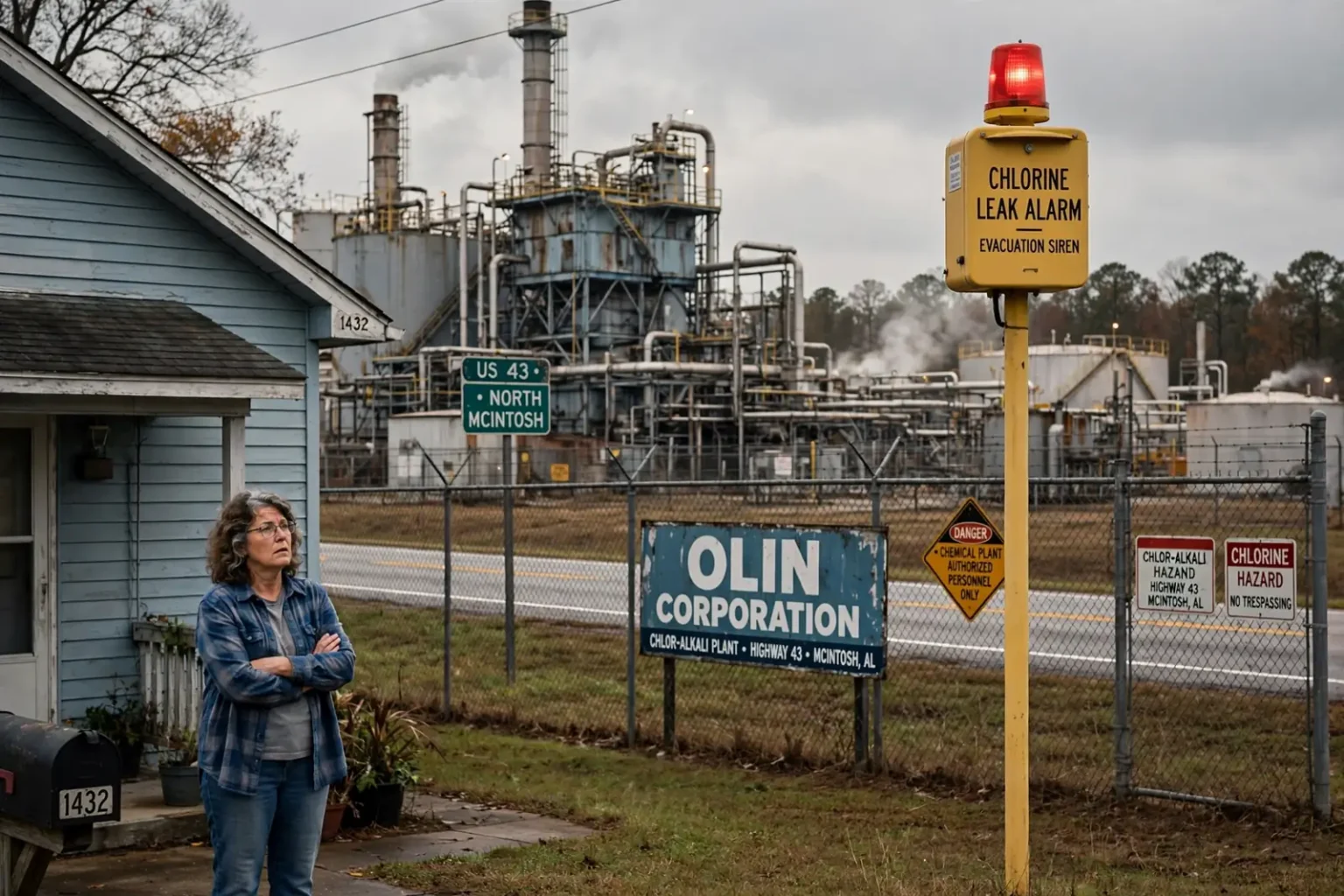
MCINTOSH, Ala. — A McIntosh woman who lives across the highway from the Olin Corporation chemical plant says she has now heard the plant’s chlorine leak alarm twice in less than a week, and she wants the company to explain to neighbors what those alarms mean and what residents should do when they sound. The latest Olin chlorine leak alarm went off Thursday, Oct. 22, four days after a similar alarm on Sunday, Oct. 18.
Lucille Foster, whose home sits across the street from the plant on U.S. Highway 43, said she called 911 both times she heard the alarm. On Thursday, she said, 911 confirmed there had been a leak but told her it was contained to the plant property.
Olin later told Foster that crews had found a leak at a storage tank, contained it and returned the plant to normal operations. The state agency that monitors air and water quality around the facility said it was investigating Sunday’s leak but had not known about Thursday’s until a reporter asked about it.
Two alarms in one week
Foster said Sunday’s alarm frightened people in the small Washington County community, which sits along the Tombigbee River in the southern part of the county, about 45 miles north of Mobile. When she heard the alarm again Thursday, she called 911 and then called Olin directly.
According to Foster, the first person she spoke with at the company told her there was no leak. When she said 911 had already confirmed one, she was told someone would call her back. That call came around 3 p.m., when an Olin representative told her crews had located a leak at a storage tank, contained it and restored normal operations.
Washington County Emergency Management said it was aware of Sunday’s incident and that Olin had reported it was contained immediately. Olin was asked by email to clarify the details of both incidents, including how much chlorine was released, if any left the plant site and what caused the leaks.
A call for clearer communication
Foster said her biggest worry is not just the leaks themselves but the lack of information that reaches neighbors during and after an incident. Residents who live close enough to hear alarms inside the plant often cannot tell whether a siren is an internal signal for workers or a warning meant for the public, she said.
She asked the Olin representative she spoke with Thursday to hold a community meeting to explain which alarms residents should act on and how they will be notified when something goes wrong. She said he did not have an answer but told her he would follow up.
The question of who gets told what, and when, has come up before in McIntosh. In 2017, residents pressed for more accountability after releases at the plant, and a Code Red notification system was set up to alert people who live nearby to leaks and other dangers. Code Red, a commercial emergency notification service used by many local governments, can send automated phone calls, text messages and emails to people who sign up or whose numbers are in its database.
Olin has said in the past that it used that system to alert the community during at least one earlier chlorine release. Foster’s experience this week suggests some residents are still unsure how much they will hear, and from whom, when an alarm sounds.
State regulators investigating
The Alabama Department of Environmental Management, known as ADEM, monitors air and water quality near the plant. The agency confirmed it is aware of Sunday’s leak and is investigating. However, an ADEM representative said the agency had not heard about Thursday’s incident until it was contacted about it. The representative said she would pass the information along to investigators already on scene.
Under federal and state rules, industrial facilities that release a hazardous substance such as chlorine above a set “reportable quantity” must notify regulators. Whether either of this week’s leaks reached that threshold has not been disclosed.
A history of releases and fines
This is not the first time chlorine releases at the McIntosh plant have drawn scrutiny. ADEM has fined Olin for infractions at the facility in recent years.
State enforcement records describe several releases:
- A 2017 release of about 738 pounds of chlorine into the atmosphere.
- A release of about 94 pounds over roughly seven minutes on Oct. 16, 2020. Olin said it shut down operations immediately and alerted the community through its Code Red system.
- A release of about 597 pounds on or about Oct. 28, 2020, which the company did not report to the state until the following January. ADEM said Olin had “demonstrated a low standard of care” for failing to notify the department in a timely manner.
- A smaller release of about 17 pounds that lasted more than four and a half hours.
Olin agreed to pay an $80,000 civil penalty to settle those violations in a consent order with ADEM. The company said at the time that it had made all reasonable efforts to limit the environmental effects of the October 2020 release and that it reported the later release once it determined the amount had exceeded a reportable quantity.
In 2024, 193 residents of the unincorporated neighborhood south of the plant filed lawsuits against Olin, claiming the company negligently released at least 700 pounds of chlorine gas in at least four incidents since 2020 and that the releases harmed their health, property values and quality of life. Olin did not admit fault in the ADEM consent order. Years earlier, in 2003, a group of neighbors sued the company over mercury pollution, a case that was settled.
About the plant
Olin, one of the largest chlorine and caustic soda producers in North America, operates the chlor-alkali plant on Highway 43 in McIntosh. Chlor-alkali plants pass an electric current through salt water, or brine, to make chlorine gas and caustic soda, two basic chemicals used to produce plastics, water treatment chemicals, paper, pharmaceuticals and many other products. Over the years the McIntosh site has also produced sodium hypochlorite, the main ingredient in bleach, and in the past made chlorinated pesticides.
The plant sits beside a large chemical manufacturing site now owned by BASF, formerly operated by Ciba-Geigy. Both properties have been designated federal Superfund sites because of contamination left from past operations, including wastewater that was historically discharged into unlined ponds or the Tombigbee River.
The plant is also one of the area’s major employers. Some residents have said in the past that the company has been a good neighbor and provides many local jobs, while others have said they worry about living so close to its tanks and pipes.
Why chlorine leaks are a concern
Chlorine is a yellow-green gas with a strong, bleach-like smell. It is heavier than air, so it tends to stay close to the ground and can collect in low-lying areas. Exposure can cause coughing, breathing problems, irritation of the eyes, nose and throat, nausea and blurred vision. Higher concentrations can cause serious lung damage.
Public health agencies, including the U.S. Centers for Disease Control and Prevention, give general advice for people who may be near a chlorine release:
- Follow instructions from emergency officials, whether they say to shelter in place or evacuate.
- If told to shelter in place, go indoors, close all windows and doors, and turn off heating, air conditioning and fans that pull in outside air.
- Because chlorine is heavier than air, move to higher ground or an upper floor if possible, and avoid basements and low spots.
- If you are outdoors, move away from the area of the release and get to fresh air quickly.
- If you have been exposed, remove contaminated clothing, wash skin with plenty of soap and water, rinse eyes with water, and seek medical care. Call 911 for trouble breathing.
Residents can also contact the Poison Control Center at 1-800-222-1222 for advice on possible chemical exposures.
What residents can do now
Neighbors who want to be notified of emergencies can check with Washington County Emergency Management about signing up for local alerts, including the Code Red system. Anyone who smells chlorine, hears an alarm and is unsure whether it applies to them, or sees a visible gas cloud should call 911.
Residents who want to report an environmental concern or ask about an investigation can contact ADEM, which accepts complaints from the public about air and water quality. Foster said she plans to keep pressing Olin for a public meeting so families on her side of the highway know exactly what each alarm means.
This story will be updated if Olin, ADEM or county officials release more information about this week’s incidents.