Fifteen Women Complete Life Skills Course at Mobile Metro Jail
Fifteen women incarcerated at Mobile Metro Jail graduated from a 16-hour life skills course focused on healthy relationships and communication.
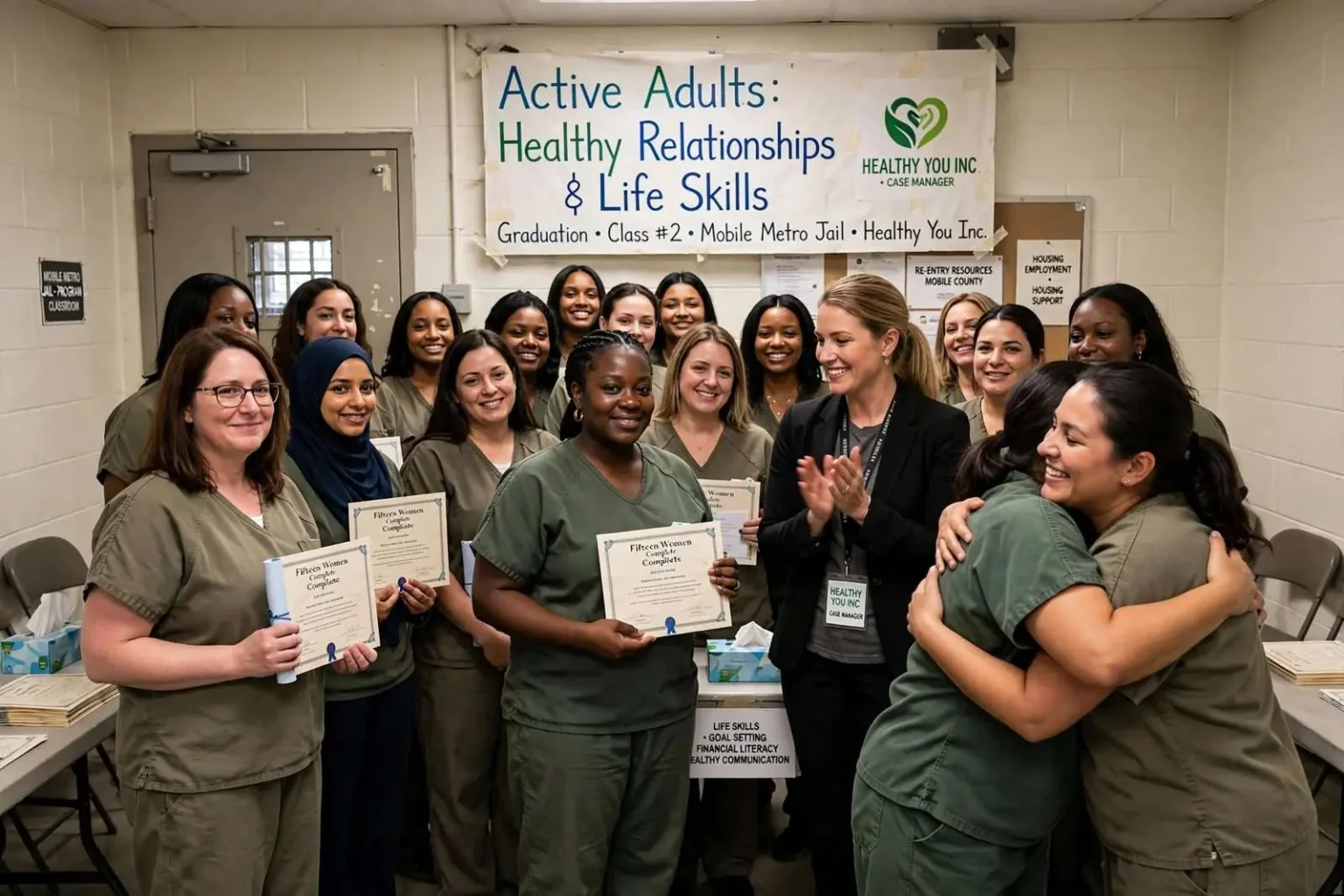
Fifteen women held at Mobile Metro Jail marked a milestone on a recent Thursday, graduating from a 16-hour course designed to build practical life skills and healthy relationship habits ahead of their eventual return to the community. The ceremony inside the facility was modest — certificates, handshakes, a few emotional embraces — but for the women completing it, the class represented something more consequential than a line on a jail program schedule. It was structured preparation for the moment when they walk out the doors and face the relationships, finances and daily decisions that await them.
The class, called Active Adults: Healthy Relationships and Life Skills, was the second session of its kind taught inside the jail by a case manager and facilitator with Healthy You Inc., a nonprofit that brings evidence-based curriculum to incarcerated women across Alabama. The organization also provides case management support to individuals re-entering society after release from jail or prison, aiming to extend the impact of its programming beyond the walls of the facility. That continuity matters: research on re-entry consistently shows that the weeks immediately following release are when people are most vulnerable to relapse, homelessness and re-arrest, and a case manager who already knows a participant’s situation can intervene during exactly that window.
Healthy You’s presence inside Mobile Metro Jail places it within a growing network of Alabama organizations working on the front end of the state’s cycle of incarceration. Rather than waiting for problems to bring someone back through the criminal justice system, the nonprofit’s model treats jail as a point of contact where structured education can still reach people — often individuals who never had access to this kind of instruction anywhere else.
What the Curriculum Covers
The curriculum itself, developed by researcher Kelly Simpson, centers on core life skills that can be difficult to build or maintain during incarceration: healthy communication, goal setting, emotional management, relationship building, basic financial literacy and recognizing one’s own strengths. The coursework runs participants through practical exercises — how to de-escalate a conflict, how to set a realistic goal and break it into steps, how to open and manage a bank account — that translate directly to life after release.
According to the instructor, the goal isn’t simply to fill a class requirement but to help participants internalize a sense of self-worth that can carry them through re-entry into daily life. “The most important thing is to help people understand healthy ways of communication,” the instructor said, adding that many incarcerated individuals don’t always recognize their own value. That framing explains the program’s design: a woman who leaves jail believing she has nothing to offer anyone is far more likely to return to the circumstances that brought her there in the first place.
Sixteen hours is a short course by classroom standards, but inside a jail it represents a substantial commitment — four sessions’ worth of sustained attention, participation and trust from women whose days are otherwise structured by custody routines. Programs of this kind also require buy-in from jail administrators, who must clear classroom space, coordinate custody coverage and permit outside instructors to work with the population.
The Graduates’ Response
That message resonated with several of the graduates, who described the course as a turning point in how they think about their relationships and their future. One graduate, a 30-year-old Mobile woman, embraced the instructor and jail administrators after receiving her certificate of completion, saying the course gave her a new outlook that she expects will help her raise her children and rebuild family relationships going forward. For incarcerated parents, family reunification is often the strongest known incentive for stability after release, and coursework that directly addresses communication and relationship skills speaks to that goal.
Another participant praised the instructor directly, saying the course taught her that there is hope available even in difficult circumstances. Testimonials like that one are the currency by which programs such as Active Adults measure themselves internally, but they also carry weight with the agencies and funders that decide whether second sessions become third ones. Mobile Metro Jail’s willingness to host a repeat session signals that administrators saw enough value in the first round to continue the partnership with Healthy You.
Programs serving incarcerated women address a population with particular needs. Women make up a minority of jail populations nationally, but they arrive with higher rates of trauma, domestic violence exposure, substance abuse and primary caregiving responsibilities for children. Curricula built for women — as Active Adults was — approach relationships and self-worth as central subjects rather than side topics, because the relationships a woman returns to after release often determine whether she stays stable.
Why Jails Invest in Re-Entry Programs
The mathematics behind programs like this one are straightforward for the agencies that operate jails. Every participant who returns to the community and stays out of trouble represents reduced future costs — fewer jail days to house, fewer court cases to prosecute, fewer children cycling through the foster and social services systems. National studies of jail-based education and life skills programming have repeatedly found reductions in recidivism among participants, and Alabama’s corrections leadership has publicly embraced re-entry preparation as a priority as the state confronts persistent overcrowding and recidivism challenges.
Mobile County’s jail operates in that context. Mobile Metro Jail houses pretrial detainees and sentenced inmates for the county’s courts, a population that turns over quickly compared with state prison. That turnover is exactly why short, intensive courses make sense in a jail setting: the window of contact is brief, so the programming must fit within it. A 16-hour course can reach a detainee who will be released within weeks, something a semester-long program cannot.
The financial literacy component deserves particular attention given the realities participants face on release. A woman leaving jail may owe court fines and fees, face child support arrears, and need to establish housing and transportation on limited income. Instruction in budgeting, banking and goal setting gives her tools for navigating those obligations before they compound into a new crisis — one of the less visible ways coursework like this prevents the spiral back into the justice system.
A Second Session, and What Comes Next
The second graduating class inside Mobile Metro Jail also builds institutional knowledge. Instructors learn how the curriculum lands with the facility’s population, administrators refine scheduling and custody coordination, and graduates who return to the community become informal evidence for the program’s value. Healthy You’s case managers can follow participants after release, connecting them to housing assistance, treatment providers and employment resources across Mobile County.
The fifteen certificates handed out on that Thursday will travel home with women at different stages of the justice process — some awaiting trial outcomes, others weeks or months from release. What they share is a documented completion of coursework in the skills that re-entry research says matter most: communication, planning, emotional regulation and financial basics. For the nonprofit, the jail and the graduates themselves, the second session confirmed a model the first one had begun: that a county jail can be a place where preparation for a better future starts before the door opens.
The Active Adults course also joins a wider set of re-entry supports available in Mobile County, where local organizations have spent years building services for people coming home from jail and prison. Employment readiness programs, substance abuse treatment providers, faith-based mentoring networks and housing agencies all play roles in whether a returning citizen stabilizes or recycles. A jail-based life skills course feeds directly into that ecosystem: a graduate with a certificate, a case manager and a plan is a far stronger candidate for those services than one released with nothing but a bus ticket.
Correctional education advocates note that programs for women remain scarcer than those for men across Alabama’s facilities, precisely because women make up a smaller share of the incarcerated population. That scarcity makes jail-based courses like this one disproportionately valuable — they reach a population that state and federal programming often overlooks. The women inside Mobile Metro Jail are, in many cases, mothers whose children live in Mobile County schools and neighborhoods, meaning the benefits of a stabilized parent extend well beyond the individual graduate.
The Instructor’s Role
Behind each graduating class stands the facilitator who delivers the curriculum, and instructors in jail settings carry responsibilities that ordinary classroom teachers never face. They work with students carrying trauma, addiction histories and the stress of pending court cases; they hold discussions that require trust in a facility where trust is scarce; and they must earn credibility with a population that has often been failed by institutions before. The warmth of the graduates’ response — the embraces for the instructor and jail administrators alike — suggested that credibility was earned in this session as well.
Healthy You’s dual role as classroom provider and post-release case manager gives the course a continuity few programs offer. The person who taught a graduate to set goals may be the same person who helps her find a treatment slot or an apartment application weeks later. Re-entry research consistently identifies that kind of sustained, personal connection as one of the strongest predictors of success after release.
For now, the second session of Active Adults at Mobile Metro Jail has ended the way its first one did — with fifteen women holding certificates and, if the program’s designers are right, something more durable than paper: a set of skills, a sense of their own worth, and a bridge to the community they are preparing to rejoin. Whether the county sees fewer return trips to the jail in the years ahead will be the program’s true report card, and Mobile’s partnership with Healthy You has positioned it to find out.