Mobile Tech Firm’s No-Bid Court Software Deal Has Earned Millions, Records Withheld by State Reveal
A Mobile-based company's 15-year, no-bid contract to run Alabama's electronic court filing system has generated tens of millions in fees — and the state initially withheld the contract by citing a critical infrastructure exemption.
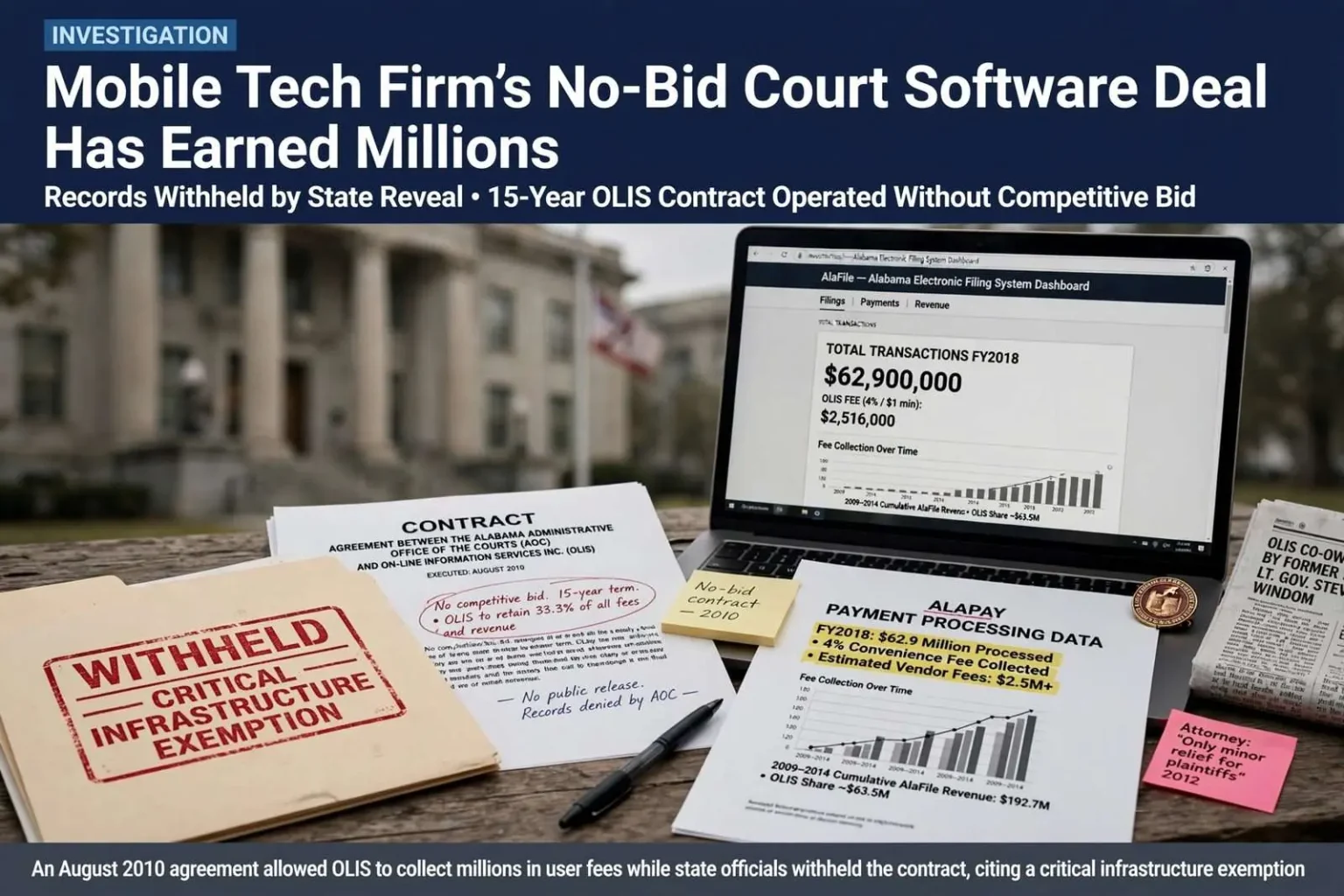
A Mobile-based technology company holding a 15-year contract to run Alabama’s electronic court filing system has collected tens of millions of dollars through the arrangement, according to an analysis of the underlying contract and related public records — a contract state officials initially refused to release.
When asked last month for a copy of the agreement between the Alabama Administrative Office of the Courts (AOC) and On-Line Information Services Inc. (OLIS), the state agency declined, citing an exemption in Alabama’s Open Records Act for information related to “critical infrastructure.” That refusal stood in contrast to how other states have handled similar requests. West Virginia readily produced its own contract with OLIS for a similar system, while Florida and Texas voluntarily post their e-filing contracts online for anyone to review.
The Alabama contract eventually surfaced anyway. It had been filed as an exhibit in a 2012 civil lawsuit against OLIS, and an attorney involved in that litigation provided a copy. The lawsuit, brought by Kevin Geeslin, challenged “convenience fees” OLIS charged court users beyond the fees set by state law, arguing the surcharges amounted to an illegal tax. A separate federal lawsuit filed the same year raised a civil rights challenge to the same fees. Both cases were ultimately dismissed with what Birmingham attorney Daniel Evans, who was involved in the litigation, described as “only minor relief” for the plaintiffs.
OLIS is co-owned by Neal Buchman, Steven Olensky and former Alabama Lieutenant Governor Steve Windom. The company’s software underpins the state’s statewide e-filing system, which digitizes court records, case data and filing procedures for courts across Alabama, including those serving Mobile, Baldwin and other South Alabama counties.
Evans said the contract, signed in August 2010, was never put out to competitive bid — a point he noted runs contrary to a public statement Windom made in August. Instead, the agreement was awarded after a multiyear pilot project involving only a handful of Alabama counties. The contract language itself reflects that history: it notes OLIS and AOC had been jointly developing the e-filing system since January 2004, and states that by the time of signing there was “no other vendor of software programming services that could duplicate the services provided to the AOC by OLIS without seriously disrupting the operation of the critical, essential services” the system provides to Alabama’s Unified Judicial System and the public.
Windom, whose wife Mary Windom sits as an associate justice on the Alabama Court of Criminal Appeals, ran unsuccessfully for governor in 2002. During that campaign, he pledged in one advertisement to “stop the crooked no-bid contracts” in state government. Windom has acknowledged that OLIS has done business with the state since 1998 — the same year he was elected lieutenant governor. He is also a partner in a law firm registered to lobby on behalf of Alabama Power, Johnson & Johnson, Blue Cross and Blue Shield of Alabama, UAB Health, USA Health, Volkert and OLIS itself, among other clients.
The financial terms embedded in the Alabama contract appear considerably more favorable to OLIS than similar arrangements the company has struck elsewhere. A 2012 report in Crain’s Chicago Business described a comparable OLIS contract with the courts in Cook County, Illinois, where the company was found to be the only qualified vendor after seven firms responded to a formal request for qualifications following a pilot project. Under that arrangement, OLIS charges a flat $4.95 fee per document filed, keeping one-third for itself and passing two-thirds to Cook County.
In Alabama, while the AOC receives the underlying e-filing system at no direct cost, the contract allows OLIS to collect a “convenience charge” of 4 percent, or a minimum of $1 per transaction, on court-ordered payments processed through a companion payment system called AlaPay. According to AOC’s most recent annual report, covering fiscal year 2018, more than $62.9 million moved through AlaPay that year alone — meaning OLIS would have earned at least $2.5 million in fees from that single year’s transactions. The contract further entitles OLIS to retain 33.3 percent of all fees and revenue collected from authorized users, special authorized users, bulk-data customers and web-services customers, with limited exceptions for certain programming and imaging fees.
The scale of those percentages becomes clearer when applied to the state’s e-filing platform, AlaFile, which allows attorneys and litigants across Alabama to file court documents electronically rather than in person. AOC reported in 2014 that cumulative AlaFile revenue had reached more than $192.7 million since the system’s launch. Applying the contract’s 33.3 percent split to that figure suggests OLIS may have retained as much as $63.5 million between 2009 and 2014 alone, leaving roughly $127.1 million for the state during that period. Revenue from bulk data sales and document images, which the contract treats separately, is not itemized in AOC’s public reporting, and neither OLIS nor AOC responded to requests for a further breakdown.
The contract does include some provisions that favor the state. It acknowledges that during the companies’ earlier working relationship, OLIS had been permitted to develop additional subscriber services — including tools known as Attorney Tracker, Name Tracker and Case Monitor — that generated revenue OLIS did not have to share with AOC. Under the 2010 agreement, AOC negotiated a stake in that revenue stream going forward, with OLIS retaining a $70,000 monthly baseline reflecting its prior six-month average earnings from those products, plus an additional 33.3 percent of any revenue above that baseline. Separately, the state established up to 1,500 special user accounts for the Alabama Department of Human Resources, with AOC collecting the associated revenue; OLIS agreed to waive its usual split on those accounts up to $1.68 million annually.
The critical infrastructure exemption AOC cited in declining to release the contract is defined under federal law to cover “systems and assets, whether physical or virtual, so vital to the United States that the incapacity or destruction of such systems and assets would have a debilitating impact on security, national economic security, national public health or safety.” Nothing in the substance of the OLIS-AOC agreement appears to fit that definition, raising questions about how broadly Alabama agencies are applying open-records exemptions intended for matters of national security. Alabama’s Open Records Act allows agencies to withhold critical infrastructure information only where disclosure “could reasonably be expected to be detrimental to the public safety or welfare” or would otherwise harm the public interest — a standard that a routine vendor services contract would not typically be expected to meet.
The law behind the records dispute
The exemption AOC relied on is written into Alabama’s Open Records Act, which lets agencies withhold security-related records, including information about critical infrastructure, when disclosure could reasonably be expected to harm public safety or welfare. The act borrows its definition of critical infrastructure from federal law, 42 U.S.C. 5195c(e), a provision enacted in 2001 as part of the USA PATRIOT Act.
The Administrative Office of Courts is the administrative arm of Alabama’s Unified Judicial System. It operates under the chief justice of the Alabama Supreme Court, who serves as the system’s administrative head and appoints the AOC director.