Mobile 911 Director McNichol Suspended 90 Days Without Pay After Daphne DUI Arrest
The Mobile County Communications District board voted 6-1 to suspend 911 director Charlie McNichol for 90 days without pay after his DUI arrest in Daphne, also revoking his county vehicle privileges and a prior pay raise.
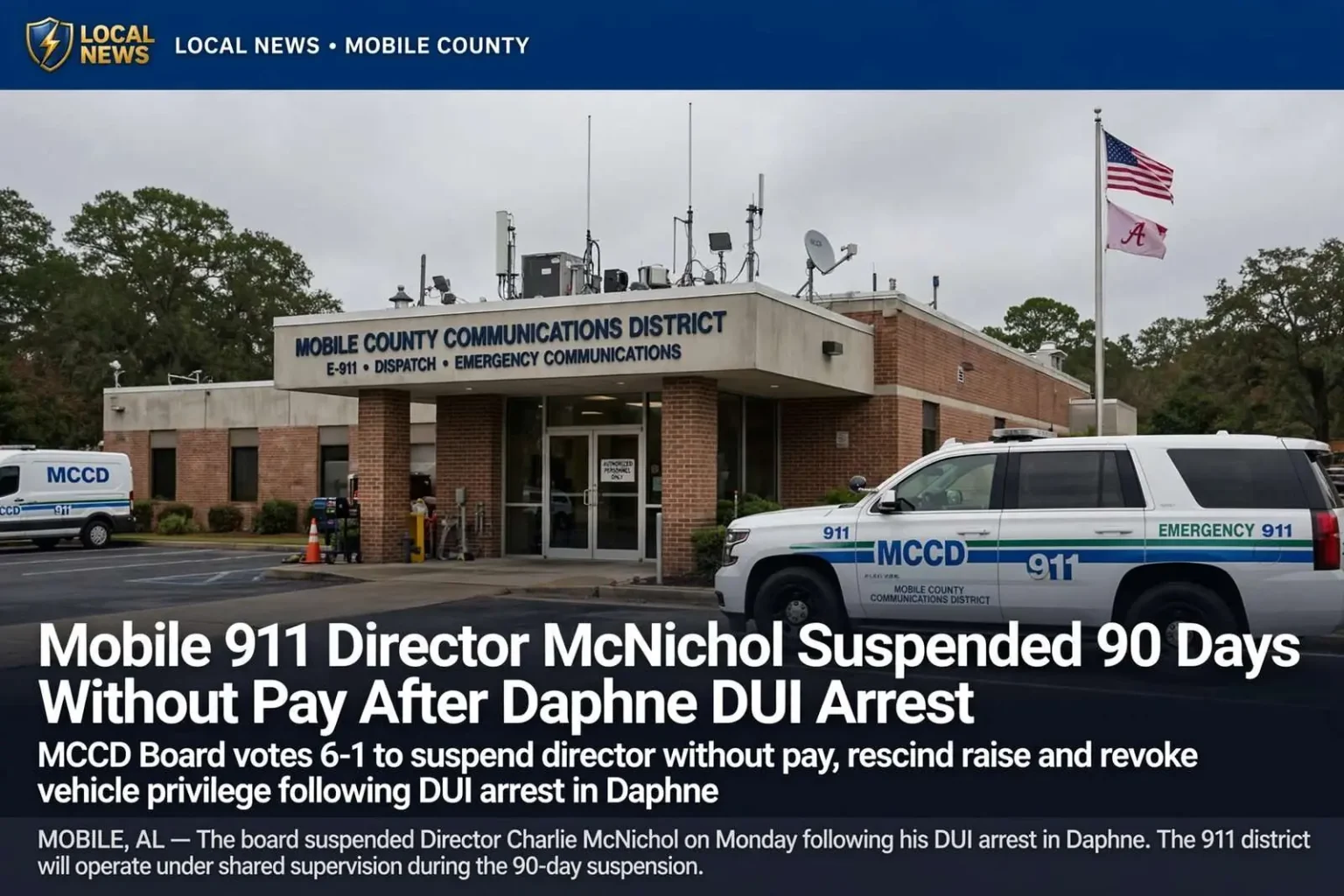
The director who oversees Mobile County’s 911 dispatch system has been suspended for 90 days without pay following his arrest last month on a DUI charge in Daphne, the Mobile County Communications District’s governing board decided this week.
The MCCD board of directors handed down the discipline against Director Charlie McNichol after a hearing held Monday. Assistant Mobile Police Chief Roy Hodge, who chairs the MCCD board, said McNichol will forfeit pay for the full three-month suspension. Board members also rescinded a pay raise McNichol had received the previous year, pulling it back for a one-year period, and stripped him of the privilege of driving a district-owned vehicle.
“We took the vehicle off the table and absolved ourselves of that liability,” Hodge said of the board’s decision. The vote was 6-1, with member Cynthia Coleman casting the lone dissenting vote.
Board members said the MCCD’s internal rules call for any employee facing a similar charge to go through a comparable disciplinary hearing, though in most cases the director himself would typically preside. The irony of that arrangement — the district’s chief administrator facing the district’s own disciplinary machinery, with himself recused — was not lost on the board, which sat in judgment of the man who ordinarily signs its employment actions.
With McNichol sidelined, his responsibilities have been divided between two other MCCD employees while the suspension plays out. The district’s operations — radio maintenance, staffing the county’s emergency call centers, technology contracts and the budget that funds them — continue under that shared supervision, and the board said it expects no interruption in dispatch services across the county.
The arrest
The more recent arrest happened in Daphne, where police say officers found McNichol asleep behind the wheel of his district-issued vehicle. The detail transformed an embarrassment into a liability question for the district itself: the car belongs to the public, insures against the public’s risk, and was found in the control of its director under circumstances that ended in a DUI charge.
For a district whose entire mission is emergency response, a DUI in a district vehicle carries a weight beyond the ordinary personnel matter. The board’s answer — removing the vehicle privilege entirely — was framed by Hodge not as punishment alone but as risk management, an acknowledgment that the district could not leave a district-owned car in the hands of a director facing the charge.
A pattern, not an incident
The arrest marks the second alcohol-related incident involving McNichol in roughly two years. In 2019, he pleaded guilty to public intoxication in Spanish Fort after his county-issued vehicle was found stopped along a local highway. That conviction was later waived after he paid court costs, completed a DUI awareness class and stayed free of further charges through last spring.
Following that earlier arrest, the MCCD board had suspended his vehicle privileges for 60 days. The episode and its resolution — a charge that disappeared with compliance, a two-month restriction on driving, and continued tenure — now read as the prelude to this week’s heavier sanction.
Hodge drew a distinction between the two cases. “It was a different situation with a public intoxication charge,” he said. The contrast the board adopted was practical: a public-intoxication plea, however embarrassing, did not involve the operation of a vehicle; a DUI charge involving a district-owned car does. The second offense changed the arithmetic of both the discipline and the risk.
The board’s decision to rescind the pay raise adds a financial dimension that outlasts the suspension itself. Pulling back a raise for a one-year period means McNichol’s compensation will remain frozen even after he returns to work, an ongoing reminder of the board’s displeasure and a signal to the district’s staff that the sanction did not end when the suspension does.
What the MCCD does
The Mobile County Communications District operates the county’s E-911 system — the network that answers every emergency call made from a landline or cell phone across Mobile County and dispatches police, fire and medical responders. It is funded largely by telephone service fees collected on every line in the county, and it operates under a board drawn from the region’s law enforcement and municipal leadership, which is why an assistant police chief chairs it.
The director’s job is technical and political at once. He administers contracts for radio systems, computer-aided dispatch, address mapping and the telephone network itself; he manages a staff of call-takers and dispatchers working around the clock; and he answers to a board of police chiefs, fire officials, county and municipal representatives who watch the district’s budget closely because it is paid for by every phone customer in the county.
McNichol’s tenure has spanned the district’s modernization — the transitions that put accurate mapping, location technology and interoperable radio under every responder’s belt. District staff have continued that work under the shared leadership arrangement, and board members took care to separate the institution’s operations from its director’s personal conduct.
The dissent and the deliberation
The 6-1 vote suggests the package was debated before it was adopted. Cynthia Coleman’s dissent, the only one, marked the board as not unanimous — whether out of a judgment that the discipline was too light, too heavy, or that the process itself was flawed, she did not say in the board’s public account of the meeting.
What the board did say, through Hodge, was that the hearing followed the district’s own rules. The distinction matters legally: a public district that disciplines a director outside its written personnel policy invites appeal, and the MCCD’s careful framing — a hearing held under rules that would apply to any employee, with the director recused from presiding over his own case — is the posture that protects the action in court.
The structure of the discipline itself is worth noting for its layering. Ninety days without pay addresses the immediate offense. The rescinded raise extends the financial consequence a full year. The permanent-in-effect removal of the vehicle addresses the specific risk that made the case public. Each piece maps to a different problem, and together they reflect a board that treated the matter as both a personnel case and a public-trust issue.
The wider stakes for 911 governance
E-911 districts across Alabama operate in a quiet but essential corner of public life, and their directors rarely make news. When one does, the scrutiny lands on governance: who oversees the district, how its fees are spent, and whether its leadership is held to the same standards it would apply to any employee.
The Daphne arrest will also prompt the district’s member agencies to look at their own policies. Vehicle assignment — take-home cars, directors’ driving privileges, trip tracking — is one of the most common soft spots in public-agency management, and the MCCD’s answer, revoking the privilege outright, is the remedy most boards eventually reach after a first or second incident.
For McNichol, the suspension and its conditions leave a path back: serve the ninety days, return under a frozen salary, and operate the district without a district vehicle. Whether his standing on the board survives the DUI case’s resolution in the municipal court in Daphne is the open question. The criminal charge remains pending, and a conviction — or a plea with the terms his 2019 Spanish Fort case carried — would arrive before the board’s next evaluation cycle.
The district’s board membership itself explains the tone of the decision. With seats held by representatives of the county government, Mobile’s municipal police departments and the region’s fire services, the MCCD board brings together the very agencies whose dispatchers answer to the district. An assistant police chief chairing the panel that disciplines the district’s director is the structure working as designed — oversight by the users of the system, not by a detached board of appointees.
What comes next for the district
The ninety-day clock gives the board a defined window to evaluate the arrangement. If the two employees sharing McNichol’s duties manage the district’s operations smoothly, the board will have learned something about the institution’s depth beyond its director — and if strains appear in dispatch staffing, radio maintenance or the contract calendar, the shared-supervision experiment will end with the suspension itself.
The criminal case runs on its own schedule. DUI charges in Baldwin County’s municipal courts typically move from arraignment through disposition within a few months, and the outcome will shape the board’s next review of the director’s status. The 2019 precedent — a waived conviction conditioned on classes, costs and clean behavior — exists as both a template and a warning; the board’s heavier discipline this week signals that a second pass through that template would not carry the same leniency.
For now, Mobile County’s 911 center answers the calls as it always has, under two acting supervisors and a board that has made its judgment plain. The county’s emergency dispatch system, funded by every phone line from Citronelle to Dauphin Island, runs on the work of dozens of employees — and, this summer, on a board’s willingness to discipline its own director by the same rules he administers.