Mobile County 911 Director Pleads Guilty to Public Intoxication in Spanish Fort Case
Mobile County 911 Director Charlie McNichol pleaded guilty to public intoxication in Spanish Fort Municipal Court, nearly a year after his 2018 arrest, under a deal that could see the charge dismissed next spring.
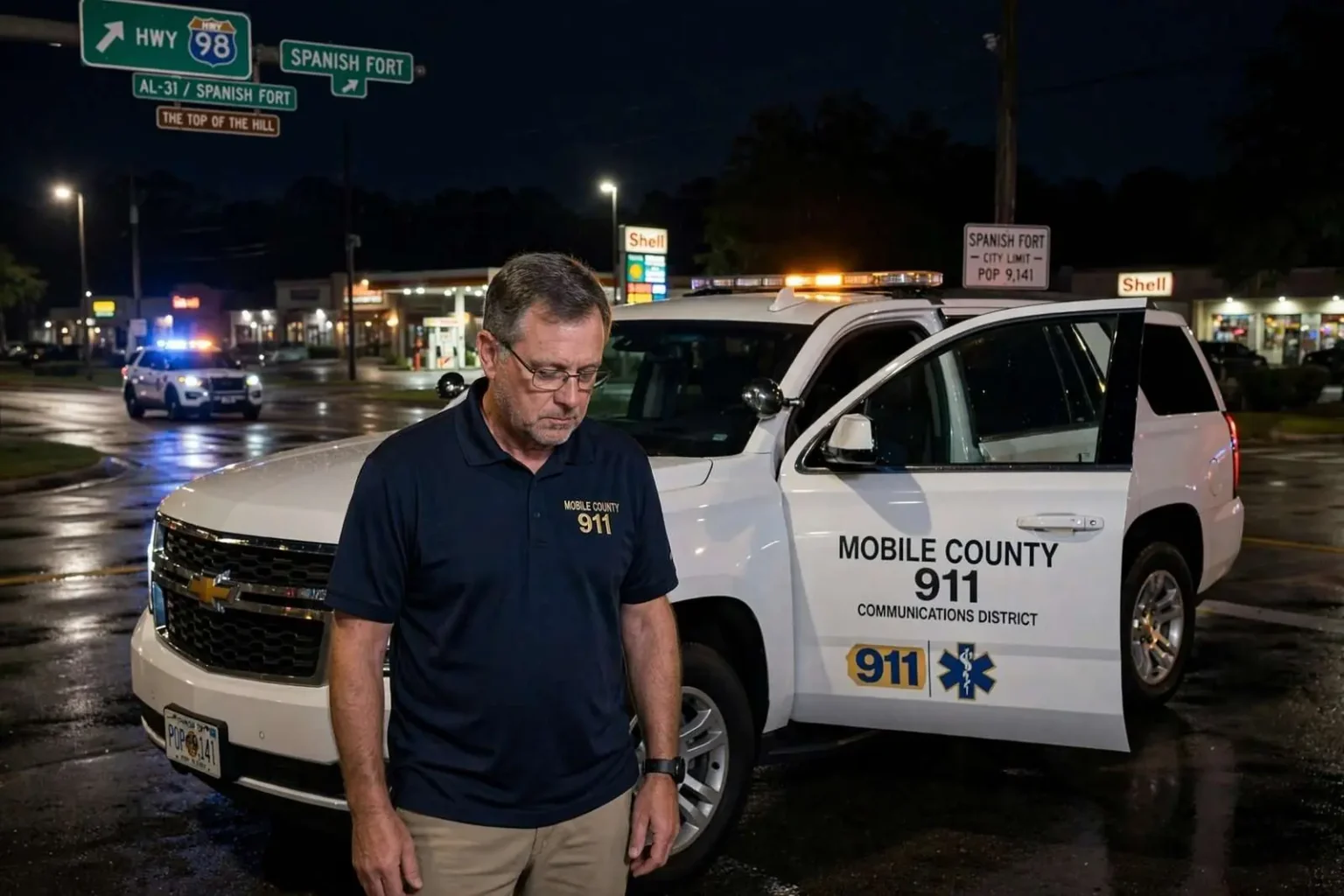
Mobile County 911 Director Charlie McNichol pleaded guilty to a misdemeanor public intoxication charge last week, closing out a nearly yearlong court process tied to his arrest in Spanish Fort in the fall of 2018. McNichol entered the plea Sept. 26 in Spanish Fort Municipal Court, nearly a year after he was found in a 911 Board-owned Chevrolet SUV stopped at the intersection of highways 98 and 31, an area residents commonly call “the top of the hill,” around 12:35 a.m. on Oct. 12, 2018.
McNichol was seated in the driver’s seat when Spanish Fort police approached the vehicle, though he has said in the past that he was asleep and not driving at the time. The distinction mattered in how the case was charged. Being behind the wheel of a running or positioned vehicle at night drew the attention of officers on patrol; the eventual charge, public intoxication, is a misdemeanor that does not require proof of driving, and it became the count McNichol answered for. The scene itself was an ordinary one for the location: the high ground where U.S. 98 and Alabama 31 meet on the Eastern Shore, a crossroads that anchors the northern edge of Spanish Fort’s commercial district and stays busy with late traffic between Daphne, Malbis and I-10.
The case moved slowly through the court system, in part because Spanish Fort, like many small Baldwin County municipalities, holds municipal court only once a month at its community center. Proceedings that might otherwise have concluded by early this year instead stretched on for months, with multiple continuances granted along the way, some just hours ahead of a scheduled hearing.
That pace is familiar to anyone who follows the small municipal courts scattered across Baldwin County. Cities such as Spanish Fort, Loxley, Robertsdale and Summerdale do not maintain full-time courtrooms; docket days roll around monthly, and any continuance pushes a case another four weeks or more. A request granted at one hearing can add a season to a misdemeanor file, and several stacked together can add a year. That is what happened here — a simple misdemeanor outliving every other development in the story, while the defendant’s public role kept him in the news between hearings.
Court Clerk Twila Pierce signaled last month that patience for further delays had run out, telling those involved in the case that no additional continuances would be granted. When McNichol finally appeared before Judge Derek Rose, he pleaded guilty to the public intoxication charge. Rose ordered him to pay court costs and complete a Level II DUI class, a requirement McNichol said he had already fulfilled ahead of the hearing.
The sentence, and what it requires
Level II classes are typically longer and geared toward repeat DUI offenders, though court records do not show any prior DUI-related incidents involving McNichol. The state’s DUI education framework runs from shorter Level I sessions to the more demanding Level II curriculum, which stretches over weeks and covers the physiology of impairment, the consequences of repeat offenses and the habits required to stay sober behind the wheel. Judges sometimes assign the longer course in borderline cases as a preventive measure, particularly when the underlying events involved a vehicle, even without a driving conviction.
McNichol’s completion of the class before his hearing meant the only remaining obligation was the payment of court costs. A guilty plea to a misdemeanor public intoxication charge carries no jail time in a first-offense resolution of this kind, but it does leave a record, and for a public official whose work depends on credibility with police, fire and emergency medical agencies across two counties, the reputational weight of the case outlasted the legal one.
A career built around emergency response
McNichol brings a lengthy career in law enforcement to his current post overseeing the Mobile County Communications District. He previously served as an assistant chief with the Daphne Police Department and later worked as a law enforcement coordinator in the office of then-U.S. Attorney for the Southern District of Alabama David York. That career gave him experience on both sides of the 911 line — as the officer responding to calls in one of Baldwin County’s Eastern Shore cities, and as a federal-coordination figure working between local agencies and the U.S. attorney’s office in Mobile.
The Mobile County Communications District is the public agency that answers and dispatches emergency calls for most of Mobile County outside the city limits of Mobile itself. Its center takes the calls that come in from unincorporated communities, small municipalities and the highways of the county, then routes police, fire and medical responders to them. The director’s job is part management and part diplomacy: the district is funded through the 911 fees collected on telephone lines across the county, governed by a board representing the jurisdictions it serves, and judged by the public on the one thing that matters — whether a call for help gets answered fast and dispatched right.
Those demands make the director’s conduct outside the center a matter of legitimate public interest, and the fact that the SUV involved in the Spanish Fort case belonged to the 911 Board kept the story alive through the year of continuances. McNichol has said he was asleep in the vehicle rather than driving it, and the guilty plea to public intoxication — not to any driving offense — is consistent with that account. Still, a board-owned vehicle at the center of a late-night arrest is the kind of detail that does not fade quickly in the agencies and municipalities the district answers to.
What the case means for the district
The district’s board has continued its work through the proceedings, and the day-to-day operation of the 911 center — call taking, dispatch, radio maintenance and the ongoing modernization of the county’s emergency communications — has moved forward under the leadership structure already in place. Alabama’s 911 districts operate under state law that creates regional boards, levies the service charges that fund them and sets standards for the technology they run, from address databases to the radio systems that tie together every police, fire and EMS agency in the county.
Modernization never stops in that world. Text-to-911 capability, location-accurate wireless calls and interoperable radio channels are permanent projects for districts like Mobile County’s, and the director is the public face of that work when city councils, volunteer fire departments and county commissioners ask why a radio does not reach a fire station or why a transfer to another agency takes precious seconds. It is exactly the kind of portfolio in which a director’s personal standing with the region’s police chiefs matters, which is why the resolution of the Spanish Fort case was watched quietly but closely across both counties.
The plea closes the legal chapter with a modest sentence — costs and a class already completed — and leaves the professional judgment about McNichol’s future where it has been all along, with the board that employs him. Public agencies in Alabama have no uniform rule for how a director’s misdemeanor should be treated; the decision rests with local officials, and the communications district’s governing board is the body positioned to weigh the guilty plea against a career spent inside the emergency response network it oversees.
Spanish Fort and the slow machinery of small-city courts
The setting of the case says something about how justice moves in Baldwin County’s smaller cities. Spanish Fort sits on the east bluff above Mobile Bay, wedged between Daphne to the south and Malbis to the north, and it has grown from a quiet suburb into a retail and dining hub that serves the entire Eastern Shore. Its police department patrols a city that more than doubles in population by day, as shoppers and commuters move along U.S. 98 and the highways that converge at the top of the hill.
A city of that size still runs its court the traditional way: one session a month, in the community center, with a municipal judge hearing the accumulated misdemeanor docket. The system keeps costs low for a city that cannot justify a full-time courthouse, but it makes every continuance expensive in calendar time. Court clerks such as Twila Pierce manage the docket and, as this case showed, eventually draw the line when repeated rescheduling threatens to turn a monthly court into a rolling one.
For defendants, the lesson of the yearlong process is practical: a misdemeanor in a small Baldwin County municipal court can follow you far longer than its sentence would suggest. For the agencies watching the McNichol case, the outcome was straightforward — a plea, a fine-level cost order, a completed class, and a director whose job now depends less on the courthouse in Spanish Fort than on the performance of the 911 center he runs. The file is closed; the scrutiny, as always in public safety work, is not.
Across Alabama, emergency communications districts operate under the same basic structure the Mobile County district follows: a regional board appointed by the jurisdictions it serves, a dedicated funding stream from telephone service charges, and a director accountable for everything from staffing the center around the clock to negotiating the shared radio network that links agencies in a storm. Directors in those districts are rarely household names, but they answer to every police chief, fire chief and EMS supervisor in their county, which is why a yearlong misdemeanor case involving one of them drew quiet attention from counterparts across the region. The resolution — a plea, costs, and a completed class — leaves the professional question to the board, and the operational question to the center’s own performance.