

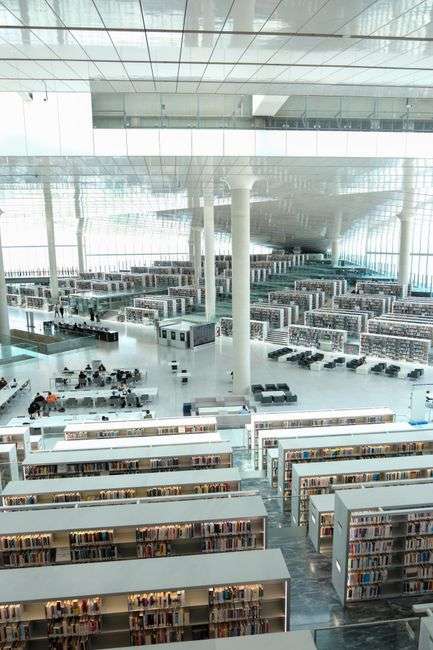
FOLEY, Ala. — The City of Foley’s new public library will officially open to the public on Tuesday, August 4, with a ribbon-cutting ceremony at 10 a.m. marking the debut of a facility twice the size of the one it replaces. The opening caps a construction project that city leaders have framed as a generational investment, giving one of Baldwin County’s fastest-growing cities a civic building sized for the population it now serves rather than the one it served decades ago.
The new 40,000-square-foot library, located at 230 E. Orange Avenue, replaces the city’s 1984-era building at 319 East Laurel Avenue, which closed to the public July 13 to allow crews to complete the move. Moving a public library is a logistical undertaking that involves transporting thousands of volumes, furniture, computers and the behind-the-scenes systems that track it all, and the temporary closure allowed staff to stage the new building without serving patrons in the middle of the disruption.
Digital services remained available throughout the transition, and patrons were able to continue requesting items from other Baldwin County libraries for pickup at designated locations. The book drop at the former East Laurel Avenue site stayed open throughout the closure so patrons could return materials at any time. The continuity reflects how library service has changed since the current building opened: a modern library system’s digital catalog, e-books and interlibrary network keep functioning even when the physical doors are shut.
City officials have said the roughly $20 million project is intended to serve Foley for decades to come. “This new facility is much more than just a library — it is a community center designed to serve our residents for the next several decades,” city officials said. The framing captures how public libraries have evolved from book warehouses into multipurpose civic buildings, and the Foley project was designed around that broader mission from the start.
A bigger home for a growing city
Foley has grown from a small railroad and farm town into one of the centers of Baldwin County’s rapid expansion, drawing new residents with its location between Mobile Bay and the beach communities to the south. Growth of that kind puts pressure on public facilities of every kind, and the city’s library, opened in the mid-1980s, had long since been overtaken by the population it serves. The new building’s place on East Orange Avenue keeps the library in the heart of the city’s downtown grid rather than relegating it to an outparcel.
The library’s role in a growing city extends beyond circulation numbers. It functions as a de facto community living room, a study hall for students, a meeting place for civic groups and a cooling refuge in the summer heat. Communities across Baldwin County have made similar calculations about their public buildings as subdivisions multiply, and Foley’s decision to double its library space is part of that regional pattern of public investment chasing growth.
What’s inside the new building
The two-story building includes a STEAM/STEM Learning Lab dedicated to science, technology, engineering, arts and math programming, along with the Foley Woman’s Club Sensory Nook, a specially designed calming space for visitors. The learning lab gives the library a classroom-grade space for the hands-on programming that has become a core library service, from coding clubs to summer science activities, while the sensory nook reflects a newer understanding of accessibility, offering visitors who need a quieter environment a designed space to regroup.
The facility also features an auditorium and multipurpose room that seats 277 people, additional study rooms, and dedicated activity areas for children and teens. Meeting space of that size makes the library viable as a venue for public meetings, author talks, performances and community classes that the old building could never accommodate. Study rooms answer the daily demand from students and remote workers for private space, a service that has become one of the most-used features of modern libraries.
A second-story porch overlooks the Perry Wilbourne Antique Rose Trail and the city’s dog park, tying the building into the network of public spaces that surrounds it. The porch is a design gesture as much as an amenity, positioning the library as part of Foley’s walkable public realm rather than an isolated building. The rose trail, a signature Foley attraction, runs nearby and connects the library grounds to the city’s broader system of parks and trails.
Opening day programming
Following the ribbon-cutting, the library will host a scavenger hunt raffle and a bookmark contest running from 10 a.m. to 5 p.m. Special children’s activities, including pop-up story time and crafts, are planned for 11 a.m., 1 p.m. and 3 p.m. in the new Children’s Story Grove, and kids can also visit the Maker Meadow for additional hands-on craft activities. The programming is designed to introduce families to the building’s new spaces by putting them to work on opening day itself.
Opening-day events serve a practical purpose beyond celebration. A library that wants residents to adopt new habits needs to get them in the door, and a day of structured activities for children brings in the families who will become the building’s most reliable users. Staff also use the occasion to walk patrons through new systems, from self-checkout to the layout of collections that have been arranged differently than in the old building.
What happens to the old building
Once the move is complete, the city plans to renovate the former East Laurel Avenue building to serve as Foley’s new municipal Senior Center and administrative offices, expanding the range of services available to residents at that location. The plan keeps the old library in public use rather than leaving it vacant, and it pairs two services, senior programs and city administration, that draw regular visits from residents. The reuse also preserves a building that has been part of downtown Foley’s civic life for decades.
For the library staff who made the move, the opening ends a period of operating out of boxes and borrowed pickup points. Patrons returning materials at the East Laurel book drop during the closure were keeping faith with a service that was temporarily in transit, and the August 4 ribbon-cutting marks the point where that patience pays off. City officials expect the new building to anchor downtown’s civic core for the next several decades, much as the 1984 building did for the ones before it.
Foley’s identity as a library city has deep roots. The city’s first library efforts predate the 1984 building by many decades, beginning as small reading rooms sustained by civic clubs and volunteers before growing into a municipal service. That history of community-sourced support shows up in the new building itself, where the Foley Woman’s Club’s sponsorship of the Sensory Nook continues a tradition of local organizations funding pieces of the library that municipal budgets alone might not cover.
The city’s connection to the Antique Rose Trail also reflects Foley’s distinctive heritage as a center of the commercial rose industry in the early twentieth century, when local growers shipped blooms across the country by rail. The trail’s antique varieties commemorate that history, and the view of it from the library’s second-story porch stitches the new building into a story about the city that long predates anyone now serving on its council.
Baldwin County’s library systems operate as a cooperative network, allowing patrons to request materials from member libraries across the county and pick them up where it is convenient. That structure was what kept service running during the Foley closure, with requests routed to other pickup points while the new building was being fitted out. For residents, the episode demonstrated a benefit of the cooperative model that usually operates invisibly: the collection they depend on is larger than any single building.
The STEAM learning lab represents where library programming has been heading nationwide. Libraries have taken on the role of informal classrooms for skills that schools and families cannot always provide, from robotics workshops to crafting circles, and the spaces to support those programs have followed. A purpose-built lab lets Foley schedule regular programming rather than converting meeting rooms for each activity, which typically expands the calendar a library can offer.
The auditorium’s 277-seat capacity also positions the library as a venue for civic life in a way the old building could not match. Public forums, candidate events, school performances and cultural programs need space, and communities that lack it see those events drift to private venues. Giving the city a public hall attached to its library concentrates civic activity downtown and gives the building a second identity as Foley’s gathering place.
Parents and caregivers in a growing city feel the library’s absence most acutely during closures, since children’s programming is often the service families use most. The Story Grove and Maker Meadow spaces answer demand that the old building met in cramped quarters, and the pop-up story times on opening day are a template for the regular schedule that will follow. Library staff typically spend the weeks after a major opening recalibrating programs to the new spaces’ capacity.
The senior center conversion also addresses a demographic reality in Baldwin County, where retirees make up a large share of new arrivals. Senior centers provide meals, exercise, social programming and access to services that help older residents remain independent and connected, and demand grows alongside the population. Pairing that mission with administrative offices in a renovated downtown building keeps both services within walking distance of Foley’s residential core.
City officials describe the project’s cost and timeline as investments with a horizon measured in decades, the way communities once measured commitments to schools and courthouses. The test of that ambition will be measured over the years ahead in visitation, programming and the building’s ability to absorb the county’s continued growth. For now, the August 4 opening gives Foley what growing cities across the region are seeking: public space built for the population that exists, not the one that has already moved on.