

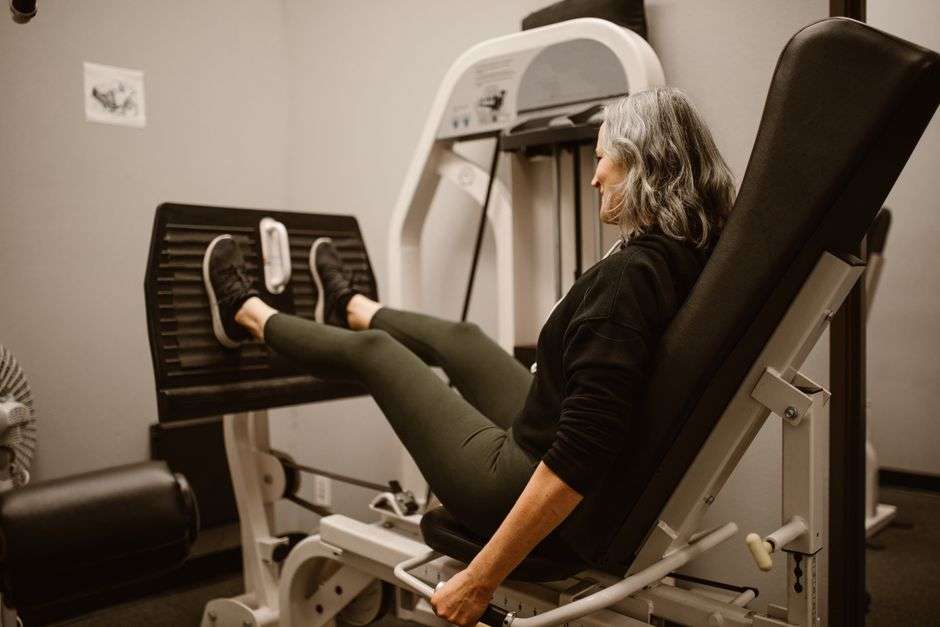
Tucked into a Fairhope retail strip is a fitness studio where nobody runs, nobody lifts a dumbbell and nobody breaks a sweat — and where a 70-year-old grandmother and a college linebacker can stand side by side, both pushing against machines that are quietly rebuilding their bones.
That is the OsteoStrong paradox. The Fairhope center, owned by Josh Fandrich, is one of roughly 170 centers in the United States and part of a franchise footprint that now stretches across 13 countries. Its members — about 360 of them in Fairhope, ranging from osteoporosis patients to high-performance athletes — come once a week for sessions that last minutes, not hours, and are built entirely around a single physiological threshold.
The 4.2 number that changes everything
The science the studio is built on comes down to a discovery about how bones grow. After about age 30, adults lose between one and three percent of their bone mass every year unless something intervenes. Bone is living tissue that replaces itself constantly — the entire skeleton is renewed every seven to ten years — but aging bodies stop triggering that replacement at full strength because everyday life no longer loads the skeleton hard enough to force it.
Researchers identified the threshold in 2015: unless a weight-bearing load reaches at least 4.2 multiples of body weight, the body’s osteogenic response — the signal that tells bone to grow denser — simply never fires. Ordinary exercise almost never gets there. For most adults, safely applying more than four times their body weight to their own skeleton in a gym setting is not realistic.
That is the problem OsteoStrong’s machines were engineered to solve. The spectrum system behind them, developed by Dr. John Jaquish, uses positions and leverage that allow a member to generate enormous forces safely — in a static, controlled posture, with a coach standing by — while monitors chart the load on the bones in real time.
A weekly session, machine by machine
A visit starts on the vibration plate: five minutes standing on a low-humming platform that stimulates circulation, fires the stabilizer muscles used for balance, helps move lymphatic fluid and preps the body for what comes next.
Then come the four core machines — upper growth, lower growth, postural and core — each targeting a different axis of the skeleton. A staff coach positions the member and coaches maximal effort: push as hard as physically possible against an immovable resistance. Because the movement is static and self-limiting, there is no momentum, no dropped weight and no joint strain. The screen records the peak force.
Members tend to get competitive with themselves. One longtime Fairhope member, a retiree who joined to fight osteoporosis, has pressed 14 times her body weight on the lower-body machine — more than three times the 4.2 threshold — and reports a 120 percent strength gain over a year of weekly visits. The studio’s point is not that everyone reaches those numbers; it is that almost everyone crosses their own growth trigger, which is the part that matters.
The recovery menu
After the loading circuit, members can choose from a lineup of recovery modalities. The BioCharger, built on a platform traced to the inventions of Nikola Tesla and Royal Rife, combines voltage, electromagnetism, light frequencies and harmonic sound in a 10-minute session aimed at cellular energy. Red-light therapy, a technology with roots in NASA research, delivers the two wavelengths of natural sunlight the body uses for collagen production and skin health; near-infrared light penetrates deeper tissue to support mitochondrial energy production. PEMF mats use pulsed electromagnetic fields for relaxation, pain management and circulation. Aqua massage tables and Normatec compression systems round out the menu, flushing lactic acid and easing inflammation.
None of it requires sweating, changing clothes or a shower afterward — a point the staff makes often, because the studio’s business model is built around people who have tried and abandoned traditional gyms, or who never joined one in the first place.
The owner’s long road to Fairhope
Fandrich’s own path to the franchise ran through the military and corporate sales. An athlete who once planned a career in sports medicine, he spent nine years on active duty in the Air Force, including a special-duty assignment in presidential security at Andrews Air Force Base during the Clinton administration. He then spent 17 years in farming sales.
In 2012 he opened one of the first OsteoStrong centers, in Huntsville. When the company launched its global franchise program in 2014, he left sales, moved to Fairhope and opened the local center in 2016. A Mobile location followed in 2020, and he has plans to expand toward Gulf Shores in the coming years. His manager, Jeana Owens, works alongside him and has become one of the studio’s most knowledgeable guides for new members.
Fandrich says the industry he joined — “biohacking,” the umbrella term for technology-driven wellness — is now the fastest-growing segment of the fitness world, outpacing traditional gym memberships because it promises measurable outcomes with minimal time investment. His pitch to skeptical visitors is simple: skeletal strength is the foundation everything else rests on. If bones, muscles and posture are not in order, energy, balance and organ function eventually follow them down.
Who it’s for
The Fairhope membership roster tells the story better than any brochure. Members fighting osteoporosis and osteopenia train beside athletes chasing performance gains, both using the same machines and the same principle: controlled, massive loading triggers adaptation. Post-menopausal women — the demographic most at risk of the fractures that change lives — sit in the same weekly schedule as teenagers recovering from sports injuries.
The center offers free consultations for anyone curious, and staff encourage people to track their own numbers across visits, because the numbers tend to tell the story on their own. The claims that matter to members are the ones they can see on the screen: forces they could not safely generate anywhere else, recorded in real time, week after week.
For a Gulf Coast population that skews retirement-age and counts bone health among its most serious medical concerns, a studio that can trigger bone growth in a sweat-free, twenty-minute session has found its market. The Fairhope center’s growth — from a gamble in 2016 to a second city in 2020 — suggests the coast agrees.