Operation Clean Sweep heads to Irvington Dec. 5 for Mobile County’s last fall cleanup
Mobile County residents can bring one load of unwanted items to the Irvington site at 7105 Half Mile Road on Dec. 5, the final fall drop-off day, from 7 a.m. to 1:30 p.m.
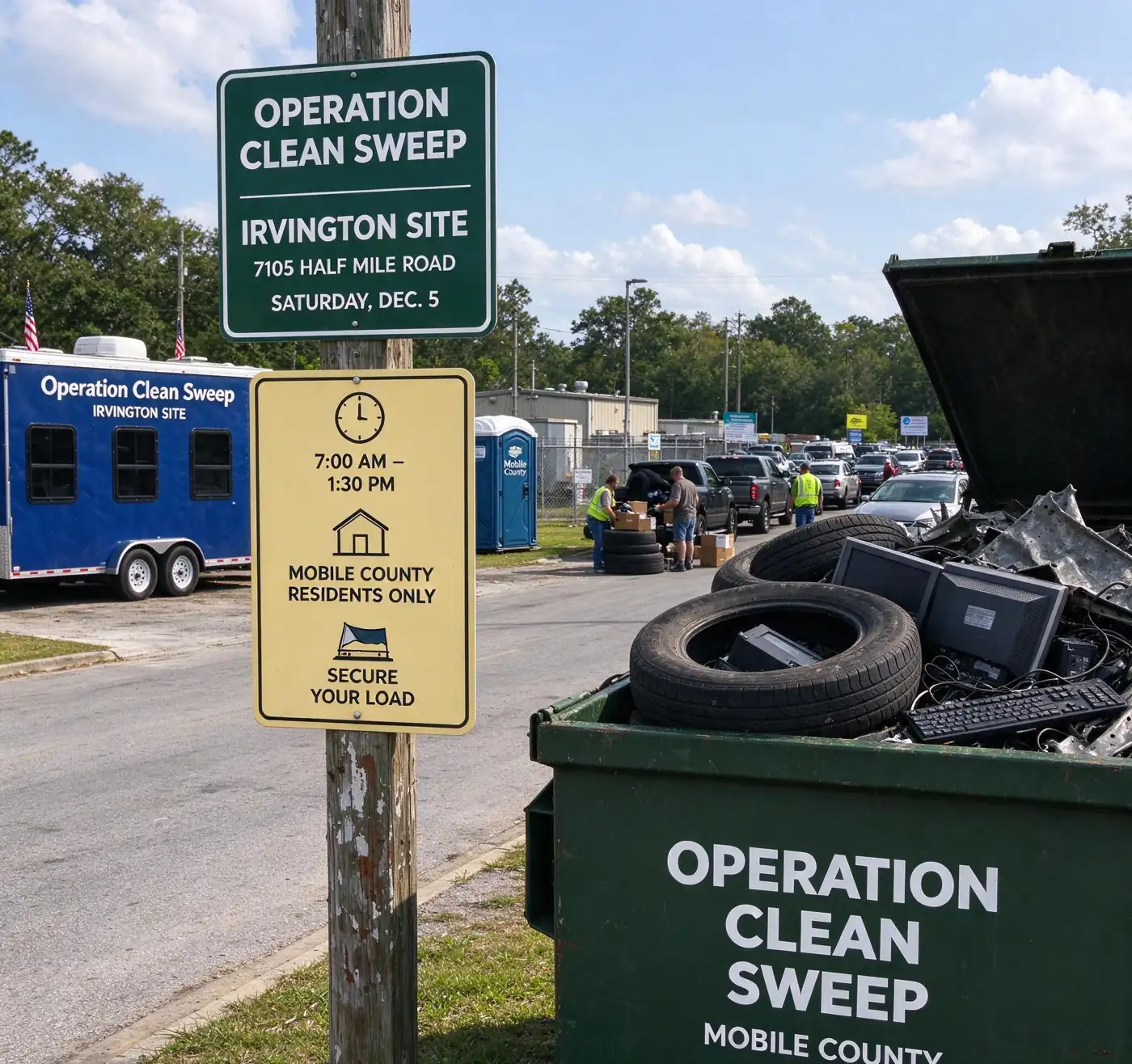
IRVINGTON, Ala. — Mobile County households hoping to clear out old tires, outdated electronics or a pile of scrap metal before the holidays have one more opportunity this fall. Operation Clean Sweep, the county’s drop-off disposal program, closes out its fall season on Saturday, Dec. 5, at the Irvington site at 7105 Half Mile Road.
Drop-off hours are set for 7 a.m. to 1:30 p.m. The county said the program exists to give residents a responsible way to part with unwanted items and materials that might otherwise end up somewhere they do not belong.
Because the Irvington stop is the last event of the fall schedule, residents who have been putting off a garage, shed or yard cleanup may want to mark their calendars now. Knowing the rules ahead of time can make the difference between a quick unload and a wasted trip.
Operation Clean Sweep at a glance
- What: Mobile County’s final Operation Clean Sweep disposal event of the fall season
- When: Saturday, Dec. 5, from 7 a.m. to 1:30 p.m.
- Where: 7105 Half Mile Road, Irvington
- Who may participate: Mobile County residents who can show proof of residency
- Limit: a single load for each household
- Turned away: hazardous waste, dump trailers and any business
- Sent for recycling: tires, electronics and scrap metal
- Before you drive: tie down the load with netting, bungee cords or a tarp
Who can drop off and what has to stay home
The program is designed for households rather than commercial operations. Anyone arriving with a load must be able to show that they live in Mobile County, and each household is allowed just one load.
The county has also drawn firm lines around what it will not take. Businesses may not participate, dump trailers are not permitted, and hazardous waste is off the table entirely.
Residency is usually demonstrated at events like this with a document that shows a person’s name and local address, such as a driver’s license or a recent utility bill. Since the county has not spelled out which documents it will accept, bringing more than one form is a sensible precaution.
Household hazardous waste, as the U.S. Environmental Protection Agency describes it in general terms, covers leftover products that can be toxic, flammable, corrosive or reactive. Common examples include many paints and solvents, pesticides, pool chemicals, motor oil and other automotive fluids, and some cleaning products.
Those materials can injure workers, contaminate other waste and create fire risks, which is why collection programs often handle them separately or exclude them. Residents holding such products should ask Mobile County or their city government about proper disposal options instead of tucking them into a Clean Sweep load.
A simple way to spot many hazardous products is to read the label. The EPA’s general guidance notes that signal words such as danger, warning or caution, along with directions about ventilation, protective gear or keeping the product away from heat, are good clues that an item needs special handling.
The county has not published an item-by-item list of everything it will accept at the Irvington event beyond the materials it highlights for recycling. Residents planning to bring anything unusual, such as old furniture or appliances, should confirm with the county first rather than assume.
Anyone unsure whether a particular item qualifies should contact the county before heading out. A quick phone call can save a long drive, especially for residents coming from the far corners of a county that stretches from the Mississippi line to Mobile Bay.
Where the tires, electronics and metal end up
One of the strongest arguments for using the program is what happens after the truck is unloaded. The county said tires, electronics and scrap metal gathered at Operation Clean Sweep events are recycled, while the other materials it accepts are disposed of properly.
Recycling tires keeps them out of landfills and away from roadsides and empty lots, where abandoned tires are a familiar sight in many communities. Tires left outdoors also trap rainwater, and the Centers for Disease Control and Prevention has long pointed to water-holding containers such as old tires as places where mosquitoes breed.
Electronics generally contain a mix of plastics, glass and metals. Older devices, particularly tube-style televisions and monitors, can contain lead, while many gadgets also hold recoverable materials such as copper. Sending them to a recycler rather than a ditch or burn pile helps keep those substances out of soil and water.
Scrap metal is among the most widely recycled materials in the country. Steel and aluminum can be melted down and reused many times, which reduces the need to mine and process new raw materials.
Why responsible disposal matters on the Gulf Coast
Mobile County leaders have framed Operation Clean Sweep as a weapon against illegal dumping. By giving residents a legitimate destination for bulky or awkward items, the events aim to keep trash from piling up along county roads and drifting into local waterways.
That second goal carries extra weight in a county laced with rivers, bayous and creeks that ultimately drain toward Mobile Bay and the Gulf. Debris left along a rural road can be washed by heavy rain into ditches and streams, eventually reaching waters that support fishing, seafood harvesting and recreation.
Illegal dumping also costs taxpayers. When furniture, tires or appliances are abandoned on public land or along a right of way, government crews generally have to spend time and money hauling them off, and an untouched pile can invite even more dumping.
Litter that reaches the water causes its own set of problems. Federal marine scientists have documented for years that wildlife such as sea turtles, birds and fish can become tangled in debris or mistake small pieces of plastic for food, and trash that breaks apart can linger in the environment for a very long time.
Irvington, an unincorporated community in southwest Mobile County, gives residents on the south end of the county a nearby place to unload. People traveling from other areas should plan their route and timing with the 1:30 p.m. closing in mind.
Getting your load ready before you leave
The county is asking every participant to secure the load before pulling out of the driveway. Netting, bungee cords or a tarp can all keep items in place, protecting other motorists and preventing the cargo from scattering along the road on the way to the drop-off.
Unsecured loads are a recognized highway hazard nationwide. The AAA Foundation for Traffic Safety has studied crashes involving debris on the road and has found that many of them trace back to items falling from vehicles that were not properly tied down.
A few general practices can help any load arrive intact.
- Put heavier pieces, such as metal and tires, on the bottom and toward the front of the cargo area.
- Cover lightweight material completely so wind cannot get underneath and lift it out.
- Tug on every strap or cord before leaving, and pull over to recheck after the first few miles.
- Avoid stacking items higher than the sides of the truck bed whenever possible.
- Drive at a moderate speed and leave extra following distance, since a loaded vehicle takes longer to stop.
Sorting before you leave can help too. Grouping tires, electronics and metal together may make unloading faster for you and for the crews working the event.
Tips for a smoother morning at the drop-off
Disposal days like this one can draw steady traffic, particularly when they are the last chance of a season. A little planning can keep the visit short and safe.
- Have your proof of residency within easy reach before you pull in.
- Give yourself plenty of time, and do not wait until the final minutes before 1:30 p.m.
- Wear sturdy gloves and closed-toe shoes if you will be handling sharp metal or heavy items.
- Follow the directions of event workers on where to park and unload.
- Bring water and patience, especially if several neighbors had the same idea.
Remember that the one-load limit applies to the whole household. Families sharing an address should coordinate so everything goes in the same trip.
It also helps to take a few minutes the night before to walk through the garage, shed and yard with a checklist. Deciding in advance what goes and what stays, and loading the vehicle while it is still light out, can keep the morning from turning into a scramble.
Anyone planning to haul items on behalf of an elderly relative or a neighbor should check with the county ahead of time about how the residency requirement and the one-load limit apply in that situation, so there are no surprises on event day.
If Dec. 5 does not work for you
Because Irvington is the final stop of the fall Operation Clean Sweep season, residents who cannot make it will need to look ahead to future dates or turn to other disposal options. Mobile County can answer questions about upcoming events and about alternatives for bulky items.
In the meantime, some general options exist for specific items. Tire dealers often take old tires when installing new ones, sometimes for a small fee, and some electronics retailers and manufacturers run take-back programs for used devices.
Whatever route residents choose, the goal is the same one the county has stressed: getting unwanted items to a proper destination instead of the roadside. A cleaner driveway before the holidays is a bonus.