Pensacola Bay Bridge reopening will bring roundabout delays, mayor says
The Pensacola Bay Bridge is set to reopen the week of May 31, but a north-end roundabout won't be done until July, prompting traffic warnings from the.
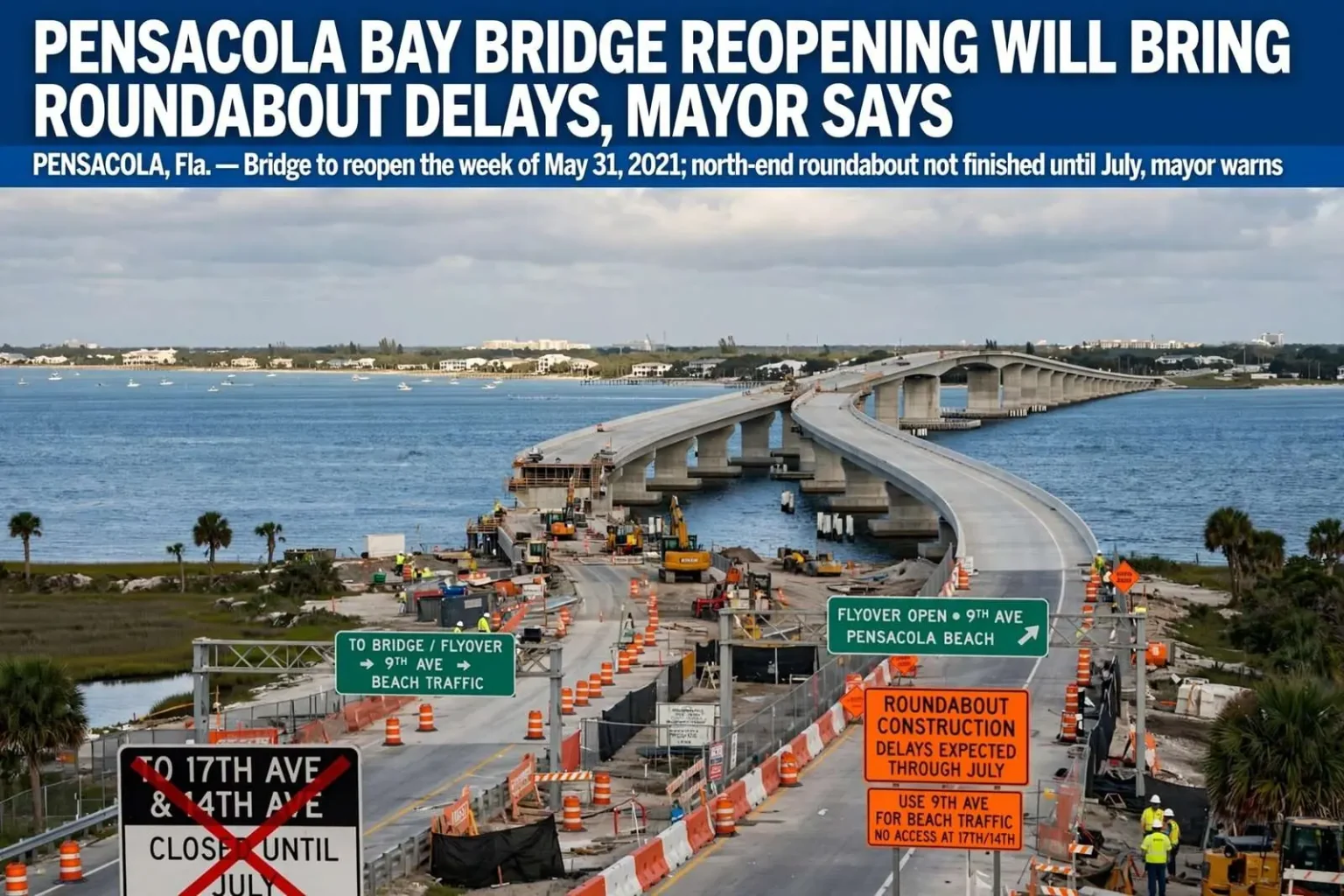
PENSACOLA, Fla. — The Pensacola Bay Bridge is expected to reopen the week of May 31, 2021, but drivers should brace for lingering traffic headaches because a key roundabout at the north end will not be finished until July, Mayor Grover Robinson said. By the time the bridge reopens, the flyover is expected to be complete, allowing motorists who exit the bridge to take 17th Avenue.
The bridge — the region’s principal crossing between Pensacola and Gulf Breeze — had been closed to traffic since damage from Hurricane Sally in September 2020 severed the link that carries tens of thousands of crossings a day. Its closure reshaped daily life on both sides of the bay: commuters added hour-long detours around the north end of the bay, businesses in Gulf Breeze lost their Pensacola customer base, and the Garcon Point Bridge to the east absorbed traffic volumes it was never designed to carry at no charge.
The reopening, then, will mark the end of the region’s most disruptive infrastructure problem since the hurricane. But the mayor’s caution about the north-end roundabout signals that the return to normal will be staged rather than sudden, with the intersection work lagging weeks behind the bridge itself.
The Roundabout Problem
The roundabout, however, is not scheduled for completion until July. “We’re going to be asking that you try to access the bridge if you’re going to the beach, once it opens, that you go 9th Avenue,” Robinson said. “That’s basically the discussion. We don’t want people going 17th and we don’t want them going 14th because of the speed of the cars coming off. It’s going to be almost impossible to cross.”
The mayor’s warning reflects the geometry of the bridge’s Pensacola landfall. The structure delivers vehicles into a corridor where 17th Avenue and 14th Avenue cross beneath or beside the approach, and until the roundabout regulating those movements is finished, drivers pouring off the bridge will meet those crossings at speed. Directing beach-bound traffic to the 9th Avenue approach — where the new flyover provides a cleaner path — is the city’s attempt to route visitors around the unfinished intersection entirely.
For local drivers used to crossing under the bridge approach on 17th or 14th, the mayor’s advice amounted to a request for patience measured in weeks: treat the crossings as effectively closed, use the alternate streets, and let the roundabout work proceed without conflicts between construction traffic and commuter shortcuts.
Progress at the Bridge Itself
In an update, the Florida Department of Transportation said contractors have completed demolition and pile driving at pier 70 on the Pensacola Bay Bridge and are preparing the site for placement of the new trophy piece. The targeted reopening remains the week of May 31, 2021.
Pier 70 became the emblem of the bridge’s troubles after Hurricane Sally’s surge knocked bridge segments from their supports, and the demolition and re-pile driving completed there represented the last major structural reset on the span. The “trophy piece” — the signature girder section topping the bridge’s navigation channel — returns the crossing’s defining silhouette to the skyline and signals that the remaining work is assembly and finishing rather than foundation.
FDOT is also improving the detour route on State Road 281 in Santa Rosa County by extending the southbound right-turn lane at U.S. 98 and installing a temporary traffic signal on Garcon Point Road by Monday, April 5. The agency said multiple crews are working around the clock, with the full project anticipated for completion in January 2022.
Those detour improvements address the other side of the bay’s traffic problem. State Road 281, the Avalon Boulevard corridor that feeds the Garcon Point Bridge, has carried the displaced commuter load for months, and the turn-lane extension and temporary signal are aimed at the intersection where congestion has been most punishing — particularly in the afternoon rush when Gulf Breeze and Pensacola-bound traffic converges at U.S. 98.
The Detour Economics
Motorists are urged to keep using available detour routes, which include the Garcon Point Bridge and State Road 87. Tolls on the Garcon Point Bridge are suspended through Friday, April 9, 2021. Commuters can also ride the Escambia County Area Transit (ECAT) temporary bus route between Pensacola and Gulf Breeze free of charge.
The toll suspension has been the detour’s one bright spot. The Garcon Point crossing, ordinarily a tolled facility east of the closed bridge, became the region’s free work-around — an unusual arrangement that shifted what would have been millions of dollars in crossing fees onto the detour’s users in the form of time and fuel. Extending the suspension through April 9 kept that relief in place while the bridge work entered its final phase.
Life on the Detour
The months of detour driving have reshaped routines across the two-county region. Commuters who once crossed the bay in minutes learned to budget an hour or more around Garcon Point and Avalon Boulevard, and businesses on both sides adapted — Gulf Breeze restaurants and shops lost walk-in traffic from Pensacola, while detour-corridor gas stations and quick-service spots saw volumes they had never experienced.
The free ECAT bus route between Pensacola and Gulf Breeze offered an alternative for riders who work on the opposite side of the bay, removing both the toll and the fuel cost from the daily trip. Transit connections like this one typically appear after disasters — the route was put in place after the bridge closed — and their ridership often reveals demand that outlasts the emergency.
State Road 87, the north-south route through Santa Rosa County, has served as the rural alternative for drivers willing to add distance to avoid the Garcon Point corridor’s crush. Together, the three routes formed the region’s improvised circulatory system while its main artery waited on the repair yard.
What Happens After Reopening
Even after traffic returns to the bridge the week of May 31, the project itself will not be finished. The full repair is anticipated for completion in January 2022, with the north-end roundabout and remaining finishing work extending into the second half of 2021. Drivers should expect the transition period to feel more like a new traffic pattern than a restoration of the old one: the 9th Avenue approach for beach traffic, the crossings at 17th and 14th restricted until the roundabout opens, and construction activity continuing along the approach roads.
For the mayors and county commissioners on both sides of the bay, the reopening date carries political weight alongside its practical importance. Robinson has used his regular updates to press the case that the region’s recovery from Sally runs through the bridge, and each announcement of progress — pier 70’s rebuilt foundation, the flyover’s completion, the roundabout’s July target — marks a milepost on the way back to a normal connection between Pensacola and its eastern neighbor.
Until then, the region’s advice to itself is the one the mayor repeated: use the detours, use the free bus, approach from 9th Avenue once the span opens — and give the crews working around the clock the room they need to finish what the hurricane broke.
Why This Bridge Matters So Much
The Pensacola Bay Bridge is more than a commuting link. Opened in its current form in 2010 after its predecessor was retired, the crossing carries U.S. 98 between Pensacola and Gulf Breeze and funnels the bulk of the region’s beach traffic toward Pensacola Beach. On a summer weekend, the span’s approach roads carry the visitors whose spending sustains the island’s tourism economy — which is why the closure was measured not just in commute times but in the health of the region’s signature industry.
Its loss also severed the natural connection between two communities that function as one. Gulf Breeze residents work in Pensacola hospitals, schools and offices; Pensacolians own boats at Gulf Breeze marinas and shop on its side of the bay. The detour kept those ties alive at great cost, and every week of the closure was a week of added miles, added fuel and added frustration for tens of thousands of households.
The rebuilt span also matters as a resilience project. Sally’s damage showed how a single storm can cut a region’s only practical bay crossing in a matter of hours, and the repair — with redesigned elements replacing what failed — is intended to make the structure better able to survive the next hurricane season that comes its way.
The Weeks Ahead
The sequence officials have laid out runs in stages. In the immediate weeks, the detour improvements on State Road 281 — the turn-lane extension and the temporary signal due by Monday, April 5 — take pressure off the routes carrying today’s traffic. Tolls on the Garcon Point Bridge stay suspended through Friday, April 9, keeping the work-around free a few weeks longer. Around the end of May, the bridge reopens and the traffic pattern inverts: the old detours empty out, the 9th Avenue approach carries the beach-bound load, and 17th and 14th Avenues sit out the summer while the roundabout is completed in July.
For drivers, the practical guidance is to recheck the route map at each stage rather than assuming the old habits apply. The crossing that reopens the week of May 31 will not be the crossing that closed in September — new approaches, a new roundabout under construction and new traffic assignments will govern until the full project wraps in January 2022.
What the region gets at the end is what it has been waiting for since the storm: its bay crossing back, its detour corridors relieved, and a restored connection between Pensacola and Gulf Breeze that the next storm will have to work much harder to break.