

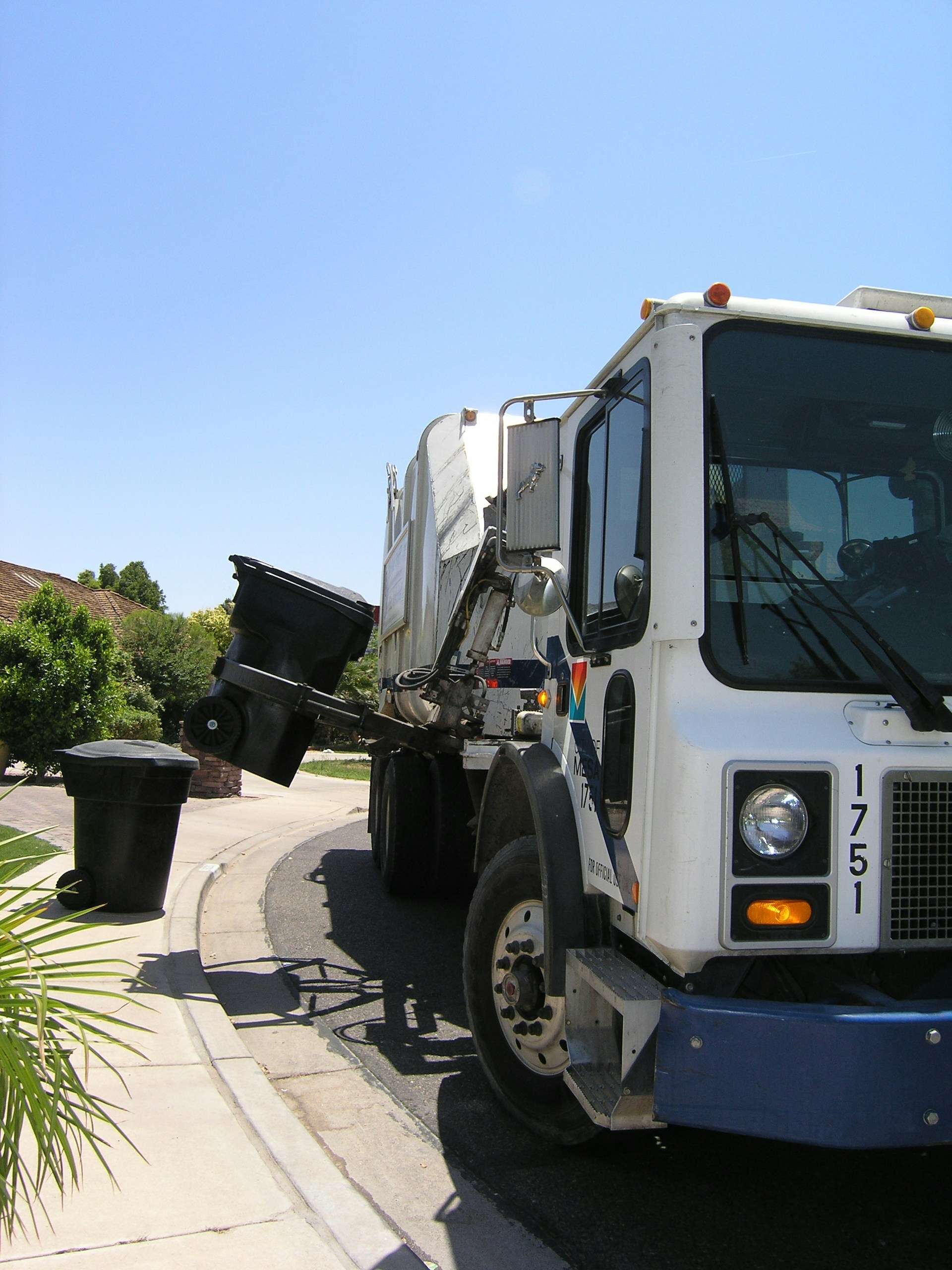
A City of Prichard sanitation employee was shot while on the job Tuesday afternoon and is expected to face multiple charges after authorities say he exchanged gunfire with another driver during a roadside altercation.
According to the Mobile County Sheriff’s Office, the incident happened near Dossett Lane and Jarrett Road around 2 p.m. Tuesday. Sheriff Paul Burch said sanitation worker Clifton Dubose, 54, allegedly used his city garbage truck to run a smaller vehicle carrying a man, woman and three children off the road. When the man and woman confronted Dubose on the roadside, a verbal argument ensued.
“Based on the investigative details we have right now, when the verbal argument ended, the male driver of the small vehicle was walking back toward his vehicle and the sanitation driver (Dubose) exited his vehicle and pointed a gun at the back of the male,” Burch said. “The female passenger got out of her vehicle and fired two shots, one striking the driver (Dubose).”
Dubose then allegedly opened fire on the couple, firing several rounds into their occupied vehicle. The three children were inside the vehicle at the time of the incident. No one else was injured.
Dubose remained hospitalized in stable condition and, upon release, was expected to be booked into Metro Jail on five counts of reckless endangerment and five counts of shooting into an occupied vehicle — one count for each person authorities say was placed at risk when the rounds went into the car with the family inside.
A shooting that reaches City Hall
The charges were only the beginning of the story’s reach into Prichard’s city government. Burch said Dubose’s driver’s license was either suspended or revoked at the time of the incident, and he was wanted on an outstanding domestic violence warrant — an issue that had previously come up at a Prichard City Council meeting on July 10 regarding city employees driving without valid licenses.
Prichard Mayor Carletta Davis initially confirmed only that an unidentified sanitation worker had been injured in an on-the-job shooting. “Our thoughts and prayers are with him and his loved ones as we pray for a full and speedy recovery,” Davis said.
The Sheriff’s Office said Wednesday that it had inaccurately reported the day before that Dubose’s driver’s license was suspended or revoked. A spokeswoman clarified that the license had actually expired in June 2023 and that Dubose appears not to have renewed it. It was not immediately clear how he continued to drive on an expired license; a city spokeswoman said each Prichard department conducts its own background checks, and the frequency of those checks may vary by department.
Mayor Davis said city policy prohibits non-police employees from carrying firearms while on the job, though she said she did not have further details about the incident. According to the Sheriff’s Office, Dubose has worked as a Prichard sanitation worker for more than five years. In addition to the charges stemming from Tuesday’s shooting, Dubose faces a third-degree domestic violence charge tied to a warrant issued in Chickasaw in November, stemming from an incident authorities say occurred on Christmas Eve 2024.
The liability question
Update: The road-rage shooting involving Prichard sanitation worker Clifton Dubose could become the city’s first civil lawsuit since Prichard’s municipal insurance lapsed on Aug. 1, according to the Mobile County Sheriff’s Office and a local personal injury attorney. Because the woman who exchanged gunfire with Dubose was defending herself and the vehicle she was in also carried a man and three small children, the family could have grounds to pursue a claim against the city over Dubose’s conduct while on the job.
Personal injury attorney Bill Eiland said the city remains financially liable for such claims even without an insurance policy in place. “Just because they don’t have any insurance doesn’t mean they don’t have to pay the claim,” Eiland said. He noted that without an insurance company to handle the claims process, the city itself will have to manage any resulting claims directly, which could complicate resolution.
Under Alabama law, municipal damages are capped at $100,000 per person and $300,000 per incident. Eiland recommended that drivers carry uninsured motorist coverage for situations like this one.
The distinction matters because the alleged conduct happened inside a city job. Dubose was behind the wheel of a Prichard sanitation truck on his collection route when, investigators say, he used the truck to force a family’s car off the road and then drew a weapon. Under Alabama’s municipal liability rules, a city answers for wrongful acts committed by employees acting within the line and scope of their duties — and driving a garbage truck is squarely within the line and scope of a sanitation worker’s duties. That legal thread runs directly from the shoulder of Dossett Lane to the city’s own accounts.
What the uninsured status changes is not who pays but how. An insured municipality typically hands a claim to a carrier, which investigates, negotiates and settles on the city’s behalf. A self-insured city must do all of that with its own staff and its own checkbook, against a backdrop in which Prichard — a small city in Mobile County that has weathered well-documented fiscal distress over the years — has limited room in its general fund for unexpected payouts. The $100,000-per-person cap limits the exposure of any single claim, but even capped judgments arrive as real money for a city of Prichard’s size.
The timing sharpened the problem. The insurance lapsed on Aug. 1, and the shooting occurred shortly afterward — meaning whatever claim emerges would arrive in the very window when the city had no carrier standing behind it. City officials had not publicly detailed the circumstances of the lapse or the timetable for restoring coverage.
What the criminal charges cover
The counts Dubose was expected to face track the people authorities say he endangered. Five counts of reckless endangerment correspond to the man, the woman and the three children in the small car; five counts of shooting into an occupied vehicle correspond to the same five occupants, reflecting Alabama’s treatment of gunfire directed at an occupied car as a serious felony regardless of whether anyone is struck. The third-degree domestic violence charge is separate, tied to the Chickasaw warrant issued in November over an incident from Christmas Eve 2024.
The outstanding warrant raised a second question for the city: how an employee wanted on a domestic violence charge kept driving a city truck. The July 10 council meeting had already put license problems among city employees on the public record before the shooting, and the disclosure that Dubose’s license had expired in June 2023 — more than a year before the incident — promised to keep the issue in front of the council. The city spokeswoman’s explanation, that each department runs its own background checks with varying frequency, effectively confirmed that there is no single uniform vetting schedule covering every employee who drives a city vehicle.
For the family in the car, the criminal case and the potential civil claim run on separate tracks with different purposes. The criminal charges, brought by the state, answer for what Dubose allegedly did; the potential civil claim, if the family pursues one, would answer for what it cost them. A woman who fired in self-defense, according to the sheriff’s own account, would not face charges; the investigation treated her two shots as a response to a gun pointed at the back of a man walking away.
Road rage on the collection route
The stretch of Dossett Lane and Jarrett Road where the confrontation unfolded sits in the kind of residential corner of Prichard where sanitation trucks work slowly and traffic is light — conditions that make an aggressive encounter between a garbage truck and a passenger car conspicuous rather than incidental. Road-rage escalations of this kind are rare on collection routes, where drivers repeat the same streets weekly, but the sheriff’s account describes an escalation that moved from driving to confrontation to gunfire in a matter of minutes.
The sequence, as Burch laid it out, is notable for what it says about who was retreating. After the verbal argument ended, the male driver was walking back toward his own vehicle when Dubose exited the truck and pointed a gun at his back, according to the sheriff. The woman’s two shots came next, one of them striking Dubose. Only after being hit, authorities say, did Dubose fire several rounds into the occupied vehicle with the children inside.
Self-defense claims in Alabama turn on whether a person reasonably believed deadly force was necessary to prevent death or serious injury, and the sheriff’s public account of a gun pointed at a retreating man’s back laid the groundwork for the family’s potential civil position: that the woman acted defensively and that the danger to everyone in the car — including the three children — originated with the city employee and the city truck.
Prichard’s wider exposure
The case lands on a city government already confronting uncomfortable questions. An employee with an expired license and an outstanding domestic violence warrant spent more than five years on the sanitation roster. A council meeting six weeks before the shooting had aired the license problem generally. A citywide firearms policy existed but apparently did not prevent a non-police employee from bringing a gun onto his route. And the insurance that would ordinarily cushion the city from the financial consequences had lapsed weeks earlier.
None of those facts determines guilt; Dubose is presumed innocent until charged and convicted, and the charges described were expected rather than filed on the day of the shooting. But they shape the civil landscape, because a negligence claim against the city does not require proving intent — only that the city failed to use reasonable care in hiring, supervising or equipping an employee whose conduct foreseeably harmed someone.
What residents can take from it
For drivers in Prichard and across Mobile County, the episode carries two practical lessons that local attorneys were quick to underline. The first is the value of uninsured motorist coverage, which Eiland recommended precisely for scenarios like this one — a collision or shooting involving a driver who cannot pay a judgment, including municipal drivers working for a city without insurance. Uninsured motorist coverage is not mandatory in Alabama, but insurers must offer it, and it can fill the gap between a capped municipal judgment and actual damages.
The second is the cap itself. Alabama’s $100,000-per-person, $300,000-per-incident limit on municipal damages means that even a fully successful claim by a family of five would be divided within a fixed ceiling, a reality that has drawn criticism from plaintiff lawyers for years and remains the law. Residents who find themselves on the wrong side of a city employee’s conduct should also understand the procedural hurdles: claims against municipalities in Alabama require advance written notice within a short statutory window, a step that can forfeit a claim entirely if missed.
The Sheriff’s Office continued to investigate, and the city had not said whether it would restore its insurance or change its background-check procedures. What began as a sanitation-route altercation on a Tuesday afternoon had, by week’s end, become a test of Prichard’s liability, its hiring oversight and its finances all at once.