Prichard Sought a Place in Gulf Coast Restoration Funding Decisions
In March 2018, Prichard leaders said the city had been left out of $315 million in Gulf Coast restoration awards and called for a fairer process.
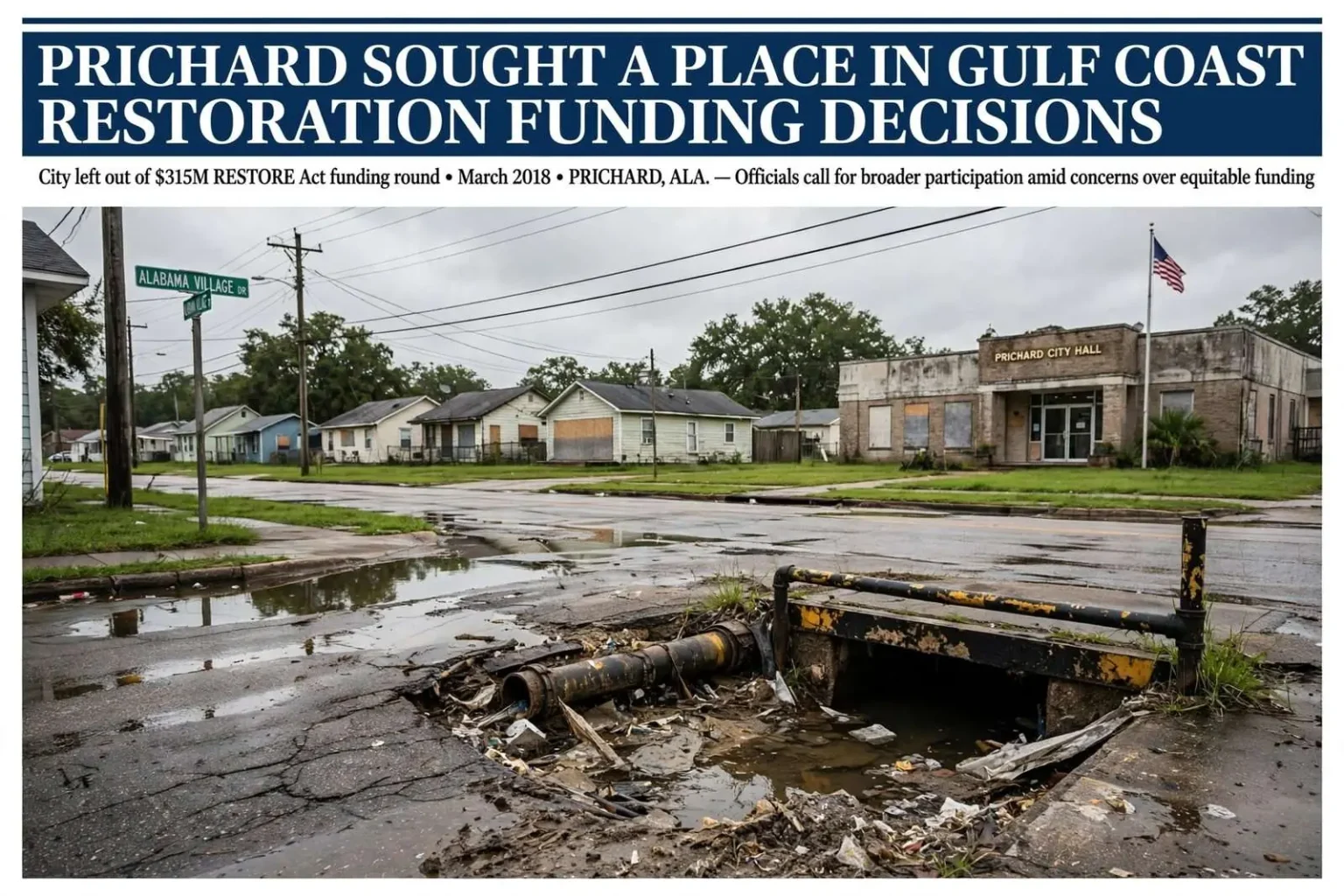
PRICHARD, Ala. — Prichard officials raised concerns in March 2018 after the city was not selected for funding in a major round of Alabama Gulf Coast restoration awards, reigniting a long-running question about how the region’s oil-spill money reaches its communities.
The Alabama Gulf Coast Recovery Council had announced $315 million for projects across the region — one of the largest single rounds of restoration funding allocated along the Gulf Coast since the disaster that created it. The funding stemmed from the federal RESTORE Act, created in the wake of the 2010 Deepwater Horizon oil spill, which directed penalty money from the disaster back to the Gulf states for economic and environmental recovery.
About $118 million was designated for projects in Baldwin County and about $161 million for projects in Mobile County. Prichard, the county’s second-largest city by population and one of its most economically distressed, came away from the round with none.
A call for broader participation
Mayor Jimmie Gardner said Prichard should have had a stronger voice in the process that selected projects. While he acknowledged Mobile’s central role in the regional economy, he argued that smaller municipalities also needed access to investment, particularly where they lacked the resources available to larger cities.
Gardner said a more inclusive approach could help communities address long-standing infrastructure and development needs rather than concentrating benefits in a limited number of places. His argument cut to the design of the RESTORE process itself: projects win funding through applications that require engineering studies, matching capacity and administrative staffing — resources a small city often struggles to assemble.
He also questioned why Prichard was not represented on the board responsible for choosing projects. The council that governs RESTORE spending allocates seats among the region’s counties, cities and state agencies, and Gardner’s objection highlighted a structural gap: a city of Prichard’s size could watch decisions about its own county’s money made around a table where it had no chair.
The mayor’s remarks placed Prichard alongside other smaller Gulf Coast municipalities that have pressed similar complaints since the RESTORE Act’s passage — that the funding formula, however well-intentioned, tends to reward the jurisdictions best equipped to pursue it.
Proposed Alabama Village improvements
One proposal submitted for Prichard would have directed about $15 million toward improvements in the Alabama Village area, a neighborhood in the city’s western reaches. The concept included work on culverts intended to improve storm drainage, new sidewalks and a plan to recruit a developer for housing and retail construction.
The proposal reflected the kinds of neighborhood-scale investments city leaders said could help Prichard strengthen basic infrastructure while supporting future redevelopment. Storm drainage in particular has been a chronic concern in the Alabama Village area, where aging culverts and low-lying streets have made heavy rain a recurring hazard for residents — the kind of unglamorous, foundational work that federal restoration money was designed, in part, to make possible.
The sidewalks component aimed at walkability and safety in a residential district where children walk to school along streets built without them, and the developer-recruitment plan would have used public infrastructure investment as a lever to draw private housing and retail construction — a sequence redevelopment planners describe as the standard playbook for reviving struggling neighborhoods.
None of those plans received funding in that round of awards. For Prichard’s leadership, the rejection was doubly frustrating: the city had done the work of drafting and submitting a comprehensive proposal, only to watch the round’s largest allocations flow to projects anchored in better-resourced communities.
The RESTORE Act and the Gulf Coast
The money at stake traces to one of the nation’s worst environmental disasters. The April 2010 Deepwater Horizon explosion and spill sent millions of barrels of oil into the Gulf of Mexico, closing fisheries, damaging coastlines and hammering the regional economy through months of closed waters. Congress answered in 2012 with the RESTORE Act, which dedicated the Clean Water Act penalties paid by BP to Gulf Coast recovery rather than the general treasury.
Alabama’s share flows through the Alabama Gulf Coast Recovery Council, which includes representatives of state government and the seven coastal counties — Baldwin and Mobile among them — and funds projects in categories set by the law: environmental restoration, economic recovery, infrastructure, tourism promotion and conservation. The council’s project selections are among the most consequential decisions made about the region’s public works, shaping which communities get dredged harbors, restored wetlands, new civic facilities and rebuilt streets.
Prichard’s position in the region
Prichard’s frustration carries particular weight given the city’s history. Once a booming industrial city whose shipyards and mills drew thousands of workers during World War II, Prichard spent the late 20th century losing population and tax base as industry departed, leaving a city with aging infrastructure, a strained budget and persistent fiscal stress — including a nationally noted pension crisis that ended in municipal bankruptcy in 2009.
Against that backdrop, a $15 million infusion for the Alabama Village area was never a minor ask. It represented, in city leaders’ framing, the kind of once-a-generation investment that could interrupt decades of decline: fix the drainage, build the sidewalks, and give a developer a reason to build. Gardner’s argument to the recovery council was that cities like Prichard — disproportionately affected by the spill’s economic fallout, and least equipped to self-fund recovery — were exactly who RESTORE money was meant to reach.
The March 2018 discussion underscored a continuing regional question following the BP oil spill: how restoration money should be divided among coastal communities with different populations, needs and capacity to advance large projects. Mobile County’s $161 million share dwarfed the sum any single small city could expect, but the distribution of those dollars among Mobile, Prichard, Chickasaw, Saraland, Satsuma, Citronelle and the county’s other municipalities remained contested terrain.
What comes next for the proposals
Rejection in one round does not end a RESTORE project’s life. Funds are allocated in multiple rounds over decades under the law’s structure, and cities that miss out are encouraged to refine proposals and resubmit. Prichard’s Alabama Village concept — drainage, sidewalks, developer recruitment — remained on the city’s planning agenda as future funding cycles approached, and Gardner continued to press the city’s case for a seat at the table.
The episode also became part of a broader civic conversation in Mobile County about equity in regional investment. Small-city mayors across the county have echoed Gardner’s argument in various forums: that the health of the metropolitan region depends on strengthening its struggling core cities, not only its booming suburbs and beachfront. RESTORE money, they argue, is the region’s best chance to fund that strengthening.
For now, the March 2018 round stands as a case study in the tension between competitive application processes and equitable regional distribution — a tension every Gulf Coast funding body has wrestled with since the RESTORE Act first began moving money to the coast. Prichard’s empty column in that round’s ledger was, for its mayor and residents, the most vivid possible illustration of what is at stake in how that tension gets resolved.
The council’s selection process is governed by the RESTORE Act’s funding components, and the round that drew Prichard’s concern was conducted under the pot that funds economic and infrastructure projects recommended by local governments. Project proposals are scored and vetted before the council votes, and the process, while public, rewards applicants with complete engineering documentation and financial plans — a standard that larger municipalities with professional planning staffs meet far more easily than small ones.
Gardner’s complaint about board representation speaks to that structural mismatch. If a city cannot assemble the staff to write competitive applications, and also has no vote on the body awarding the funds, its chances of capturing meaningful investment depend almost entirely on the goodwill of other jurisdictions. The mayor’s call was essentially for a second lever: either help smaller cities build capacity, or give them a voice proportional to their need.
The debate also carried a budget-year edge for Prichard, which funds basic services on one of the leanest municipal budgets in the county. Federal restoration money is among the few sources flexible enough to address the city’s combined needs — drainage, streets, housing and commercial redevelopment — in a single package, which is precisely how the Alabama Village proposal was built. Missing the round meant the city’s infrastructure calendar slipped at least another cycle, at a moment when storm events were already testing the neighborhood’s aging drainage.
City officials indicated the Alabama Village concept would be revised and resubmitted as future funding rounds opened, with the city seeking technical assistance to strengthen the application. The March 2018 outcome, in that sense, became both a setback and a lesson: in the RESTORE era, the Gulf Coast’s smaller cities are learning that access to the money now depends as much on administrative capacity as on need.