

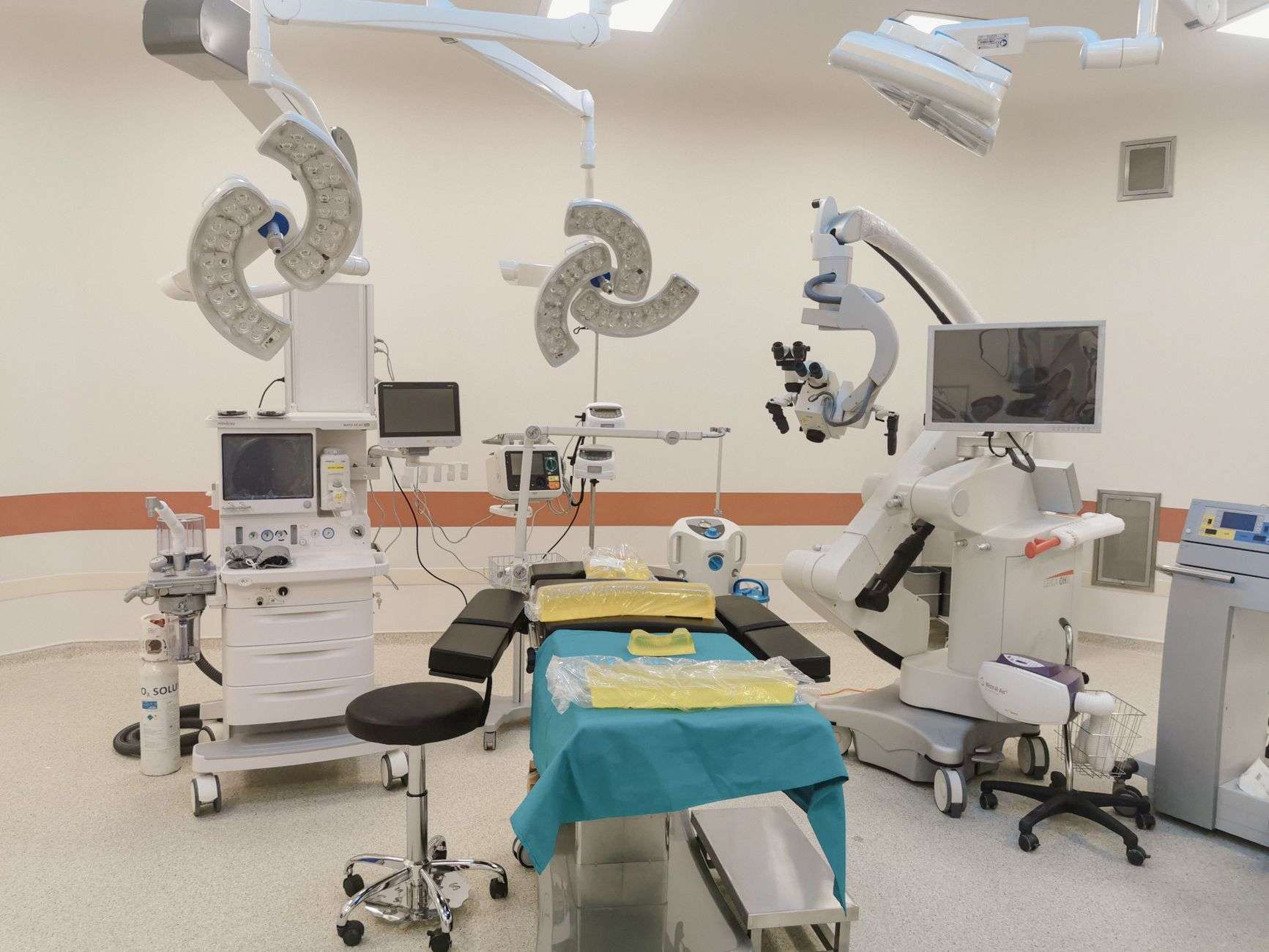
MOBILE, Ala. — The Da Vinci surgical system is driving a generational shift in how complex medical procedures are performed, according to medical specialists at Mobile Infirmary Hospital.
Dr. Isaac Payne, a colorectal surgeon, and Dr. Meg Heusser, a gynecologist, say the robotic-assisted technology provides surgical precision that was impossible just a few years ago.
“Though it’s not the robot operating on the patient, we, as the surgeon, are controlling the robot itself,” Payne said.
Rather than working autonomously, the system acts as a high-tech extension of the doctor. Operating from a console a few feet away from the patient, surgeons use a magnified, high-definition 3D view and articulating instruments that allow for finer movements than the human hand alone. The console translates the surgeon’s hand motions into smaller, steadier movements inside the patient’s body, while the system filters out natural hand tremor — a capability that changes the calculus in the tight anatomical spaces where colorectal and gynecologic procedures take place.
“Patients are leaving the hospital in a much shorter time,” Payne said. “Surgical site infection rates are significantly decreased. Pain after surgery is significantly decreased — that’s a big advantage of minimally invasive surgery versus open surgery.”
How the Technology Works
The Da Vinci system’s advantages begin with what the surgeon can see. The magnified 3D view offers depth perception and detail that traditional laparoscopic monitors — with their two-dimensional images and long, rigid instruments — struggle to match. Where standard minimally invasive surgery relies on instruments that pivot at the abdominal wall and offer limited articulation, the robotic platform’s wristed instruments bend and rotate far beyond the range of the human wrist.
That combination matters most in procedures that demand dissection around delicate structures. In colorectal surgery, the operative field sits deep in the pelvis and abdomen, surrounded by blood vessels, nerves and organs where millimeters matter. In gynecologic surgery, the uterus, ovaries and fallopian tubes sit in similarly crowded territory. Finer instruments, steadier motion and a better view mean surgeons can remove tissue precisely while sparing healthy structure around it.
Because the procedures are minimally invasive, patients avoid the large incisions of traditional open surgery. Smaller incisions mean less tissue disruption, which is what drives the recovery benefits Payne described: shorter hospital stays, lower infection risk, less post-operative pain and a faster return to normal activity. For older patients and those with other health conditions, that difference can be the difference between a complicated recovery and a straightforward one.
A Generational Shift in the Operating Room
Surgeons describe the transition to robotic assistance as comparable to earlier leaps in surgical technique — the move from open surgery to laparoscopy a generation ago, and before that, the arrival of modern anesthesia and imaging. Each shift changed not only how operations were performed but which patients became candidates for them at all.
Payne and Heusser emphasize that the technology does not replace surgical judgment or training. The robot executes nothing on its own; every motion originates with the surgeon at the console, and outcomes still depend on the operator’s skill and experience. What the platform changes is the ceiling of what precise, minimally invasive surgery can accomplish in complex cases that previously required open procedures.
New Options in Women’s Health
For Heusser, the Da Vinci system has changed how gynecologic procedures are performed, including robotic hysterectomies and the removal of ovarian cysts and uterine fibroids. She said the technology has expanded options for fertility preservation.
“Specifically thinking about fertility preservation surgery — when we’re removing an ovarian cyst, previously we might have had to remove the whole ovary,” Heusser said. “Now with the robot, I’m able to remove that cyst and preserve the ovary, preserving more of that woman’s fertility, hormones, and egg quality going forward.”
That shift carries real consequences for patients in their childbearing years. An ovary that can be preserved continues producing hormones and, potentially, eggs — protecting both natural fertility and the patient’s long-term hormonal health, which affects bone density, cardiovascular health and the timing of menopause. Uterine fibroids, the noncancerous growths that affect a large share of women during their reproductive years, similarly can be removed with greater precision, offering patients who want to preserve their uterus an alternative that was often unavailable with older techniques.
Robotic hysterectomy, too, has reshaped recovery for one of the most common surgeries in American medicine. What once required a large incision and a lengthy hospital stay can often be completed through small ports, with patients home in a day or two rather than a week.
What Comes Next
Both specialists said the technology is poised for further advancement, particularly through the integration of real-time diagnostic imaging directly onto the surgical screen.
“Moving into the future, we’ll have the ability to bring MRIs and CT scans into our system and operate simultaneously,” Payne said. The concept — sometimes described as image-guided or augmented surgery — would overlay the patient’s diagnostic scans onto the surgical view, letting surgeons navigate by imaging captured before or during the operation rather than memory and anatomical landmarks alone.
For tumor surgery in particular, the implications are significant. Being able to see, in real time, where a mass sits relative to blood vessels and healthy tissue could extend minimally invasive approaches to cases that currently require open surgery, and could improve the completeness of removals in cancers of the colon, rectum and reproductive organs.
What It Means for Mobile Patients
For residents of Mobile and the surrounding Gulf Coast region, the availability of robotic surgery close to home removes a burden that patients once shouldered in the form of long drives to larger cities for advanced procedures. Local access means pre-operative visits, surgery and follow-up care all happen within the patient’s own community, with family nearby — factors that measurably affect both outcomes and patient satisfaction.
Mobile Infirmary Hospital has served the region for more than a century, and its investment in surgical robotics reflects a broader trend among community hospitals: technology that was once the province of major academic centers is becoming standard equipment, giving patients at mid-sized institutions access to the same minimally invasive options.
The specialists’ message for patients is simple: ask whether a minimally invasive or robotic approach is available for your procedure. Not every operation is a candidate, and surgical decisions always belong to the patient and surgeon together — but for colorectal and gynecologic conditions in particular, the robotic option has moved from novelty to routine, and it is changing what recovery looks like for Gulf Coast patients.
Training and the Learning Curve
Adopting robotic surgery is not as simple as installing a machine. Surgeons complete dedicated training on the platform, moving from simulation exercises to supervised cases before operating independently, and hospital surgical teams — nurses, scrub techs, first assistants — learn an entirely new choreography around the console and the patient bedside.
That investment is part of what specialists say distinguishes the current era of the technology. As more surgeons across specialties complete robotic training, the platform’s reach expands beyond its early flagship procedures into more complex operations, and referring physicians across the Gulf Coast increasingly consider it a first-line option rather than a last resort for appropriate cases.
The learning curve also explains why specialists are careful in describing what the robot can and cannot do. Patient selection still matters enormously, and surgeons convert to open procedures when anatomy, scarring or unexpected findings make the minimally invasive approach unsafe. The technology broadens the range of what can be done through small incisions, but it does not erase surgical judgment from the equation.
Why Recovery Times Matter So Much
The recovery benefits Payne described compound beyond the hospital stay itself. Shorter admissions free up beds and staff in a hospital serving a growing region, but for patients the effects are more personal: less time away from work, fewer weeks of limited mobility at home, lower overall cost of care and reduced exposure to hospital-acquired complications.
Reduced post-operative pain carries its own cascade of benefits. Patients who hurt less move sooner, and early movement lowers the risk of blood clots and pneumonia — the classic complications of long recoveries. Less pain also means less opioid use, a meaningful consideration as providers across Alabama work to limit narcotic exposure after surgery.
For colorectal cancer patients especially, faster recovery matters in sequence: the sooner a patient recovers from surgery, the sooner they can begin any additional treatment their case requires, when timing can affect outcomes. Minimally invasive surgery, done well, buys back weeks that traditional open surgery once consumed.
The Bottom Line for Patients
Specialists at Mobile Infirmary describe the Da Vinci platform not as a replacement for the surgeon but as an amplifier of surgical skill — a tool that turns steady hands into steadier ones and good views into great ones. As more procedures move to the robotic platform and future imaging integration arrives, the distance between diagnosis and definitive, minimally invasive treatment will keep shrinking for patients across Mobile and the Gulf Coast.