Famous Mobilian You Should Know: Roderick D. MacKenzie, Orphan Who Became a World Traveling Artist
Orphaned in Mobile, artist Roderick D. MacKenzie went on to paint rajahs and tigers in India before dying nearly penniless in his own hometown.
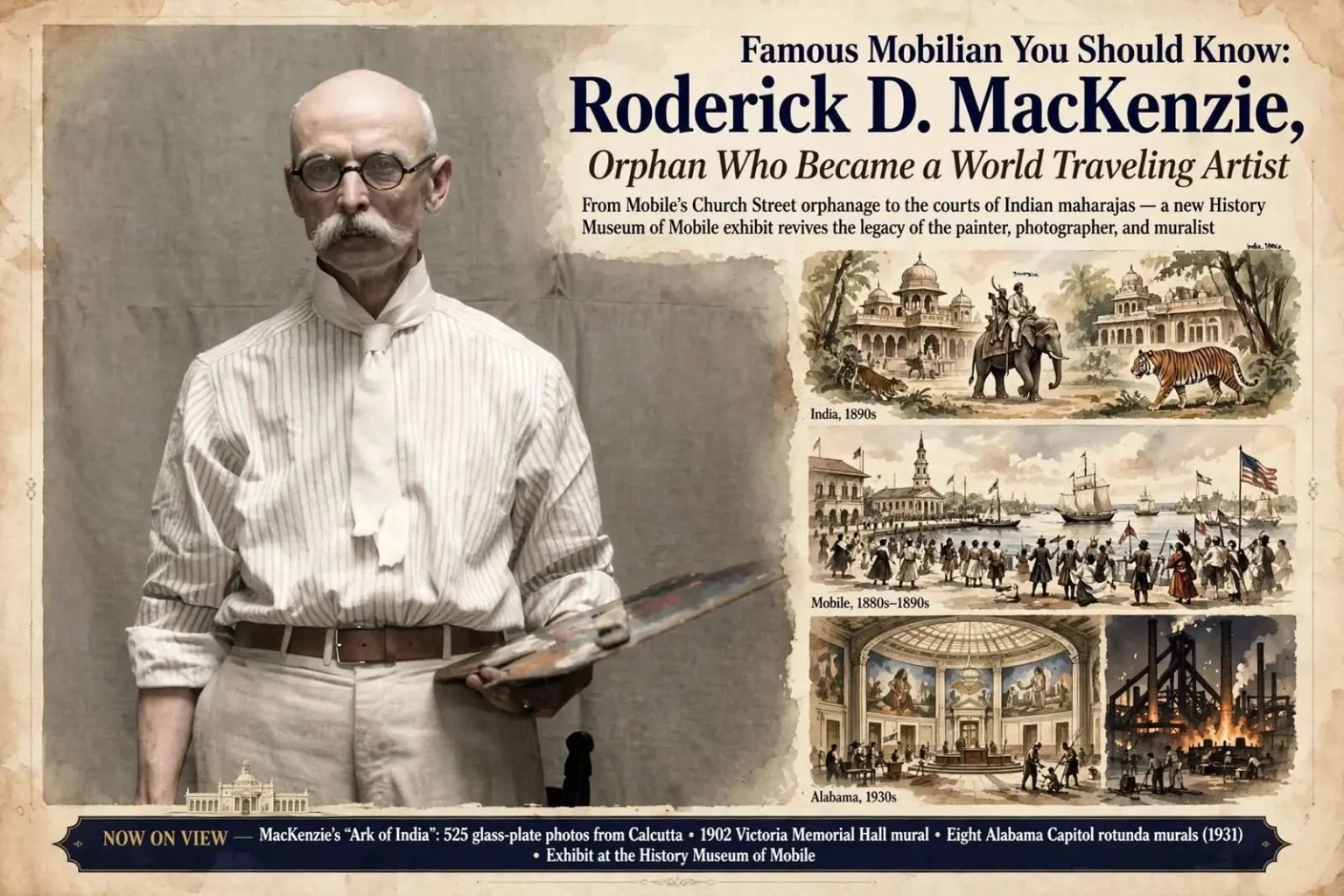
Few Mobile stories carry the sweep of Roderick D. MacKenzie’s life, a rags-to-recognition arc that took him from an orphanage on Mobile’s Church Street to the courts of Indian maharajas and back again, all before he died with almost nothing to his name. A new exhibit at the History Museum of Mobile is bringing renewed attention to an artist whose work once earned him a reputation as one of the most skillful painters in Asia, only for much of it to be scattered, lost or forgotten after his death.
Born in London in 1865, MacKenzie moved to Mobile with his family as a young child. His mother died in 1880, and his father, unable to keep the household together, sent Roderick and his younger brother to the orphanage then run out of Mobile’s Episcopal Church Home, an institution known today as Wilmer Hall. It was there that caregivers noticed his talent for drawing and painting, giving him space, supplies and time to develop his skill. Impressed by what they saw, Wilmer Hall officials raised money to send him to the School of the Museum of Fine Arts in Boston, where he trained from 1884 to 1886.
MacKenzie returned to Mobile and opened a studio, quickly building a following for his Mardi Gras scenes and Delta landscapes and collaborating with photographer William A. Reed. But by 1889 he felt his education wasn’t complete, and he left for Paris, not returning to the United States for a quarter-century. The defining turn of his career came in 1891, when art dealers in Calcutta invited him to capitalize on European demand for exotic paintings of tigers and jungle scenes. MacKenzie and his wife, Charlotte, sailed for India the following year, beginning a stretch of more than a decade in which he painted wealthy rajahs, documented laborers and rode along on tiger hunts with the Maharajah of Cooch Behar, using a small glass-plate camera to capture scenes moving too fast to sketch by hand.
Those 525 glass slides, preserved in three small boxes, form what historians call MacKenzie’s Ark of India, now the centerpiece of the museum’s exhibit on his years abroad. His best-known Indian work, a massive 1902 mural depicting the ceremonial proclamation of Edward VII as Emperor of India, still hangs in Calcutta’s Victoria Memorial Hall, even though most of his other Indian paintings have vanished and his name has faded from recognition both in India and in Britain.
MacKenzie and his wife eventually resettled in Mobile in 1914 as World War I loomed, and he opened an art school on Dauphin Street, though money remained tight for the rest of his life. In the 1920s he produced a series of pastels depicting Alabama’s steel industry, painted mostly at night at a Birmingham-area mill, and in 1926 the State Capitol Commission commissioned him to paint eight murals depicting Alabama history for the Capitol rotunda in Montgomery, work he completed in 1931 that remains on display today. A 1925 fire destroyed his studio, compounding his financial troubles, and when he died in 1941 his creditors began liquidating what little art he had left. Former students and Mobile families intervened to save much of what survives, eventually donating pieces to the History Museum of Mobile and the Mobile Museum of Art.
MacKenzie is buried in Magnolia Cemetery, and his legacy lives on in ways many Mobilians encounter without realizing it, from portraits displayed at the Ben May Main Library to the seal he designed for Murphy High School in 1920.
Wilmer Hall and the History Museum
The orphanage that took in MacKenzie traces its origins to 1864, when Bishop Richard Hooker Wilmer of the Episcopal Diocese of Alabama founded the Church Home for Orphans in Tuscaloosa. The home moved to downtown Mobile in 1866, relocated to Spring Hill in 1916 and was formally renamed Wilmer Hall Children’s Home in 1948 in the bishop’s memory. It still serves young people in Mobile today.