Grass Fire at Shuttered Searcy Hospital Draws Four Fire Departments
Four Mobile County fire departments responded to a reported building fire at the closed Searcy Hospital in Mount Vernon, later confirmed as a grass fire.
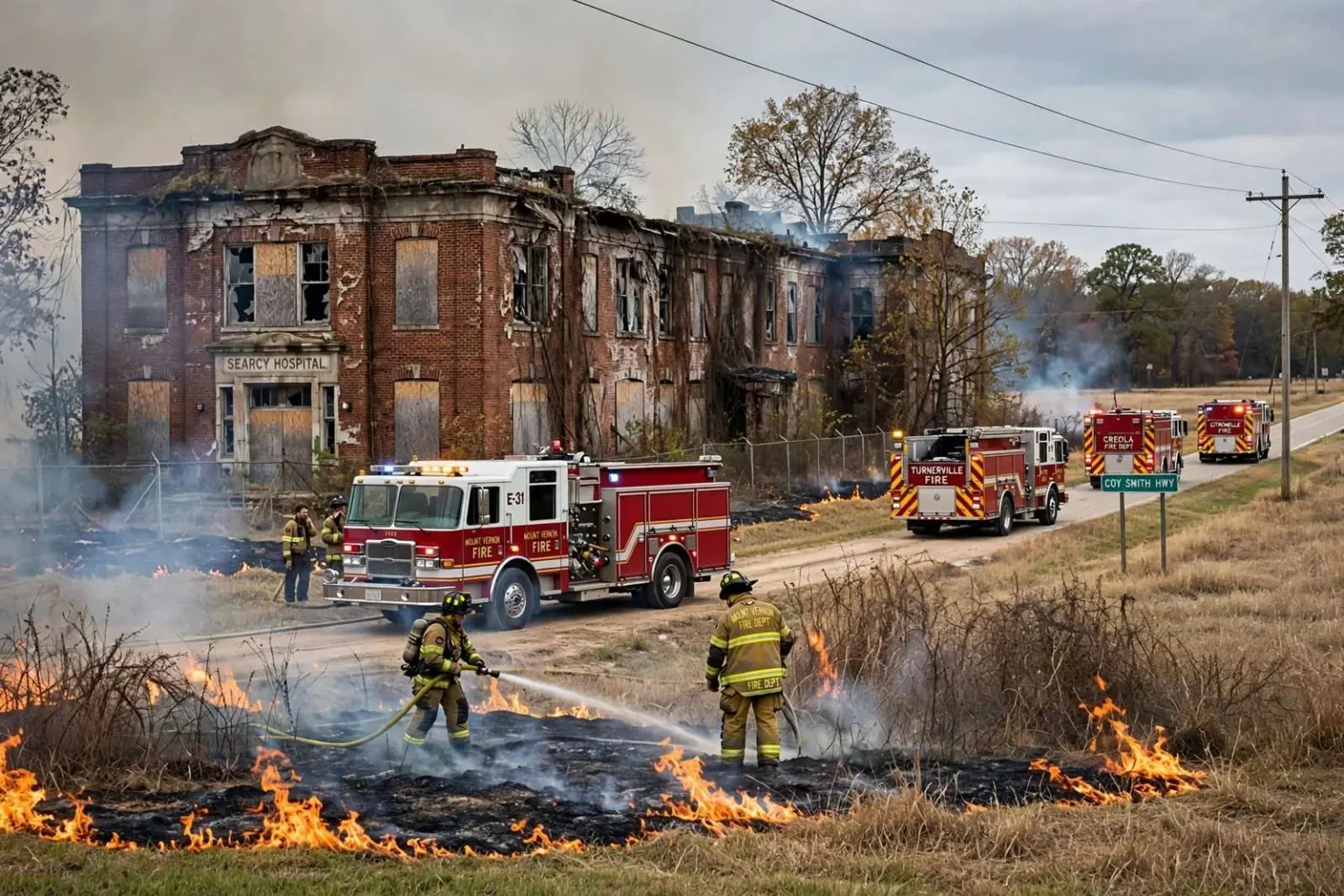
Four volunteer and municipal fire departments converged on the grounds of the long-closed Searcy Hospital in Mount Vernon after an initial report described smoke coming from one of the property’s buildings. Crews from the Mount Vernon, Turnerville, Creola and Citronelle fire departments were dispatched to the hospital campus on Coy Smith Highway after the initial call came in describing a structure fire.
Once firefighters arrived and assessed the scene, they determined the blaze was actually burning in grass and brush on the property rather than inside any building. Three of the four responding departments were subsequently canceled, leaving a single crew to extinguish the fire.
The escalation, and the rapid walk-back that followed, was mutual aid working exactly as designed. A report of smoke at a large abandoned property triggers the worst-case assumption — a structure fire in a vacant building where nobody is watching, with no working alarm system to narrow the response. By dispatching all four departments at once, dispatchers ensured that enough water, hose and manpower were rolling toward Coy Smith Highway before anyone on scene could confirm what the fire actually was, and by canceling three of them as soon as reality was known, the system freed those crews to cover their own districts within minutes.
An Empty Campus With a Long History
Searcy Hospital operated for decades as a state-owned psychiatric hospital before it was closed permanently on Oct. 31, 2012. The campus in rural Mount Vernon has largely sat empty in the years since, and the initial confusion between a possible structure fire and a grass fire underscores how quickly local fire departments must mobilize when a call comes in involving a large, unoccupied property with limited eyes on it day to day.
The hospital’s campus carries one of the longest institutional histories in north Mobile County. The site served in the 19th century as the Mount Vernon Arsenal, a federal military post, before its conversion to hospital use in the early 20th century, and generations of Alabama families knew it as a state psychiatric facility whose patients and staff shaped the small community around it. Its permanent closure at the end of October 2012 followed years of state budget deliberations, and the departure of the hospital left behind a sprawling campus of buildings and open grounds at the edge of town — a property whose scale and emptiness now define the fire-risk problem it presents.
Abandoned institutional campuses are among the most difficult properties fire departments ever face. Buildings deteriorate quietly behind fences and vacant corridors, dry vegetation accumulates across acres of grounds, and no resident calls in the details that make a typical fire report precise. What a passing motorist sees from the highway is a plume of smoke, and the first question — building or field — can only be answered by someone standing on the property.
Grass Fires and Mutual Aid in North Mobile County
Grass and brush fires are not unusual on large, undeveloped or lightly monitored properties, particularly when dry vegetation is present. Rural fire departments in north Mobile County routinely coordinate mutual aid responses for such calls, dispatching multiple units until the scope of a fire can be confirmed on scene, then releasing crews that are not needed once the situation is under control.
The north county’s fire protection map explains the pattern. Mount Vernon sits near the Washington County line, with Creola along the river corridor to the south, Citronelle to the northwest and Turnerville nearby — a cluster of small departments whose volunteers and equipment must cover wide territories with limited personnel. None of them can safely commit everything it has to a single reported structure fire, because a second call in the district while the first is burning leaves a community uncovered. Mutual aid agreements turn four small departments into one flexible response force, with each fire spread across the group.
That structure is why the cancellations mattered as much as the response. The three departments released from Searcy Hospital returned to their stations with their crews intact, ready for the next call, at no cost to the coverage of their own districts. For volunteer departments, where members leave jobs and homes to answer a pager, minimizing unnecessary runs is also a matter of keeping the volunteers themselves willing and able to serve over the long term.
No Injuries, No Confirmed Cause
No injuries were reported in connection with the fire, and there was no immediate public confirmation of what sparked the blaze. Fires on vacant grounds often end that way — extinguished in the field, with a cause left undetermined unless investigators find evidence pointing to a specific origin such as downed power equipment, discarded smoking materials or an escaped debris burn.
Season matters in these calls as well. North Mobile County’s dry spells leave the grasses and undergrowth on large properties primed to burn, and a fire that would gutter out in wet conditions can run across acres in an afternoon wind. Fire departments in the area encourage residents to respect burn bans and to never leave outdoor fires unattended, since the distance between a controlled burn and a mutual aid response like the one at Searcy Hospital can be a single shift of the breeze.
The geography of the response also showed how the county’s fire service has adapted to its rural shape. Coy Smith Highway sits along a stretch of north Mobile County where station distances are measured in miles of two-lane road, so the first engine on scene often arrives with the initial attack line and little else until water supply is established from tankers shuttling between the fire and the nearest hydrant or fill point. Structure fires in that terrain burn toward their own rhythm — a reason the initial four-department dispatch, sized for a working building fire with no water source confirmed, was the prudent assumption rather than an overreaction.
What Responders Found
On this day, the worst-case assumption dissolved quickly. Firefighters reaching the property found flames moving through grass and brush between and around the buildings, not inside them, and the command structure on scene downgraded the assignment accordingly. One department stayed to mop up and extinguish the burn area thoroughly; the others turned around before they ever stretched a line.
That early confirmation is what mutual aid is built to enable. Dispatching heavy and cancelling light costs almost nothing in the long run, while dispatching light and arriving heavy costs everything. Rural departments in Mobile County and across Alabama have learned the arithmetic the hard way, and the Searcy Hospital call showed the lesson applied: when the report says smoke at a vacant building, everyone rolls, and the ones who are not needed turn around.
The Burden of Vacant Institutional Properties
The response nonetheless illustrates the continued burden that large, vacant institutional properties like the former hospital can place on the small communities that surround them. A closed state facility does not stop generating emergencies; it simply generates them for volunteer crews who have no state budget behind them, no maintenance staff on the grounds, and no fence secure enough to keep out every trespasser, guttering cigarette or set of curiosity-seekers with a lighter.
Communities across Alabama that host former state campuses know the pattern. The buildings attract vandals and urban explorers, the grounds attract off-road riders and campers, and the combination of aging structures and unmaintained vegetation makes every dry week a countdown to the next smoke sighting. Until a long-term reuse or demolition plan settles the property’s future, the local fire department remains its de facto caretaker for fire protection, answering calls at a campus that generates no tax revenue to offset the cost.
Fire chiefs in these situations often become reluctant experts in property management as well. They track which buildings on a campus are most vulnerable, meet with local and state officials about securing the site, and keep their crews briefed on access routes, water supply and the hazards — collapsing floors, uncovered shafts, debris — that any interior response would involve. That preparation is invisible until the day it is needed, but it is the reason a report of smoke at an abandoned campus produces an organized response rather than chaos.
For Mount Vernon, a town of roughly 1,500 residents, the calculation is particularly direct. The town’s small department led the response to a property that dominates its landscape, and the mutual aid system stood behind it within minutes. The October grass fire — four departments dispatched, one working, nobody hurt — will not rank among the community’s most memorable days at Searcy Hospital, a place whose century of institutional life touched far more people than any fire on its grounds.
But it was a working demonstration of how rural fire protection holds together: neighbors answering each other’s pages, dispatchers scaling a response in real time, and crews walking the empty acres of a shuttered hospital until the last wisp of smoke was gone and the campus went quiet again.