Severe weather prompts Mobile County schools to cancel after-school activities
The Mobile County Public School System canceled after-school activities and Bishop State closed campuses early amid a threat of severe weather.
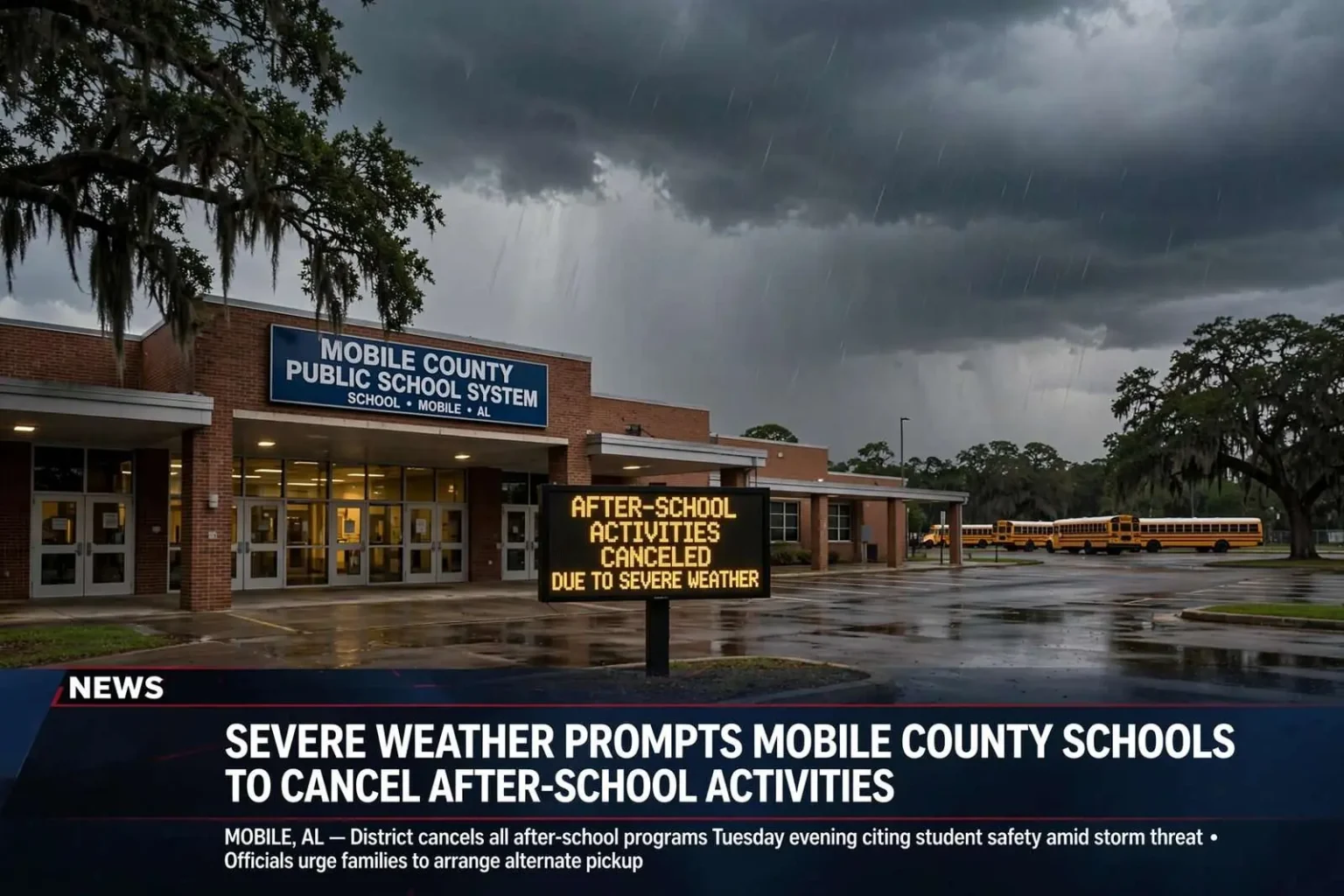
MOBILE, Ala. — The threat of severe weather moving through the area Tuesday evening prompted school officials across Mobile County to call off after-school activities, upending routines for thousands of families who rely on campus programs once the final bell rings. The Mobile County Public School System announced that all after-school activities were canceled for the day, including after-school care, citing the weather threat as the reason for the sweeping shutdown. Officials stressed that the decision was precautionary, made with student safety as the guiding concern as meteorologists warned of conditions capable of producing damaging storms during the evening hours.
The cancellation covered the full range of activities that normally fill school campuses after dismissal. Athletic practices and games, club meetings, tutoring sessions, rehearsals, and parent-teacher events were all called off under the blanket announcement, and families using the system’s after-school care programs were told to make alternate arrangements for pickup. The school system said activities could be rescheduled if conditions allow, leaving open the possibility that games and events lost to the stormy weather could be placed back on the calendar once the threat passes.
For a district of Mobile County’s size, an afternoon shutdown of that scope is no small logistical matter. The Mobile County Public School System is the largest school district in Alabama, serving tens of thousands of students across dozens of elementary, middle, and high schools spread from downtown Mobile to communities along the bay and out toward the county’s rural western and northern edges. After-school care programs alone serve a substantial share of working families, and a same-day cancellation sends parents scrambling to adjust work schedules, arrange carpools, and line up grandparents or neighbors to cover the gap between the end of the school day and the end of the workday.
How the decision gets made
School systems along the Gulf Coast have long maintained weather protocols for exactly this kind of day. When forecasters flag an evening window for severe storms, administrators weigh the timing of the weather against the schedule of buses, car riders, and after-school programs. A threat that builds after dismissal puts officials in a difficult position: students can be sent home on time, but the adults who supervise them in gyms and classrooms late into the afternoon would be on campus precisely when conditions deteriorate.
Canceling activities wholesale removes that exposure. Athletes who would otherwise be on practice fields during a lightning threat stay home, and after-school care staff are not left responsible for children while warnings are in effect. The approach mirrors the system’s handling of morning threats, where delays or closures are announced before buses roll, but applied to the other end of the school day. In both cases, the stated priority is keeping students and staff out of harm’s way rather than preserving the schedule.
Parents across the county learned of the cancellation through the district’s standard notification channels, including automated calls, texts, and posts to the school system’s website and social media accounts. Schools typically ask families to keep contact information current in the district’s records precisely so that weather notices reach them quickly. Local news outlets also relayed the announcement, spreading word to households that might not monitor district channels during the afternoon.
Bishop State closes campuses at 4 p.m.
The weather threat also reached into higher education in the city. Bishop State Community College canceled classes and closed all of its campuses beginning at 4 p.m., pulling students and employees out of buildings ahead of the evening weather window. The college said regular schedules were set to resume Wednesday, May 5, giving students a clear picture of when normal operations would pick back up.
Bishop State, a two-year institution serving the Mobile area with campuses in and around the city, runs a mix of daytime and evening course schedules, and the 4 p.m. cutoff landed squarely in the stretch where afternoon sections wrap up and evening classes would be getting underway. Students enrolled in late-afternoon and evening courses bore the brunt of the closure, and the college directed its community to watch for updates as the weather situation developed. Closing all campuses rather than individual sites reflected the broad geographic reach of the storm threat across the Mobile area.
The Tuesday cancellations fit a familiar pattern for south Alabama, where severe weather is a year-round consideration rather than a single-season worry. The Gulf Coast sits in a region where strong storms can develop in any month, driven in the cool season by strong frontal systems sweeping across the region and in the warm months by afternoon heat and humidity that can ignite thunderstorms with little notice. Tornado climatology along the coast includes both the classic spring severe weather season and a notable secondary risk during the fall and winter months, when jet-stream energy combined with Gulf moisture has produced some of the region’s most damaging outbreaks.
That reality shapes how institutions across Mobile County plan their calendars. School districts, community colleges, municipal governments, and youth sports leagues all build weather contingencies into routine operations, from designated shelter areas in buildings to communication trees for spreading cancellation news. A Tuesday evening threat is the kind of scenario local officials rehearse for in the abstract, and when it materializes the response tends to be swift and standardized: shut down optional gatherings, get people home, and wait out the weather.
What residents are asked to do on threat days
Emergency management officials in the region routinely urge residents to take basic precautions when severe weather is forecast. Those steps include knowing where they will take shelter if a warning is issued — a basement or an interior room on the lowest floor of a sturdy building, away from windows — and having multiple ways to receive warnings, since a single notification method can fail at the wrong moment. Cell phone alerts, NOAA weather radios, and broadcast media all play a role in getting warnings out as storms develop.
Households are also encouraged to keep basic emergency supplies on hand: flashlights, batteries, water, medications, and sturdy shoes for navigating debris. Mobile County and the city of Mobile maintain emergency management operations that coordinate with the National Weather Service office serving the Gulf Coast, which issues watches and warnings and provides detailed briefings when hazardous weather threatens the area. On days like Tuesday, those agencies monitor conditions in real time and pass along updates as storms form and track across the region.
The afternoon and evening timing of the threat carried its own dangers. Severe weather after dark is notoriously difficult to deal with along the Gulf Coast, because warnings that arrive at night find many people asleep and tornadoes that are visible against a daytime sky become invisible hazards after sunset. Officials often note that evening storms demand extra vigilance precisely because residents cannot rely on seeing what is coming. Canceling activities that would have put students, parents, and staff on roads and in buildings during those hours removed a slice of that risk entirely.
Rescheduling remains an open question
With the immediate decision made, attention turned to what happens next for the teams, clubs, and programs that lost their Tuesday slots. The school system’s language that activities “could be rescheduled if conditions allow” leaves the path forward flexible. Athletic contests can often be made up on open dates in the schedule, though district schedules are crowded and finding mutual openings between schools is not always simple. Club meetings and tutoring sessions are more easily shifted to later in the week, and after-school care was expected to resume on a normal footing once conditions cleared and the district gave the all-clear.
For families, the practical advice from educators and emergency officials alike is to watch for updates from the school system and individual schools, since makeup plans are typically announced building by building or team by team rather than through a single district-wide list. Coaches and activity sponsors generally communicate directly with students and parents once new dates are set, and the district’s official channels remain the authoritative source for any system-level changes to the schedule.
The closure at Bishop State, meanwhile, meant that students planning to attend evening classes needed to check on how those sections would be handled. Two-year colleges along the Gulf Coast serve large numbers of working adults, many of whom schedule courses around jobs and family obligations, so a 4 p.m. campus closure lands differently than a K-12 dismissal. The college’s announcement that regular schedules would resume Wednesday, May 5 provided the certainty students needed to plan their week, even as the specific handling of missed instruction was left to individual instructors and academic departments as is customary.
Bishop State’s role in the Mobile community extends well beyond its classroom schedule. The institution traces its roots to the 1920s and has grown into a comprehensive community college offering academic transfer programs, career and technical education, workforce training, and adult education services. Its campuses anchor educational opportunity in the city, and its responsiveness to weather threats reflects the operational reality of any institution charged with keeping hundreds of students and employees safe across multiple sites.
A reminder of the region’s weather rhythm
For longtime residents of the Gulf Coast, Tuesday’s events were routine in the way that only familiar risks can be routine. The region has weathered hurricanes, tornado outbreaks, straight-line wind events, and flooding rains across generations, and the institutional muscle memory built by those experiences shows up on days like this one: schools announce early, colleges follow, agencies push warnings, and families adjust. There was no drama in the announcements, only the practiced choreography of a community that knows severe weather and plans around it.
The cancellations also served as an informal drill for the communication systems that matter most when conditions turn dangerous. District notification calls, social media updates, and local news coverage all functioned as designed, and the same channels that spread the activity cancellations would carry any subsequent warnings or all-clear messages. Emergency managers often observe that the households best positioned in a true emergency are those that already know where their information will come from — a lesson reinforced on ordinary threat days when parents learn how quickly news of a school cancellation reaches them.
As the evening wore on, the focus shifted from the cancellations themselves to the weather that prompted them. Forecasters tracked the storms as they developed, and residents were reminded to stay weather-aware through the overnight hours. By the time Wednesday arrived and regular schedules resumed at Bishop State, the episode would take its place among the many routine weather disruptions that punctuate life on the Gulf Coast — an inconvenience for families and coaches and students, perhaps, but a manageable one, and a demonstration that the region’s schools and colleges stand ready to put safety ahead of the calendar whenever the sky demands it.
Students and parents with questions about specific rescheduled activities were directed to their individual schools and programs, and the district reiterated that updates would be posted as decisions were made. The college and the school system both thanked families for their flexibility in adjusting to the shortened day, noting that cooperation on weather days is a key part of keeping the community safe during severe weather season on the Gulf Coast.