

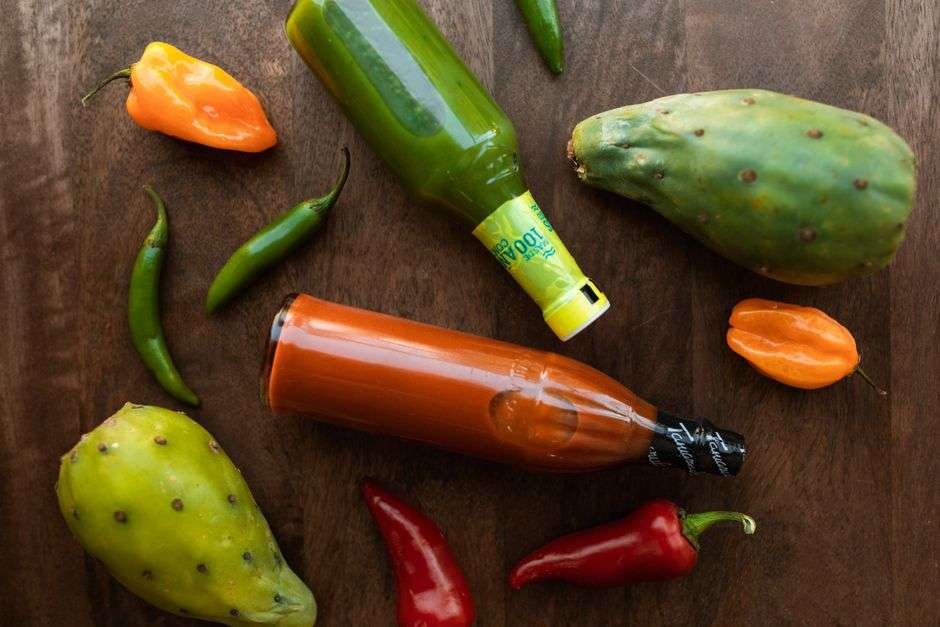
Restaurants across the Gulf Coast have taken to bottling their own hot sauces, and supermarket shelves now groan under dozens of options. But in the kitchens and dining rooms of coastal Louisiana and south Alabama, one bottle has held its ground for more than a century: Crystal Hot Sauce, the New Orleans original made from fresh cayenne peppers and a recipe discovered in an old desk more than 100 years ago.
Crystal’s story runs through one of the most famous restaurant families in America — the Brennans of Commander’s Palace — and through a third-generation owner who learned the business sweeping a warehouse floor and reading the Wall Street Journal at his aunt’s kitchen table.
A recipe found in a desk
The company traces its start to 1923, when founder Alvin Baumer found the recipe for Crystal Pure hot sauce tucked away in an old desk and began making the sauce for friends and family. He formed Baumer Foods that year, and the business grew around preserves as much as sauce — so much of it shipped overseas to feed troops during World War II that Baumer liked to joke that so much product went down with sunken merchant ships, the ocean itself must taste sweet.
The flagship brand, Crystal Pure Hot Sauce, is built on a deliberately simple formula: three ingredients, built around fresh cayenne peppers sourced exclusively from Mexico. It was never intended to be the hottest sauce on the shelf. Crystal is used by chefs as an ingredient — a way to enhance flavor without overwhelming a dish. “We like to say ‘sigh, not cry,'” says Alvin “Pepper” Baumer III, the company’s president and CEO. “Crystal doesn’t take anything away from the dish you’re creating. We are the chef’s best friend.”
The Brennan education
Pepper Baumer’s path to the family business ran through the most storied dining room in New Orleans. A third-generation owner, he earned a hospitality management degree with a computer science minor at the University of Alabama in 2012 — “I wanted to get one more National Championship under my belt,” he says — but his real business education came from his aunt, Ella Brennan, the legendary founder of Commander’s Palace.
Before college, he had worked in Crystal’s New Orleans production plant, sweeping the warehouse and hand-loading containers before earning a forklift. After a year with the New Orleans Convention and Visitors Bureau and three years at Commander’s Palace, he began what he calls his “MBA at the foot of Ella Brennan.” Each afternoon at 3:30, he would report to Ella’s home across the street from the restaurant. “She would throw the Wall Street Journal at me and make me read the whole thing,” he says — then quiz him on three articles: what worked, what didn’t, and what could have been done better.
She also instilled the house rule known as “Brennan on Duty”: at any moment during service, one family member must be present in the dining room. It is a discipline he carried back to the sauce company.
Katrina, and a new home in Reserve
Crystal’s century of production has survived more than one catastrophe. The company’s original Tulane Avenue plant — crowned by a sign visible from Interstate 10 — was destroyed by Hurricane Katrina along with much of New Orleans. Production was rebuilt in Reserve, Louisiana, upriver from the city, where Crystal has operated since.
Pepper worked in every department on his way up: shipping and receiving, purchasing, production scheduling, preparation, final production and quality assurance. He bought the company from his father in 2019 — and immediately ran into the pandemic. Bottles became impossible to source, allocations were cut in half, the trademark green-neck bottles from Mexico disappeared, and production dropped from two shifts to one.
“It was trial by fire,” he says. “Up was down, down was up, and the supply chain was unreliable, to say the least.” The company rode it out without laying anyone off, and by the fourth quarter of 2023 production caught up with demand. Today the company is adding production lines and product varieties to meet it.
75 countries, but the SEC first
Crystal Hot Sauce ships to 75 countries, but its map of loyalty starts in the American South. “The Southeastern Conference is our bread and butter,” Pepper says. New Orleans is the biggest market, followed by Miami, with Philadelphia, Baltimore and Northern California strongholds beyond. Growth markets include the Twin Cities, Houston and North Carolina.
The company’s most effective marketing, he says, costs nothing: getting people to taste it. His father had a habit of asking for hot sauce in restaurants; if the server brought Crystal, Dad would tip a $100 bill — and the restaurant rarely served anything else again.
How Gulf Coast cooks use it
Along the coast, Crystal’s role in the kitchen is as an enhancer, not a dare. One classic local technique for fresh-caught speckled trout: sauté the filet in butter and Crystal, nothing else — the sauce deepens the flavor without covering it. The same logic applies to gumbo, red beans, fried seafood and eggs, where a few dashes add brightness rather than burn.
Asked for his favorite dish with Crystal, Pepper does not hesitate: the Shrimp and Tasso at Commander’s Palace — “It’s everyone’s favorite.”
New Orleans is back
Pepper has become an ambassador for his hometown, and he says the city’s tourism engine is running again. When Taylor Swift played three nights in New Orleans, Commander’s Palace was fully booked — including the Monday after the weekend — and hotel rooms across the city sold out, an estimated $350 million boost. With the city hosting the Super Bowl and fine dining at the heart of any visit, he wants diners to know the city is back on track.
For Gulf Coast home cooks, the takeaway is older than any of that. A century-old three-ingredient sauce from a recipe found in a desk drawer still sits on tables from the SEC country to 75 countries — because, as its CEO puts it, it is not about heat. It is about flavor.