

Lunch at a rooftop restaurant in San Miguel de Allende, six senior señoras deep into the guacamole and tequila drinks, when the two young men at the next table — Chicagoans house-hunting in Mexico’s central highlands — lean over and ask where the accents are from. “Atlanta or Mobile,” they guess. Mobile! The odds of an American stranger pinpointing a Gulf Coast accent across a courtyard in Mexico felt like a parlor trick. “I would call you Southern Chic,” one added. The table was on top of the world.
The compliment repeated itself all week, in one form or another, as the six friends explored a city that has quietly become one of North America’s most beloved travel destinations.
Why San Miguel Casts Its Spell
San Miguel de Allende sits at 6,234 feet in the hills of Guanajuato state, and its setting explains much of its magic: baroque Spanish architecture in shades of ochre, orange and yellow, a thriving arts scene, and cultural festivals that fill the calendar. The city and the nearby Sanctuary of Atotonilco were inscribed together on the UNESCO World Heritage list in 2008, honoring a colonial town whose 16th-century street plan survived into a remarkable 18th-century flowering of Mexican Baroque architecture.
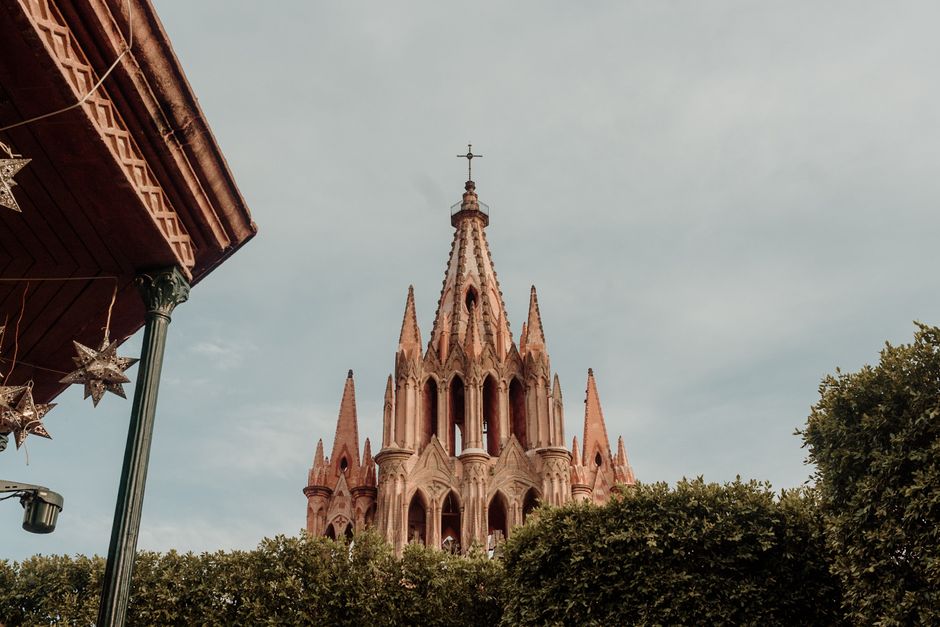
The postcard moment comes at the Parroquia de San Miguel Arcángel, the neo-gothic church whose dramatic pink towers rise above the main plaza, El Jardín. Bougainvillea spills over walls everywhere, and in spring the purple jacaranda trees bloom across the city. In the historic center, locals count an estimated 2,000 doors — and behind them, 2,000 courtyards, many restored to their colonial state with handcrafted ironwork framing the windows.
The streets themselves are part of the pleasure: narrow, cobblestoned, rising and falling over the hills, each building’s stonework pattern distinct. Nearly everywhere a visitor walks, the city reveals itself one doorway at a time.
Shopping as a Profession
With six women on holiday, shopping is not an activity; it is a profession. First stop: Fábrica la Aurora, an old textile mill converted into shops and galleries, where linens, jewelry, pottery and home furnishings — all made in San Miguel — found their way into suitcases. The next day brought a more traditional experience at the Mercado de Artesanías, where stalls sell hand-painted ceramics, hanging lamps, Oaxacan rugs, clothing and jewelry, and where a favorable exchange rate stretched pesos impressively. Back in the center of town, higher-end shops rewarded a slower browse.
A hands-on cooking class with Chef David Jahnke turned market ingredients into traditional dishes: creamy corn soup, shrimp tacos with fresh pico de gallo, tuna with mole sauce and flan for dessert. The group also toured the tequila distillery Casa Dragones, tasting and carrying bottles home.
World-Class Tables
San Miguel’s restaurants justify the trip on their own. Reservations are essential — the best rooms fill early — and the favorite was Quince, at once elegant and hip, where the menu, music and service combined into a high-energy evening that featured a DJ, a tightrope walker performing on a neon-lit suspended wire, and, between sets, a violinist wandering among the tables. Beyond Mexican cuisine, the town’s international dining scene offers choices for every palate.
The Sistine Chapel of Mexico
Fifteen minutes outside town lies the trip’s most astonishing sight: the Sanctuary of Atotonilco, often called the “Sistine Chapel of Mexico.” Its walls and ceilings are nearly covered with oil paintings, frescoes, sculptures and verses in vivid blues, reds, greens and blacks — mythical creatures, gilded baroque virgins, horned devils, red-robed priests, and biblical scenes from the life of Christ, much of it the work of the 18th-century painter Miguel Antonio Martínez de Pocasangre.
Because the visit fell near Holy Week, the group learned the sanctuary’s living tradition: pilgrims carry a sculpture of Christ, wrapped in silk, eight miles into San Miguel, where a piece of silk is unwrapped each day until Easter. The travelers’ driver pulled over on the way to the León airport so they could watch the procession — singing worshippers walking against a backdrop of cactus-covered hills. It was, one of the six says, a goosebump moment: the perfect farewell from a city that keeps revealing itself, doorway by doorway, until the very last mile.