University of South Alabama Spanish Fort
Spanish Fort Runners Trade Practice for Movie Set as Film Extras
Spanish Fort High School cross-country runners spent a day as extras on a movie set at their own school track, running alongside a Hollywood actor.
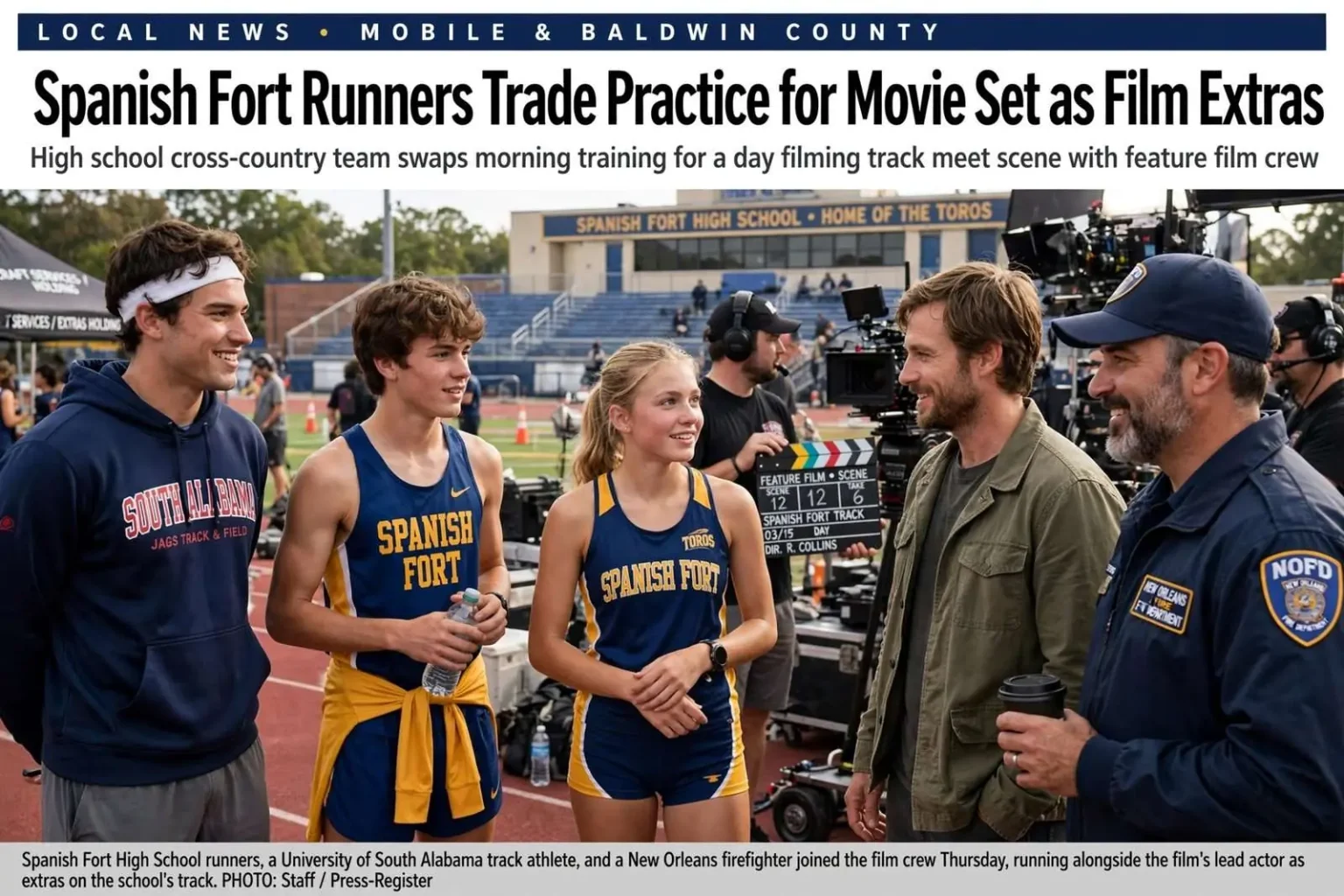
A film crew’s arrival in the Mobile area gave a group of Spanish Fort High School runners an unusual break from their normal training routine, trading a workout for a day in front of the cameras.
The production, a feature film with a slim public profile at the time, began shooting in midtown Mobile on South Monterey Street before moving to Spanish Fort High School’s track for its second day of filming.
The day’s scenes centered on a track meet, and local extras were needed to fill out the crowd of runners. Several members of Spanish Fort’s cross-country team answered the call, showing up to the set after already completing a six-mile morning run.
Cast among them was one of the film’s principal actors, known for earlier roles in family films and teen dramas, who worked alongside the local athletes for the shoot.
For most of the Spanish Fort runners, it was their first experience as extras, and the day came with some on-set lessons about how filmmaking actually works.
One runner, tapped to sprint during a crowd shot, said he did not realize the cameras weren’t rolling on him specifically until he was already halfway through his run, at which point he eased off the pace.
After that scene wrapped, the group lined up for a staged 100-meter dash.
A University of South Alabama track athlete who joined the extras for the day called the experience exciting, saying he simply enjoys running regardless of the setting.
One of his fellow extras said the highlight of the day was getting to run alongside a college-level athlete, while another said his personal goal was simply not to finish last, all while staying a step behind the film’s lead actor as the scene required.
Not Everyone Was a Runner
Not everyone on set that day was a competitive runner. A New Orleans firefighter serving as an extra admitted he hadn’t run at that pace in about a decade and was mainly focused on keeping up.
It wasn’t his first brush with a film production in the area either; he had recently wrapped work as an extra on another production, part of a growing band of Gulf Coast residents who sign up for background work whenever crews come to town.
The two-day shoot captured the practical choreography of location filming: a midtown Mobile street doubling for its own self on day one, then a high school track staged to look like a meet in progress, complete with races, crowd shots and the repeated takes that make a few seconds of screen time.
For the Spanish Fort runners, the day ran on the same fuel as their sport — repetition. Each take required lining up, running the assigned segment, and resetting, a rhythm familiar to anyone who has rehearsed handoffs or starts. Their coach’s six-mile morning already behind them, the extras treated the takes as the day’s second workout.
The college athlete from South Alabama brought a different perspective: for him, the chance to run alongside high schoolers, a professional actor and a firefighter was simply another way to spend a day doing what he enjoys, and he treated the staged dash with the same relish he brings to meets.
Film Work Comes to the Gulf Coast
Feature productions scouting the Mobile area have found a workable mix of locations — historic midtown neighborhoods, the Eastern Shore’s schools and waterfronts, and the port city’s industrial backdrops — along with a growing pool of local extras. Casting calls for background actors typically draw students, retirees and working professionals, and a day as an extra pays a modest rate but offers a behind-the-scenes look most residents never get.
School locations are prized by production managers because they come with parking, restrooms, bleachers and open ground — and principals trade the disruption for a campus story students talk about for years. Spanish Fort High School, which opened its doors in 2005 and has grown into one of Baldwin County’s larger high schools, supplied not just its track but a supply of athletes whose fitness made them natural casting for a track-meet scene.
The cross-country runners who spent their day being filmed learned quickly that movie running differs from competitive running. Camera angles, background action and the lead actor’s positioning dictate the pace and the lane, and a sprint that looks dramatic on screen may be, as one runner discovered mid-stride, a shot focused somewhere else entirely.
The staged 100-meter dash — with the film’s principal actor in the mix and instruction to stay a step behind him — showed how much choreography goes into even a simple race shot. Extras who might otherwise have run all-out throttled themselves to the scene’s requirements, an inversion of every competitive instinct they own.
A Day in the Life of an Extra
Background work runs on patience. Extras arrive early, wait through lighting and camera setups, and stand by for calls to action that may come hours apart. Meals and holding areas keep the crowd fed between takes, and assistant directors shepherd the background through each setup with firm but friendly direction.
For high school athletes, the exposure to that world is part of the appeal. Few days combine a sport they love with a glimpse of how a feature film assembles its images, and the Spanish Fort runners left with stories — the unknown camera, the dash choreography, the actor in their midst — that outlasted the soreness from their morning run.
The firefighter from New Orleans represented the other side of the extra pool: adults who take background work for the experience and the occasional brush with production life. His admission that a decade had passed since he ran at that pace endeared him to the runners, who appreciated anyone willing to suffer through a sprint for the camera.
Mobile-area casting has grown along with the region’s film activity, and productions continue to draw on the same formula this shoot used: real locations, local faces and athletes who can make a scene move. For one day at least, Spanish Fort’s track served as a movie set, and its distance runners found out that being an extra is its own kind of endurance event.
The Location Shoot, From the Ground
Day one on South Monterey Street transformed a quiet midtown block into a production zone: trucks lining the curb, equipment carts crossing lawns, and neighbors watching a street they drive every day become a backdrop. Midtown’s mature oaks and historic homes have long made the area attractive to location scouts, and residents have grown accustomed to the occasional camera crew among the joggers and dog walkers.
Day two moved across Mobile Bay to Spanish Fort, where the school’s track offered the open sightlines a race scene needs. Crews positioned cameras along the straightaway and in the infield, and the extras — high school runners, a college athlete, a firefighter — became the field of competitors the script called for.
The behind-the-scenes rhythm absorbed the newcomers quickly. A first assistant director calls the set to order for each take; the slate claps; the scene runs; and then everyone resets while the crew reviews what the cameras caught. What looks spontaneous on screen is often the sixth or eighth version of the same fifteen seconds, and the extras learned to pace their energy across the repetitions.
For the runners, the instinct to compete had to be unlearned take by take. The crowd-shot sprint that one runner started at full speed taught him the first rule of background work: the camera decides where the action is, and the extras exist to fill the world around it. By the time the group assembled for the staged dash, they understood the assignment — run fast, stay behind the lead, and hit the mark.
Why Productions Choose the Gulf Coast
Alabama’s film incentives and the Gulf Coast’s range of locations have drawn an increasing share of productions to the Mobile area in recent years, supplementing the state’s established film activity around Birmingham and the river region. Mobile offers a port city’s textures — historic districts, shipyards, bridges and waterfront — within a short drive of Baldwin County’s newer suburbs and beaches, letting a production gather diverse settings without long company moves.
Local economies feel each shoot quickly. Hotels fill with crew, restaurants and hardware stores see production purchases, and the background-actor payroll spreads modest pay across dozens of residents per day. Schools and municipalities weigh those benefits against the disruption, and most find the trade worthwhile — a closed track for a day, in exchange for a story and a location fee.
The extras’ pay for such shoots is modest, but the intangible returns run higher: a look at how films are made, a possible glimpse on screen when the movie is released, and the small-town novelty of watching classmates and neighbors play track meet extras alongside a principal actor.
The production’s low public profile during shooting is standard practice; studios keep locations and story details quiet to avoid crowds and protect the film’s marketing rollout. That secrecy left even the extras guessing about the movie’s plot and title, making their day on set a curiosity first and a credit second.
When the film eventually reaches audiences, the Spanish Fort runners and the rest of that day’s background cast will watch for the moments they helped build — a street scene in midtown Mobile, a race on their own track, and a 100-meter dash staged one careful step behind the star.