Spanish Fort Nears Completion of $2.7 Million Bluff Stabilization Project
Spanish Fort is wrapping up a $2.7 million project to stabilize an eroding bluff near the Mobile Bay Causeway after years of litigation. Officials say final
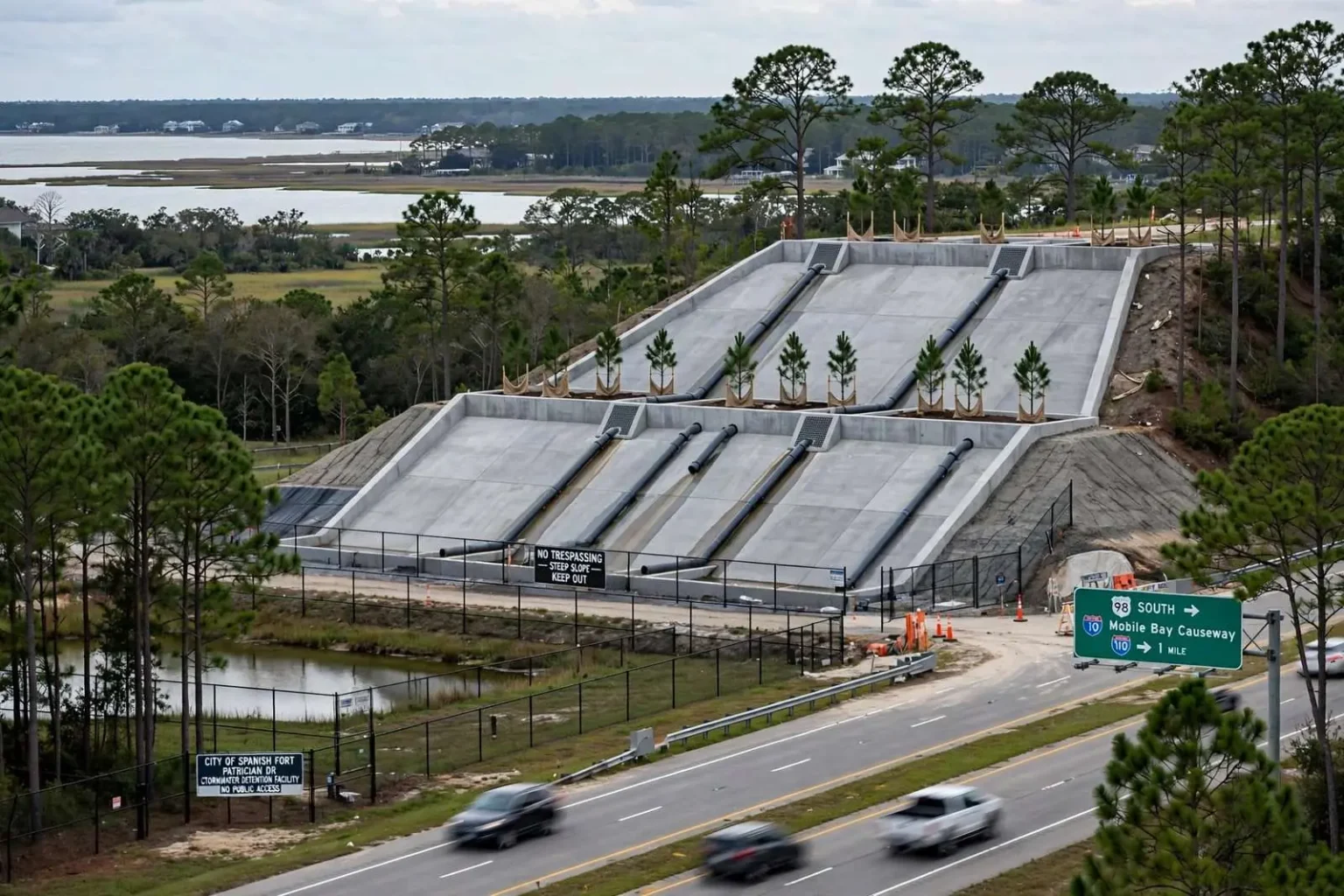
A years-long effort to stabilize a crumbling bluff in Spanish Fort is nearing the finish line, with the city set to spend $2.7 million by the time the project wraps up after five months of construction. Work on the roughly 100-foot bluff began in July, capping a legal battle that stretched back to 2009, when two homeowners on Patrician Drive sued the city over erosion damage tied to a failing drainage system. The undertaking, which reshaped a steep hillside above one of the busiest corridors on the Eastern Shore, has become one of the most expensive infrastructure fixes in the young city’s history.
The bluff sits near the roadway connecting U.S. 98 with the Mobile Bay Causeway, an approach used daily by thousands of commuters, shoppers and freight drivers moving between the Eastern Shore ridges and the Mobile Bay waterfront. City officials said from the outset that the slope’s failure was more than a neighborhood dispute — it threatened a critical transportation link and required an engineering response built to last for decades.
After losing the lawsuit and a subsequent appeal, the city ultimately purchased both homes as part of a settlement finalized earlier this year. Those properties have since been demolished and the land converted into a fenced stormwater detention area designed to prevent similar erosion problems in the future. What was once a quiet residential street now includes a permanently dedicated drainage facility, a visible reminder of how the dispute ended for the two families who lived there.
Mayor Mike McMillan said roughly $2 million of the overall cost went directly toward repairing and stabilizing the bluff itself, which now consists of a two-tiered concrete slope built with drainage pipes and catch basins that funnel water down toward the roadway connecting U.S. 98 with the Mobile Bay Causeway. The design channels stormwater in controlled paths rather than letting it percolate through the hillside, which engineers identified as the mechanism that had steadily hollowed out the bluff over the years.
“There are a couple of loose ends that have yet to be tied up,” McMillan said, noting that the Army Corps of Engineers had signed off on the completed work. The federal review was a necessary step because the project sits within regulated waters and wetlands near the causeway corridor, where any large-scale construction touching drainage and slopes must satisfy the Corps’ permitting requirements before it can be declared complete.
Loose Ends Before the Final Sign-Off
Crews still plan to install fencing along the base of the slope to discourage climbing, a safety measure intended to keep pedestrians away from the steep concrete face. Newly planted pine trees are also expected to grow in over time and soften the appearance of the concrete structure, which for now stands out starkly against the wooded hillside that East Shore residents have long been used to seeing above the causeway approach.
City officials said those finishing touches matter both for safety and for aesthetics. The bluff rises above a route that carries visitors arriving from I-10 toward the shops and neighborhoods of Spanish Fort, and the city wants the repaired slope to blend into the landscape rather than read as a scar. The fencing, signage and landscaping together form the last phase of a project that has already consumed most of the construction season.
The bluff project’s price tag grew from an original estimate of about $2.5 million after the city opted to build a stormwater detention pond on Patrician Drive rather than pursue a simpler scenic overlook, a decision McMillan said engineers recommended for safety reasons. The detention option required more land work and additional structures, but engineers concluded it was the only choice that would address the root hydrology problem rather than merely dressing it up for passersby.
The decision reflected a hard lesson learned from the litigation itself: controlling where stormwater goes, and how fast, is the difference between a slope that holds and one that fails again. By buying the homes, demolishing them and dedicating the parcels to detention, the city effectively removed the risk that anyone would ever build or live in the path of the drainage flow again.
How a Drainage Dispute Became a Court Fight
The root of the project traces back to an August 2013 verdict from a Baldwin County jury, which found that the city had failed to properly maintain the Patrician Drive drainage system, contributing to the eventual collapse of the bluff. Jurors awarded more than $1.3 million to the affected homeowners, though a municipal liability cap reduced that award to $500,000 — a limit that applies to damages against Alabama municipalities and frequently shapes how such cases are resolved.
The case was closely watched by municipal officials across Baldwin County, because it tested how far a city’s responsibility extends for aging stormwater infrastructure beneath streets it maintains. Evidence in the trial traced years of complaints, repairs and erosion on the hillside, and jurors concluded the city bore responsibility for allowing the drainage system’s deterioration to accelerate the bluff’s collapse beneath the two homes.
A judge later ordered the city to begin emergency repairs after the city’s appeals were rejected by both the lower court and the Alabama Supreme Court. The appellate rulings left Spanish Fort with few options: the repairs had to happen, the question was when and at what cost. Even so, the case ultimately ended not with an imposed remedy but with a negotiated settlement, in which the city bought the two damaged homes rather than continuing to contest their value and condition.
The timeline grew more urgent after record rainfall hit the area in the spring, creating what officials described as a critical situation at one of the homes before it was purchased and demolished. Heavy storm events that season inundated drainage systems across the Eastern Shore, and on the Patrician Drive bluff the additional water flow brought new movement to soil that engineers had already flagged as unstable, accelerating the schedule for the city’s response.
The spring rains also served as an unplanned stress test of the region’s stormwater infrastructure generally. Spanish Fort’s experience prompted other Eastern Shore municipalities to take a second look at their own drainage networks, many of which were built decades ago when the ridges above Mobile Bay carried far less pavement and far fewer rooftops. Engineers note that as development spreads across the uplands, stormwater volumes grow even without unusual weather, putting older systems under strain they were never designed for.
A Model for Other Cities Facing Aging Drainage
For Spanish Fort, a city that incorporated in 1990 and has grown rapidly along the I-10 corridor, the project represents a coming of age of sorts. The city inherited and built drainage infrastructure as fast subdivisions spread across the bluffs above the bay, and the Patrician Drive case showed how expensive deferred maintenance can become when slope failures reach private property and critical roadways alike.
City officials have said the lessons of the litigation are being applied elsewhere in Spanish Fort, with crews inspecting drainage outfalls and hillside structures on a regular schedule and budgeting maintenance into the annual plan rather than waiting for complaints. The city’s insurance and legal teams have also reviewed the case file for guidance on how documentation of inspections and repairs can protect the municipality — and residents — if problems begin to develop on other slopes.
The engineering approach used on the bluff — a two-tiered concrete structure with catch basins and piped outfalls — is common on highway projects but relatively unusual for a municipality to fund on its own. City leaders have noted that the per-foot cost of such work dwarfs routine paving and drainage budgets, which is why the settlement and court orders, rather than ordinary capital planning, drove the project’s timeline.
Residents who use the causeway approach daily have watched the slope transform over the summer, first as excavators stripped the failing hillside, then as the concrete tiers rose in its place. Traffic through the corridor was maintained throughout construction, though drivers encountered occasional lane restrictions as trucks delivered materials and crews worked close to the roadway.
Closing the Book on a Five-Year Dispute
With the heaviest construction now complete, Spanish Fort officials say the finished bluff should provide long-term stability for the area near the Mobile Bay Causeway approach, closing the book on a drainage dispute that spanned more than five years and multiple rounds of litigation. The remaining work — fencing, plantings and final site cleanup — is expected to wrap up in short order now that the Corps has signed off on the structural work itself.
The end of the project also settles a question that hovered over the city’s finances for years. Between the purchase of the two homes, the reduced jury award and the $2.7 million construction bill, the total cost of resolving the Patrician Drive failure far exceeds what routine maintenance of the drainage system would have cost, a point city officials have acknowledged openly as they redirect their attention to preventive work elsewhere in town.
For the former residents of Patrician Drive, the settlement ended years of living above a slowly failing hillside, and their homes have given way to a facility that now protects the corridor for everyone who uses it. City leaders have expressed hope that the site, once the pines mature and the fence is in, will simply fade into the hillside — a quiet piece of concrete engineering that keeps the bluff above the Mobile Bay Causeway where it belongs.