

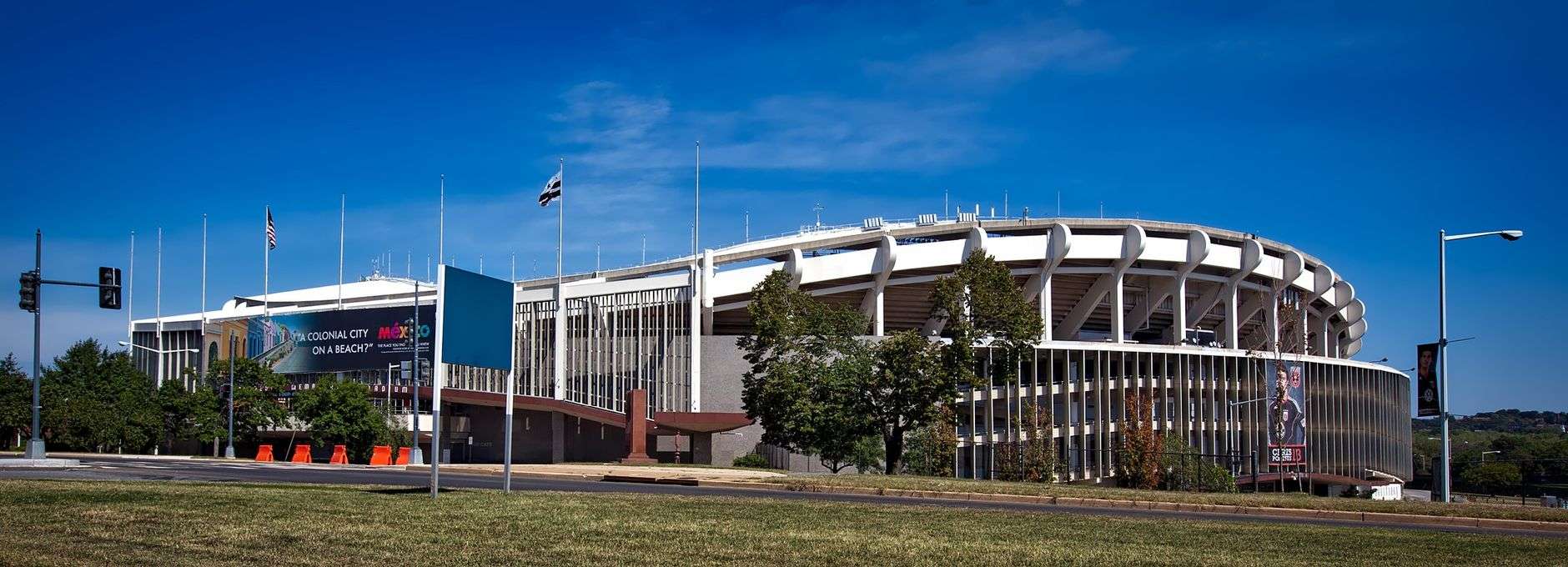
Speculation is building in Mobile political circles that President Donald Trump could return to Ladd-Peebles Stadium in the coming weeks to headline a rally for U.S. Senate candidate Tommy Tuberville, though as of now the talk remains unconfirmed. Staff at Ladd-Peebles Stadium said this week they have received no official notice of any such event, and no campaign or White House official has publicly confirmed a visit. Still, the possibility has generated buzz among local political observers, in part because of the historical weight the aging stadium carries in Alabama Republican politics.
The 2015 Rally That Changed Everything
It was at Ladd-Peebles in August 2015 that Trump, then a long-shot presidential candidate, drew a massive crowd for one of the signature rallies of his early campaign. That night is remembered less for the size of the crowd than for a single moment on stage: then-U.S. Sen. Jeff Sessions of Mobile stepped out, donned a “Make America Great Again” hat and became the first sitting senator in the country to endorse Trump’s candidacy. The Trump-Sessions alliance forged that night helped propel Trump’s outsider campaign toward legitimacy with the Republican base and, after Trump’s election, into the West Wing, where Sessions was tapped to serve as U.S. Attorney General.
The partnership soured dramatically after Sessions recused himself from the Justice Department’s Russia investigation, a decision Trump has repeatedly and publicly criticized in the years since. Trump ultimately forced Sessions out of the administration, and the two have traded public jabs ever since. That history is what makes the prospect of a Ladd-Peebles rally for Tuberville so notable to political watchers. Sessions, who represented Alabama in the Senate for two decades before joining the Trump administration, is now trying to reclaim his old seat and faces Tuberville, the former Auburn University football coach, in the Republican runoff. Trump has already thrown his support behind Tuberville and used his considerable influence with Alabama Republicans to try to finish off Sessions’s comeback bid.
Ladd-Peebles as Political Ground Zero
Ladd-Peebles Stadium, opened in 1948 and expanded multiple times since, has been Mobile’s primary outdoor venue for high school football, college games, and major events for generations. Its 40,000-seat capacity makes it the largest stadium in the city, though it has aged significantly and the city has debated its future for years. The University of South Alabama played its home football games there until Hancock Whitney Stadium opened on campus in 2020. The Senior Bowl, college football’s premier all-star game, called Ladd-Peebles home from 1951 until moving to Hancock Whitney Stadium in 2021.
Politically, the stadium occupies a unique place in Alabama lore. George Wallace, Ronald Reagan, and George H.W. Bush all held rallies there during their campaigns. But the 2015 Trump rally — and Sessions’s endorsement — gave it a new layer of significance. For Trump loyalists, Ladd-Peebles is hallowed ground: the place where the Republican establishment first bent the knee to the insurgent. For Sessions supporters, it’s a reminder of the moment their champion made a choice that would ultimately cost him his Senate seat and his relationship with the president he helped elect.
The Senate Race Dynamics
The 2020 Republican runoff for Alabama’s Senate seat pitted two figures with deep Alabama roots against each other. Sessions, 73, had held the seat from 1997 to 2017, building a reputation as one of the Senate’s most conservative members on immigration, trade, and judicial philosophy. His early endorsement of Trump in 2015 was a political risk that paid off in access and influence — until it didn’t. Tuberville, 65, had never held elected office but carried the aura of Auburn football royalty, having coached the Tigers to a BCS national championship in 2010 and an SEC title in 2013. His campaign leaned heavily on his outsider status, his loyalty to Trump, and the contrast with Sessions’s perceived disloyalty to the president.
Trump’s endorsement of Tuberville came early and unequivocally. The president tweeted his support, recorded radio ads, and dispatched surrogates including Donald Trump Jr. and campaign manager Brad Parscale to Alabama. The message was simple: Sessions had betrayed the movement; Tuberville would fight for it. Polls showed Trump’s approval rating among Alabama Republicans hovering above 85 percent, making his endorsement the single most potent force in the race. Sessions countered with his own record — the conservative judicial confirmations, the border enforcement initiatives, the decades of service — but struggled to overcome the narrative that he had abandoned the president when it mattered most.
Mobile’s Stake in the Race
For Mobile, the race carried particular resonance. Sessions is a native son — born in Hyde County, raised in Camden, educated at Huntingdon College and the University of Alabama School of Law, a U.S. Attorney in Mobile before his Senate career. His former U.S. Attorney’s office sits a few blocks from Ladd-Peebles. Tuberville, though born in Arkansas and raised in Florida, built his coaching career in Alabama — first as an assistant at Arkansas State and Miami, then as head coach at Ole Miss, Texas Tech, and Cincinnati before the Auburn job. His ties to the state are professional rather than natal, but in a state where college football allegiance often trumps geography, that distinction matters less than it might elsewhere.
Mobile’s business and political leadership largely lined up behind Sessions, viewing him as a known quantity who delivered for the region’s defense contractors, shipyards, and port infrastructure. The Mobile Area Chamber of Commerce, the Alabama State Port Authority, and the region’s congressional delegation — Rep. Bradley Byrne, who also ran in the primary but was eliminated — all backed Sessions. But the grassroots energy, amplified by Trump’s megaphone, favored Tuberville. The runoff would test whether institutional support could withstand a presidential endorsement in a state where Trump’s brand had become synonymous with the Republican Party itself.
Rally Logistics and Security
A presidential rally at Ladd-Peebles would present significant logistical challenges. The stadium’s aging infrastructure — limited restroom facilities, outdated electrical systems, minimal climate control — would require substantial temporary upgrades for a presidential event. The Secret Service would need to secure a perimeter extending well beyond the stadium footprint, coordinating with Mobile Police Department, the Mobile County Sheriff’s Office, and the Alabama Law Enforcement Agency. Traffic management for a venue with limited parking and constrained ingress/egress routes would be a multi-agency operation lasting days.
The 2015 rally demonstrated both the appeal and the strain. An estimated 30,000 people attended, with thousands more turned away. Traffic on I-65 and the surrounding arterials gridlocked for hours. Mobile’s emergency services were stretched thin. A 2020 rally, in the context of a pandemic (the article’s context suggests this was written in 2020), would add public health considerations: screening, distancing, mask distribution, and the political optics of a mass gathering when health officials were advising against them. The Trump campaign had already faced criticism for rallies in Tulsa and Phoenix where attendance fell short of projections and COVID-19 precautions were minimal.
The Broader Political Landscape
Beyond the Senate race, a Trump rally in Mobile would signal the president’s investment in Alabama’s down-ballot Republicans. The 2020 election cycle featured competitive races for the Public Service Commission, the State Board of Education, and multiple legislative seats where Trump’s coattails could matter. Alabama’s seven congressional districts were all rated safe for incumbents — six Republicans and one Democrat — but turnout in the Republican base would affect the presidential race itself. Alabama’s nine electoral votes were not in play, but the margin of victory mattered for the national popular vote narrative and for the president’s claim to a mandate.
The rally would also serve as a bookend of sorts. Trump’s 2015 appearance at Ladd-Peebles launched his Alabama connection; a 2020 return would reinforce it on the eve of a runoff that pitted his chosen candidate against the man who made that connection possible. The symbolism was unavoidable: the same stage, the same city, a different race, and the ghost of the 2015 endorsement hanging over everything.
What Happened Next
Trump did not ultimately hold a rally at Ladd-Peebles for Tuberville in the 2020 runoff. The campaign opted instead for a tele-rally — a conference call with supporters — and a series of digital and radio ads. Tuberville won the runoff decisively, capturing roughly 60 percent of the vote, and went on to defeat incumbent Sen. Doug Jones in the general election. Sessions’s political career effectively ended with the runoff loss, though he remained a vocal commentator on conservative media.
Ladd-Peebles Stadium’s future remains unsettled. The city of Mobile has explored demolition and redevelopment of the site, citing maintenance costs that exceed $500,000 annually and the stadium’s diminishing utility now that USA football and the Senior Bowl have moved to Hancock Whitney Stadium. Preservation advocates argue for rehabilitation, pointing to the stadium’s historic significance and its role in the community’s collective memory. The Trump-Sessions-Tuberville chapter added a political layer to that debate, but the fundamental question — what does Mobile do with a 70-year-old stadium it can no longer afford to maintain? — remains unanswered.