Deputies Seize Nearly 2,000 Beers From Truck Headed to Gulf Shores
Mobile County deputies seized hundreds of cases of beer and liquor from a truck on Interstate 10 headed toward Gulf Shores for spring break.
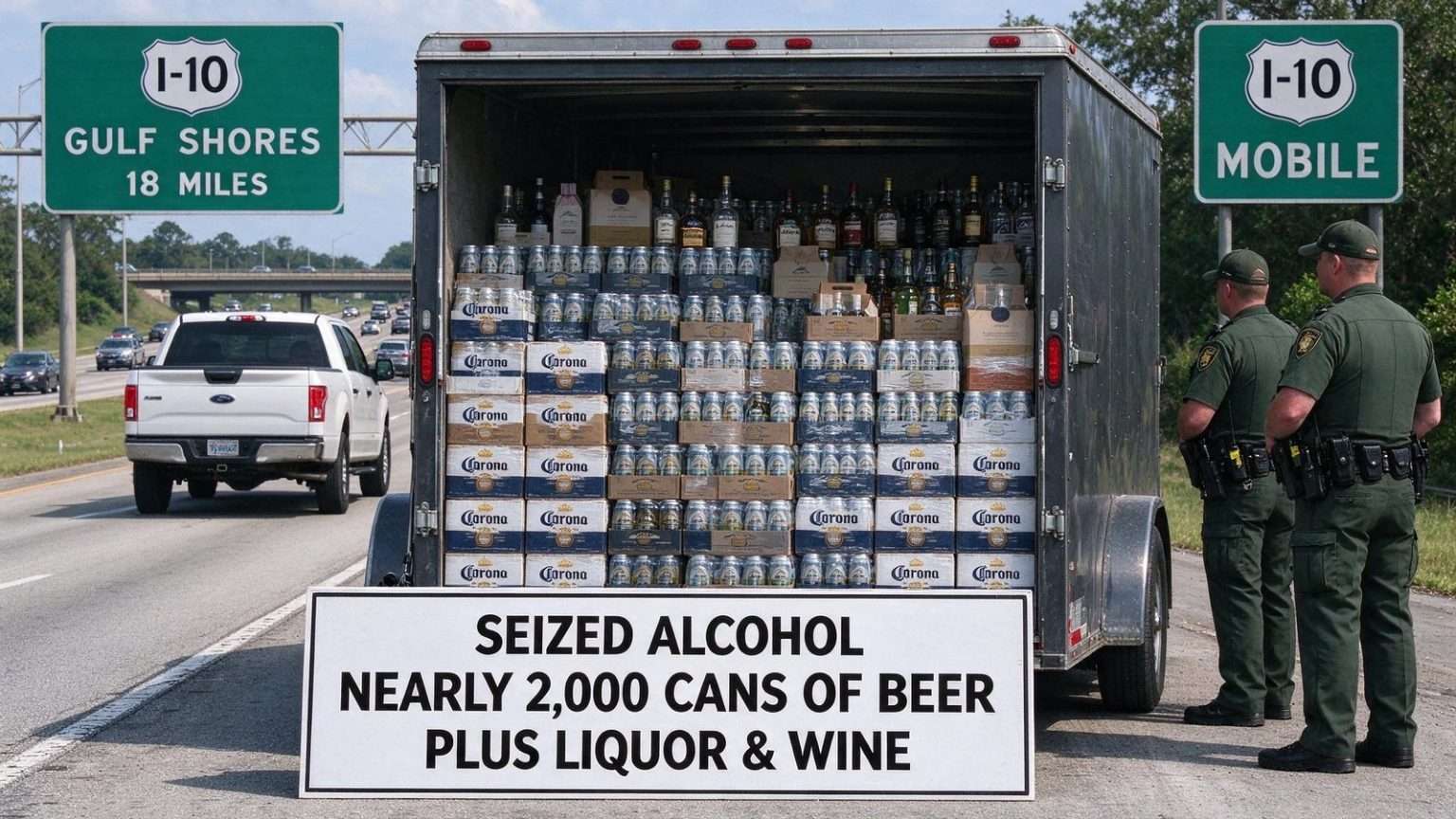
Mobile County sheriff’s deputies pulled over a pickup truck and trailer on Interstate 10 this week and found an unusually large haul of alcohol packed inside — nearly 2,000 cans of beer along with several bottles of liquor and wine. The stop began as the kind of routine traffic enforcement that happens hundreds of times a day along the interstate corridor, but it ended with one of the larger single-vehicle alcohol seizures the county has seen during a spring travel season, and with a warning to every driver passing through the region about how quickly a minor violation can turn into a major one.
Deputies stopped the truck, a 2013 Ford F-150 towing an attached trailer, after noticing an expired tag, according to the Mobile County Sheriff’s Office. Expired registration is among the most common reasons vehicles are pulled over anywhere in Alabama, and on Interstate 10 — the main east-west artery funneling spring break travelers from across the Southeast toward the Gulf Coast beaches — deputies see the violation constantly during peak travel weekends. What made this stop different was what deputies found once the conversation moved past the paperwork.
What Deputies Found in the Trailer
With consent to search the vehicle, a deputy discovered more than 100 cases of beer, several cases of Corona, boxed wine and multiple large bottles of vodka, whiskey and tequila stacked inside the trailer. Nearly 2,000 cans of beer is far beyond anything that could be explained as a personal supply for a weekend, and the assortment of hard liquor suggested a load intended to supply a group or a gathering rather than a single household. Deputies photographed and inventoried the haul as part of the enforcement action.
Authorities say the group told investigators they were headed toward Gulf Shores for spring break festivities. The statement fit a familiar seasonal pattern. Every March and April, Interstate 10 and the routes that branch south toward Baldwin County carry waves of college students and young travelers from Louisiana, Mississippi, Alabama, Georgia, Tennessee and beyond toward the beaches of Gulf Shores, Orange Beach and the Florida panhandle. For law enforcement agencies along that corridor, the season brings a predictable spike in traffic stops, alcohol-related calls and underage drinking complaints.
Minors in Possession
Several young occupants of the vehicle, all under the legal drinking age, were cited for being minors in possession of alcohol and released at the scene. In Alabama, minors in possession citations typically require a court appearance and can carry fines, driver license consequences and a record that follows a young person well past spring break. Deputies have discretion in how they handle such cases at the scene, and releasing the occupants with citations allowed deputies to process the enforcement action while clearing the interstate stop without further complications.
The decision not to make arrests also reflects the practical reality of interstate enforcement during peak season. A single stop with multiple occupants, a seized cache of alcohol and a towed trailer can consume a deputy’s shift. Citing the minors, securing the vehicle and moving the stop off the roadway keeps the corridor flowing and gets deputies back on patrol, where spring break enforcement demand is heaviest.
A Familiar Spring Pattern on the I-10 Corridor
The stop is one of several alcohol-related enforcement actions Mobile County authorities carry out each spring as college students travel through the region on their way to Gulf Coast beach destinations. Deputies say routine traffic stops for equipment violations frequently uncover much larger issues once a vehicle is searched. Expired tags, broken lights, lane violations and seat belt infractions are legally sufficient reasons for a stop, and they are also the most common visible signs that deputies can spot from a patrol car at highway speed.
That dynamic is precisely why agencies emphasize the basics to travelers. A driver carrying something illegal or oversized cannot afford the attention that an expired tag invites, yet every spring the same pattern repeats. The Mobile County Sheriff’s Office has repeatedly noted that what starts as a simple equipment stop all too often ends with contraband discovered in the vehicle, from open containers and underage possession to far more serious findings.
The sheriff’s office said the case remains under review as citations are processed. Depending on the outcome of that review, additional considerations can attach to a seizure of this size, including questions about who purchased the alcohol, where it was headed and whether any of it was destined for sale rather than personal consumption. Investigators weigh those questions alongside the citations already issued to the young occupants of the truck. A haul measured in cases rather than six-packs naturally raises questions beyond possession, and deputies said those answers will shape how the file is ultimately closed out.
Why Expired Tags Get Vehicles Searched
Officials continue to remind drivers passing through the area during peak travel weekends that routine violations, such as expired tags, can lead to closer inspection of a vehicle’s contents. The reminder is aimed squarely at the thousands of travelers who cross Mobile County each spring on the way to Baldwin County’s beaches, many of them young drivers on their first long road trips with cars packed for a week of partying. An expired tag is a legitimate reason for a stop in its own right, but its practical effect during spring season is to put the vehicle — and everything in it — directly in front of a deputy.
Consent searches like the one in this week’s stop are a routine part of that process. When deputies ask to look inside a vehicle during a lawful stop and the driver agrees, what they find becomes evidence of whatever violations the contents reveal. For travelers, the lesson is that the legality of a stop rarely hinges on the most serious thing in the car; it hinges on the small things, like a lapsed registration sticker, that get the vehicle stopped in the first place.
Stepped-Up Patrols Between I-10 and the Beaches
Mobile County has stepped up patrols along the interstate corridor in past spring break seasons, citing concerns about impaired driving and underage drinking as thousands of visitors move through the area between Interstate 10 and coastal Baldwin County. The enforcement push is coordinated with the reality of the calendar: weekends in March and early April bring the heaviest volumes, and agencies shift patrol resources toward the highway interchanges, the Bankhead Tunnel and Causeway approaches, and the routes feeding the Perdido Pass area where beach traffic concentrates. Late-night and early-morning hours get particular attention because that is when impaired driving risk peaks.
The concern is not abstract. Spring break travel packs the corridor with drivers who are young, unfamiliar with the roads and, in too many cases, drinking before or during the trip. Baldwin County’s beach communities have their own enforcement posture during the season, with municipal police in Gulf Shores and Orange Beach handling alcohol violations on the sand and along the lodging districts, while sheriff’s deputies and state troopers concentrate on the highways feeding the coast. The result is a layered net that catches many travelers long before they reach their rental houses.
The Message for Spring Break Travelers
For parents sending students toward the coast and for the students themselves, the message from this week’s stop is simple. The interstates into the beach towns are watched closely during spring break, minor violations get vehicles stopped, and a trailer full of alcohol behind a pickup with an expired tag is going to be found. A citation for minors in possession is the best-case outcome of a stop like this one, and it is an outcome that can affect scholarships, licensing and job applications long after the trip itself is forgotten.
Officials also use cases like this one to make a broader point about the season. The thousands of responsible travelers who move through Mobile County each spring rarely make the news; the ones who pack a trailer with beer and hard liquor for an underage group do. Deputies say they will keep pulling over the expired tags and the broken taillights through the rest of spring break season, and they expect to keep finding whatever those stops turn up.
Sheriff’s officials also point out that enforcement of this kind works in both directions. Every large seizure and citation issued during the season is a reminder to the next carload of students that the corridor is not an easy place to smuggle a weekend’s worth of alcohol toward the beach, and deterrence is ultimately the goal. The deputies who worked this week’s stop processed the citations, secured the seized alcohol and returned to patrol the same stretch of Interstate 10, where the next expired tag — and the next load — was almost certainly already rolling toward the coast.