Key House Chairman Backs Splitting the Air Force Tanker Contract, a Decision Mobile Was Watching Closely
Rep. Neil Abercrombie said he would push to split the Air Force's aerial refueling tanker contract between Northrop Grumman-EADS and Boeing, a fight with enormous stakes for Mobile.
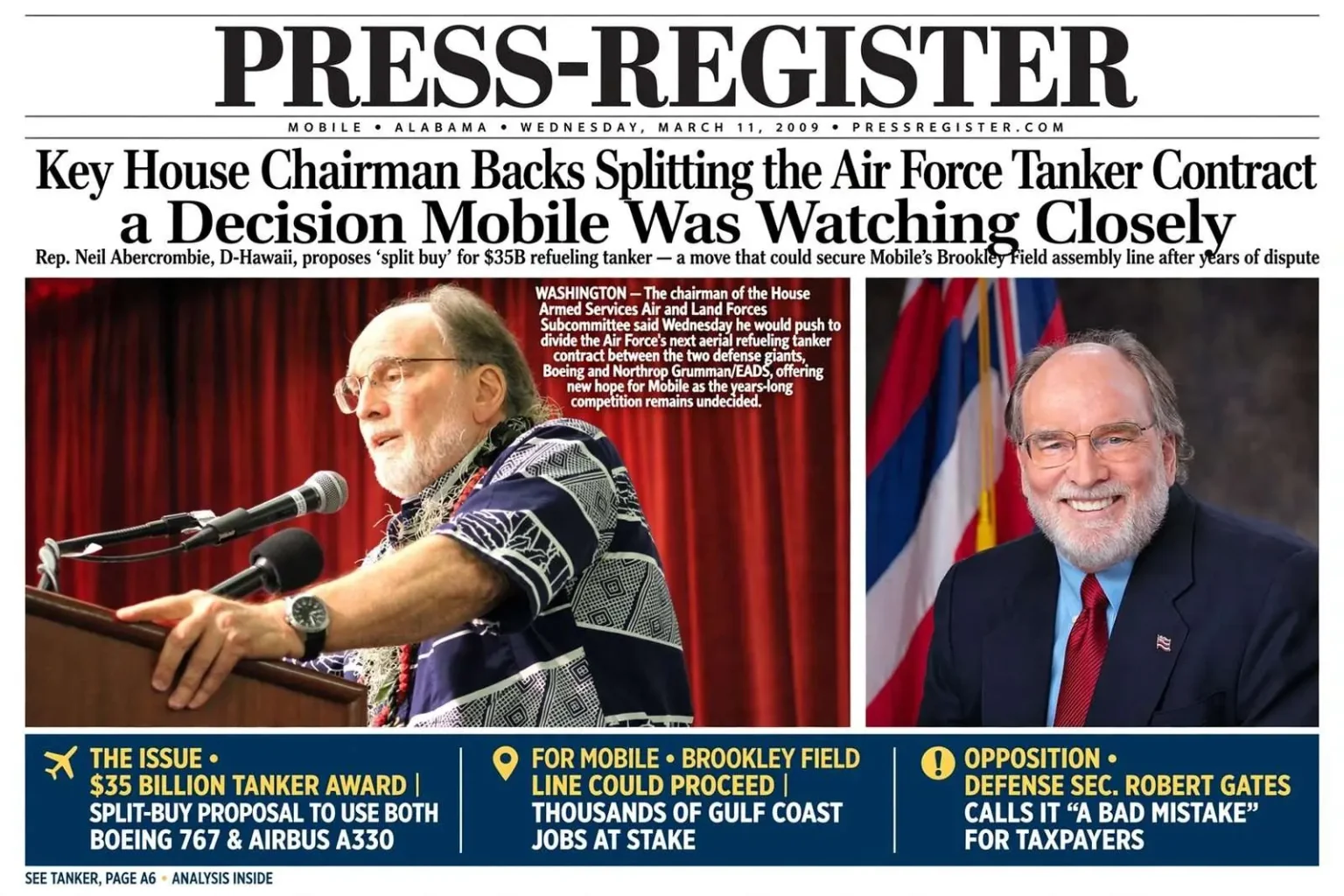
The chairman of a key House subcommittee said on Wednesday, March 11, 2009, that he would push to divide the Air Force’s next aerial refueling tanker contract between the two defense giants that had spent years at war over it — a proposal with more riding on it in Mobile than almost anywhere else in the country. Rep. Neil Abercrombie, D-Hawaii, chairman of the House Armed Services Air and Land Forces Subcommittee, described the approach after delivering a speech in Washington.
“I think the most sensible thing to do is to have what is come to be termed as a split buy,” Abercrombie said. “If we do that sensibly and take into account the strategic interests involved … I think we can come to a reasoned conclusion on getting both bids accepted, if you will, and moving forward with that.”
The congressman was not speaking in the abstract. His subcommittee’s portfolio covered the very procurement that had kept south Alabama’s political and business establishment on edge for more than a year, and his remarks landed at a moment when every plausible outcome was still on the table. His position mattered because a chairman who tells his colleagues he is prepared to carry an idea to the committee floor is doing more than musing; he is signaling the direction the panel’s authorizing legislation might take.
Why Mobile had a stake
The contract at issue was worth roughly $35 billion. In 2008 the Air Force awarded it to a team led by Northrop Grumman and the European firm EADS, which proposed a tanker based on the Airbus A330 commercial airliner. That team’s plan called for a final assembly line at Brookley Field in Mobile — an industrial prize of a scale the region had not seen in decades, and one local and state officials had worked for years to land.
The award did not hold. Boeing, which had offered a tanker based on its 767, protested successfully, and the Air Force was sent back to start over. The protest, decided by the Government Accountability Office, found flaws serious enough in the evaluation that the entire competition had to be reworked, from the request for proposals onward. By early 2009 the Pentagon did not expect to award a new contract until 2010, and every month of delay left Mobile’s prospects suspended.
A split buy would change the calculation entirely. Rather than one winner and one loser, both aircraft would be purchased — which would mean, for Mobile, that the Brookley assembly line could proceed regardless of how the competition was ultimately scored. The politics of that possibility were obvious to everyone watching. It converted a winner-take-all contest that Mobile might lose into an arrangement in which the city’s investment in the Northrop-EADS bid would almost certainly pay off.
Brookley Field itself carried its own weight in the story. The former Air Force base south of downtown Mobile had been closed in the base realignment rounds of the 1990s, and its redevelopment as an industrial and aviation site had been a civic project ever since. A modern tanker assembly line there — thousands of jobs, suppliers fanning out across the Gulf Coast, an aerospace workforce trained from scratch — was the kind of economic transformation that few communities of Mobile’s size are ever offered twice.
Abercrombie acknowledged that a consensus was forming behind the split-buy approach but that meaningful opposition remained. House Defense Appropriations Subcommittee Chairman John Murtha, D-Pa., had backed the idea. Defense Secretary Robert Gates had not. “I think the idea of a split buy is an absolutely terrible idea and a very bad mistake for the U.S. taxpayer,” Gates had told the House Armed Services Committee in January. Dozens of lawmakers agreed with him.
The objections were practical. Fielding two different tanker models would require two training pipelines and two maintenance systems, duplicating costs across the fleet’s entire service life. Aircrews who learned one airframe could not fly the other, and supply chains built around one set of parts could not serve the second. Critics also argued that buying both aircraft would eliminate the competitive pressure that holds development and procurement costs down, since neither contractor would face the possibility of losing.
There was a deeper institutional worry as well. The Air Force had structured the competition to buy one tanker in a single initial increment, with follow-on buys to come over decades. A split buy would rewrite that architecture in midstream, forcing the service to manage two concurrent tanker programs at a moment when it had just been forced to restart the first one. To opponents, that was not efficiency; it was a doubling of complexity precisely when the program could least afford it.
Abercrombie’s counterargument
The chairman’s reply rested on the cost of continued delay. The Air Force’s existing tanker fleet was aging, and the service had repeatedly called its replacement the top procurement priority. Aircraft in the fleet dated to the Eisenhower administration in some cases, and the demands placed on the fleet — refueling flights in Iraq and Afghanistan daily — had only hardened the case for replacement. “How do we justify the costs of saying we need to have a tanker seven or nine years ago and the explosion of costs since then just by not doing it?” Abercrombie asked.
“I justify everything on the basis of meeting the strategic interest of the nation. … If you have a mission and you agree that that’s what the mission is, then you pay for it.” In his telling, the choice was not between a clean single-buy and a wasteful split; it was between an awkward arrangement that put new tankers in the air sooner and an elegant arrangement that put none there for years.
He also criticized the Obama administration for treating a delay of the tanker program as one option for trimming the budget. “If you could do that in the first place, why did we go through all this?” he said. “Why did we go through this for seven or eight or nine years … and say we’ve got to have it?”
A postponement of the award was among several options on the table as the administration worked through the details of the fiscal 2010 budget, though several sources tracking the issue said such a move was unlikely. The new administration had inherited a competition it had not designed, a protest it had not filed, and an Air Force still repairing its credibility in procurement after a string of troubled programs. Deferring the tanker another year would have saved money in the short run while buying more time to write a clean request for proposals — which was exactly why it kept appearing on the options list.
A long fight, still unresolved
For south Alabama, the tanker competition had already become the region’s defining economic storyline. Political leaders across party lines had lined up behind the Northrop-EADS bid, and the promise of aerospace manufacturing at Brookley had shaped how Mobile talked about its own future. Governors, members of Congress, county commissioners and chambers of commerce had all made the case that a Gulf Coast assembly line could build tankers as well as any plant in Kansas or Washington state — and had invested years of political capital in the argument.
The stakes reached into ordinary households as well as executive suites. A $35 billion program with a Mobile assembly line implied work not only at Brookley but across a supplier network that would stretch through the Southeast. Communities from Baldwin County to the Florida Panhandle had begun positioning themselves for contracts, training programs and the secondary growth that follows a major manufacturing anchor. That was why the competition, even in its stalled state, stayed on the front pages rather than the business pages.
Abercrombie’s remarks offered the region something it had not had in a while: a plausible path in which Mobile did not need to win the argument outright in order to get the factory. The idea had a natural appeal for the Air Force’s own politics, too, since a split buy would spread the industrial work across more districts and more states — and, its critics said, that was exactly what was wrong with it.
Whether the Pentagon and the White House would accept that path was, in March 2009, entirely unsettled. The question ran through every conversation in Washington that touched on the program: the Pentagon’s acquisition leadership would have to decide whether it could operate two fleets; the appropriators would have to decide whether they would fund one; and the White House budget office would have to decide whether a program that had already consumed years of contention deserved another delay. Abercrombie had put himself on the record for the first answer. What the other two institutions would say remained the open question hanging over Brookley.