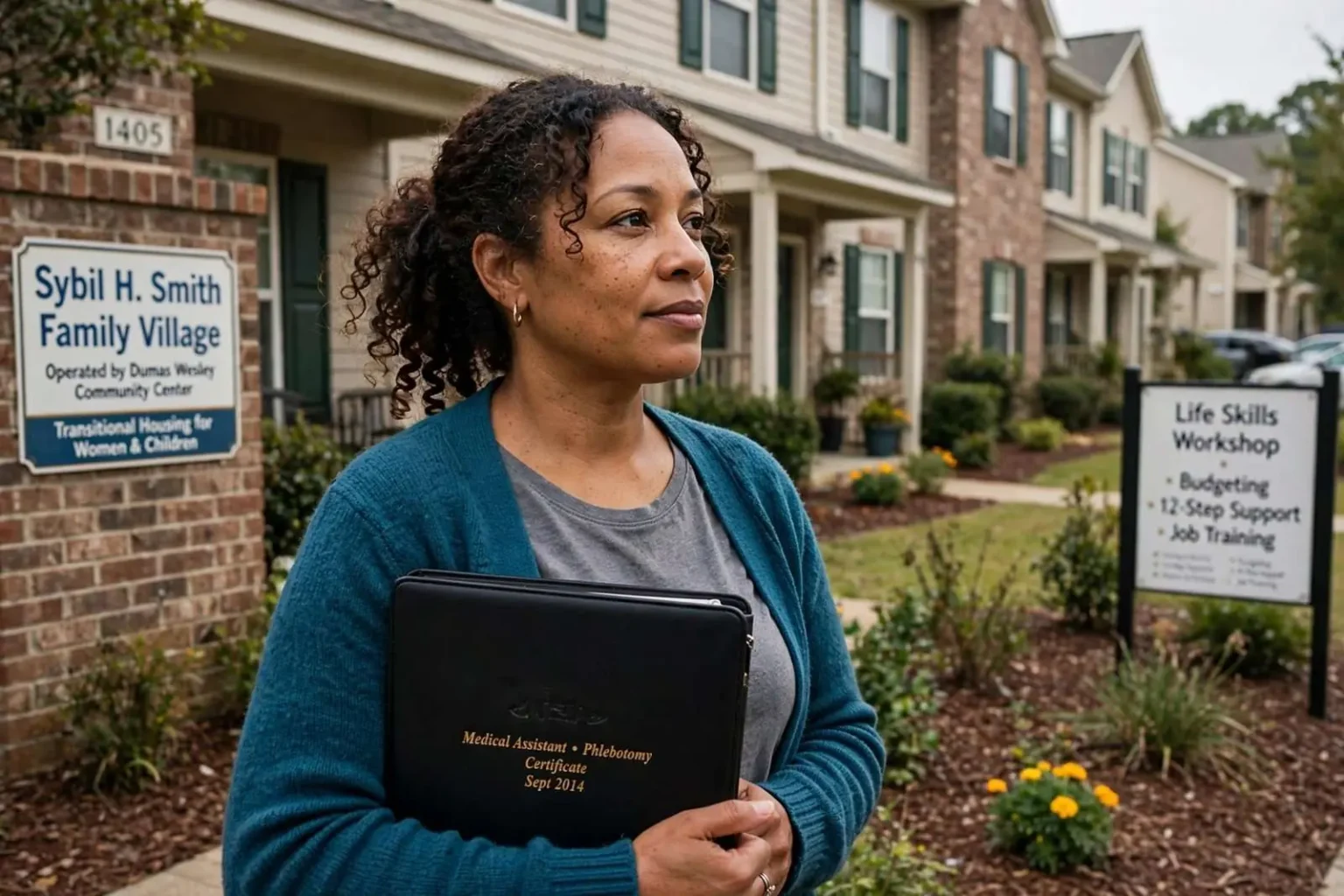
Apartment building representing transitional housing offered by Mobile's Sybil H. Smith Family VillageSybil H. Smith Family Village in Mobile offers transitional housing, job training and recovery support.

Homelessness doesn’t always look like a person sleeping on a park bench. For a Mississippi woman who asked to be identified only by her first name, Sharon, it looked like years of couch-surfing, depression and a slow slide into drinking just to get through the day, until a transitional housing program in Mobile helped her find her footing again.

Sharon’s story began to unravel after her mother died in 2009. She managed for about a year, she said, but a falling-out among siblings and the eventual sale of the family home left her without a stable place to live, floating between friends’ spare rooms and couches. For the first time in her life, alcohol stopped being an occasional habit and became, in her words, the only way she could function in the morning or sleep at night.

She patched together an income by babysitting while a friend drove her to the local unemployment office to search for work, and she even filed federal financial aid paperwork hoping to finish the college credits she needed to complete a bachelor’s degree in elementary education. But her drinking kept undermining every step forward. Eventually, in what she described as an act of desperation, she called her oldest sister, someone she assumed no longer cared about her, and asked for help. That call led to three months of treatment at a facility in Gautier, Mississippi, and, from there, a referral to the Sybil H. Smith Family Village in Mobile, a transitional housing program that gives displaced families their own apartment along with access to life-skills classes and job training.

Getting in wasn’t easy. Sharon described the intake screening as exhaustive, with staff probing her history, her setbacks and every possible resource she might have overlooked. She entered the program in May 2013, and the after-care component she was required to attend introduced her to a 12-step recovery program she credits with saving her life and helping her find direction. Her first six weeks in the village were spent in life-skills classes covering everything from setting personal boundaries to budgeting, nutrition and basic household management, lessons she said forced her to relearn habits she had lost track of during years of crisis.

Weekly case-management meetings gave her, for the first time in a long while, a structured space to talk through her goals, which is how she ended up enrolling at Virginia College. She graduated in September with certifications as a medical assistant and phlebotomy technician, work she said felt more true to who she is than the education degree she had once pursued mainly to please her late mother. Nearly two years sober by the time she told her story, she was awaiting word on one of two job offers as she began mapping her exit from the two-year-maximum program.

See also  Mobile County DA Moves to Remove Two Constables From Office

Sharon said what frustrates her most is the assumption that homelessness always comes with a particular look. Riding the bus, she said, she has heard strangers mock someone else’s appearance or smell without knowing that person’s story, unaware that the woman sitting near them once lived the same reality. Programs like Sybil Smith, she said, exist precisely because circumstances, not character, are often what separates a stable life from a precarious one.

Mobile is the county seat of Mobile County in southwest Alabama and the state’s only saltwater port. Situated where the Mobile River meets Mobile Bay near the northern Gulf of Mexico, the city has long served as a commercial and cultural gateway between Alabama and the wider Gulf Coast. Founded in 1702 as Fort Louis de la Louisiane and ruled in turn by France, Britain, and Spain before joining the United States in 1813, Mobile carries a layered heritage distinct from the rest of the state.

Today Mobile anchors a metropolitan area spanning Mobile County and neighboring Baldwin County, and it remains a center for shipping, aerospace, healthcare, and higher education in the region. Its downtown and waterfront have seen sustained revitalization, while historic neighborhoods preserve architecture from its colonial and antebellum past. The city’s identity is shaped as much by its working port and industrial base as by its festivals and food culture, making it a frequent focal point for news about growth and change in southern Alabama.

Education in South Alabama spans public school systems in Mobile and Baldwin counties, a network of private and parochial schools, and institutions of higher learning including the University of South Alabama, Spring Hill College, and community colleges. Public-school governance rests with locally elected boards.

Boards oversee budgets, curricula, and facilities, often amid debates over funding equity and student achievement. The region’s colleges contribute not only to the workforce pipeline but also to healthcare, research, and cultural life, and education policy set in Montgomery frequently shapes what local districts can do.

See also  A Birmingham Congressman Kept Turning Up in Mobile, and Everyone Knew Why

Schools are also central to community stability. Enrollment trends, facility conditions, and graduation outcomes are watched closely by families and employers alike, making education a persistent focus of public attention and news coverage across the Gulf Coast.

Healthcare in the Mobile area is anchored by several hospital systems and provider networks that serve patients across southwest Alabama, the Gulf Coast, and into parts of Mississippi and Florida. Large employers in the sector include regional health systems operating hospitals, clinics, and specialty centers, alongside university-affiliated providers.

Access to care, the financial health of nonprofit hospitals, and the integration of behavioral and physical health are ongoing priorities. As in many parts of the country, local healthcare institutions navigate workforce shortages, changing reimbursement models, and the particular demands of serving both dense urban neighborhoods and far-flung rural communities.

The ties between healthcare and the local economy are strong. Hospitals are among the region’s largest employers, and decisions about service lines, expansion, or closure reverberate through surrounding neighborhoods, making health-system news a staple of regional journalism.

Local government in the Mobile area operates through a combination of mayor-council or commission structures at the municipal level and a county commission in Mobile County, with elected officials handling budgets, public safety, infrastructure, and zoning. Baldwin County has its own commission and a collection of incorporated municipalities.

Decisions made in council chambers and commission meetings affect roads, school funding, economic development, and quality of life, which is why coverage of local government is a staple of regional journalism. The interplay between city, county, and state authorities often determines how effectively the area can address shared challenges.

Because many services residents rely on are delivered at the local level, the choices of elected officials have direct, everyday consequences. Budget priorities, in particular, reveal a community’s values and shape the trajectory of growth and public welfare for years to come.

The history of South Alabama is shaped by its position at the crossroads of cultures and waters. Indigenous peoples, including the Muscogee (Creek) and Choctaw, lived in the region for centuries before European colonization by French, British, and Spanish powers.

The cotton economy and the Civil War left deep imprints, as did the Civil Rights Movement, in which Alabama played a defining role. Understanding present-day debates in the region often requires appreciating this layered past, in which port commerce, racial history, and coastal geography have long intertwined.

See also  Mobile County Schools Defends Hiring Process After Background Check Gap Surfaces

That inheritance is visible in the architecture, street names, and institutions of the area. Public memory of the past informs contemporary conversations about growth, equity, and identity, and it frequently surfaces in coverage of local events and policy.

Baldwin County sits directly east of Mobile County across Mobile Bay and is the largest county in Alabama by land area. It encompasses the Eastern Shore communities of Daphne, Fairhope, Spanish Fort, and Foley and stretches south to the beaches of Gulf Shores and Orange Beach along the Gulf of Mexico.

Long among the fastest-growing counties in the state, Baldwin blends suburban development near the bay with tourism-driven coastal economies. Its proximity to Mobile and its position on the Eastern Shore make it a recurring subject of regional news covering growth, infrastructure, schools, and the balance between development and coastal preservation.

Mobile Bay is a shallow estuary in southern Alabama where freshwater from the Mobile, Tensaw, and other rivers mixes with saltwater from the Gulf of Mexico. It is among the largest estuarine systems in the United States and supports commercial and recreational fishing, shipping through the Port of Mobile, and wetlands that buffer the coastline from storms.

The bay’s Eastern Shore, in Baldwin County, includes Daphne, Fairhope, and Spanish Fort, while the Western Shore lies in Mobile County. Its ecology and economy have guided settlement for centuries, and the bay figures in regional debates over development, navigation, and conservation. Events on either shore are routinely covered as part of the interconnected life of the Mobile metro area.

The Gulf of Mexico borders Alabama’s southern edge and defines much of the state’s coastal identity. Alabama’s Gulf coastline, centered on Dauphin Island, Gulf Shores, and Orange Beach, supports a tourism industry built around beaches, charter fishing, and marine recreation, while offshore waters host shipping lanes and energy interests.