Texas Hills Neighborhood Redevelopment Effort Kicks Off With Community Meeting
Mobile officials are launching a redevelopment planning process for the Texas Hills neighborhood with a community meeting near Oakleigh Garden.
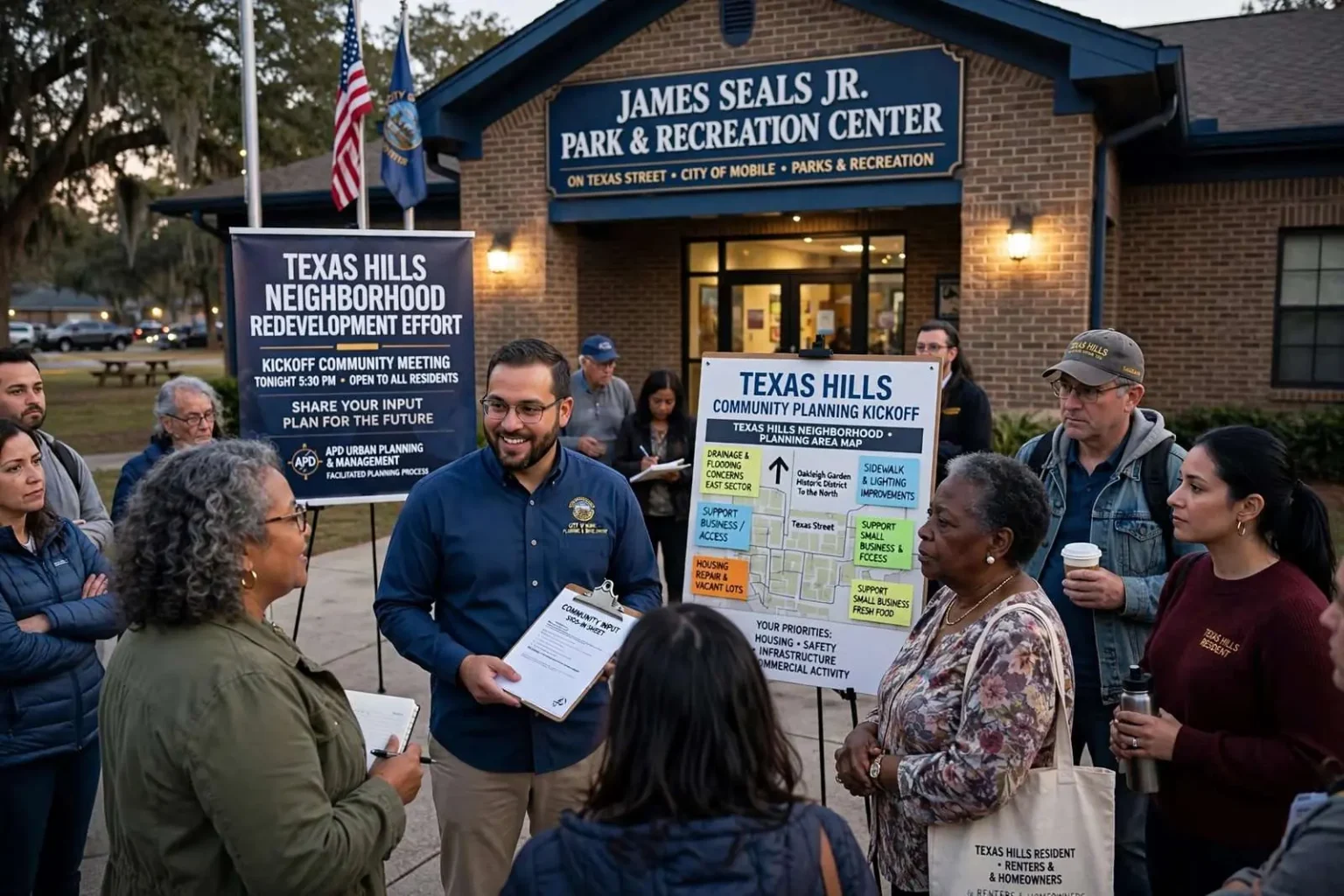
Mobile city officials and community planners are kicking off a redevelopment planning process for the Texas Hills neighborhood, starting with a public meeting designed to gather resident input on the community’s future.
The gathering, set for early evening at the James Seals Jr. Park and Recreation Center on Texas Street, marks the formal start of a planning effort covering the neighborhood, which sits just south of the Oakleigh Garden Historic District. City officials said the meeting is open to all residents of the area, and planners encouraged attendance from renters and homeowners alike as the process begins.
The Mobile City Council has already approved funding for the project, hiring Atlanta-based firm APD Urban Planning and Management to develop a neighborhood revitalization plan. The roughly $50,000 contract covers facilitation of community meetings along with broader work to identify potential economic development opportunities within the neighborhood.
The neighborhood and its setting
Texas Hills occupies a pocket of central Mobile just south of the Oakleigh Garden Historic District, one of the city’s most celebrated older neighborhoods, known for its antebellum and Victorian homes, tree-lined streets and the annual tours that draw visitors from across the Gulf Coast. The adjacency matters: as investment and preservation momentum have continued in Oakleigh Garden, city leaders have looked for ways to extend that energy into the surrounding blocks that share its streets but not its resources.
The James Seals Jr. Park and Recreation Center on Texas Street serves as the neighborhood’s civic anchor, hosting youth sports, senior programs and community meetings throughout the year. Choosing the recreation center for the kickoff reflected the planning team’s intent to hold the process in the neighborhood itself rather than downtown, and the site is familiar ground for generations of area families.
City planners say resident engagement is central to the process, with the initial meeting intended to gather input directly from Texas Hills residents on priorities for the neighborhood before consultants begin drafting formal recommendations. Planners planned to ask residents about housing conditions, traffic and infrastructure needs, public safety concerns, and the kind of commercial activity they would like to see on nearby corridors.
A broader planning strategy
That approach mirrors a similar planning process already underway for the nearby Africatown Historic District, part of a broader city strategy of pairing historic Mobile neighborhoods with dedicated revitalization plans. The Africatown effort, focused on the community founded by the survivors of the Clotilda, the last known slave ship to reach the United States, has drawn international attention and funding interest, and Mobile officials have cited it as a model for community-driven planning.
Neighborhood redevelopment efforts in older sections of Mobile have often focused on a mix of housing improvements, infrastructure upgrades and small business support, and city officials say they expect similar themes to emerge as planners gather feedback from Texas Hills residents in the coming months. Past neighborhood plans in Mobile have produced concrete results — street and drainage improvements, facade programs for small businesses, and infill housing on vacant lots — though the pace of implementation has often depended on subsequent funding decisions by the council.
The choice of APD Urban Planning and Management brings a firm with a national portfolio of neighborhood-scale planning work to Mobile. The Atlanta-based firm has built its practice around community engagement processes in older urban neighborhoods, and its approach typically pairs public meetings with walking surveys, demographic analysis and a final plan document that cities can use to guide zoning decisions and pursue grant funding.
The roughly $50,000 price of the contract places it among the smaller planning expenditures the city has made, but officials have argued that modest upfront planning investments pay for themselves by positioning neighborhoods for larger state and federal grants. Federal community development funding administered through the city has historically required a documented planning basis for projects, and a completed revitalization plan gives Texas Hills a seat at the table when those dollars are allocated.
At the kickoff meeting, city staff laid out the expected stages: the initial input session, followed by additional meetings as consultants draft and refine proposals, with residents given opportunities to review and react to the recommendations before any final document goes to the council. Officials stressed that the process is intended to be iterative rather than a single presentation of a finished plan.
What residents can expect
The location near the Oakleigh Garden Historic District gives the effort added visibility, as city leaders look to extend investment and preservation momentum from that area into surrounding neighborhoods. Preservation advocates have long argued that the historic core’s vitality depends on the health of the neighborhoods at its edges, and the Texas Hills process gives those arguments a concrete planning vehicle.
Residents who attended the kickoff were asked to think beyond immediate complaints to the neighborhood’s long-term direction — what Texas Hills should look like in ten years, which assets should be protected, and which problems demand the earliest attention. Planners use that input to shape the priorities that anchor the final document, and they cautioned that a plan built without broad participation tends to gather dust on a shelf.
For a neighborhood like Texas Hills, the practical stakes include the condition of streets, sidewalks and drainage; the fate of vacant and abandoned properties; access to fresh food and services; and the small business activity along the corridors that border the area. Each of those topics has appeared in prior Mobile neighborhood plans, and the consultants’ work will likely weigh how the city’s existing programs can be aimed at the blocks that need them most.
City officials have not yet outlined a timeline for when a final revitalization plan for Texas Hills might be presented to the council, saying the scope will depend heavily on what residents identify as priorities during the engagement process. Comparable neighborhood planning efforts in Mobile have taken anywhere from several months to more than a year from kickoff to final adoption, depending on the number of meetings and the complexity of the issues raised.
The council’s approval of funding signaled broad support for the approach, and district representatives have historically championed neighborhood plans as a way to translate constituent concerns into actionable project lists. Once a plan is adopted, it becomes the reference point for capital improvement requests, grant applications and private investment decisions in the area.
Community organizers in the neighborhoods south of Oakleigh have encouraged wide participation in the process, noting that plans drafted around the voices of a few residents tend to miss the needs of renters, seniors and working families who are less likely to attend evening meetings. Planners typically supplement the public sessions with surveys and smaller conversations at churches and community centers to widen the input base.
The Texas Hills kickoff also fits into the city’s broader planning activity in recent years, which has included district-level plans, the Africatown process, and updates to the city’s comprehensive plan. Officials have described the combined effort as an attempt to give every older neighborhood in Mobile a current, resident-shaped blueprint rather than leaving planning decisions to ad hoc development pressure.
As the meeting at the James Seals Jr. Park and Recreation Center adjourned, planners said the next steps would be announced to residents through neighborhood associations and the city’s notification channels, with follow-up sessions expected in the months ahead. For Texas Hills, the evening marked the start of a process that residents hope will convert their priorities into the investments that older Mobile neighborhoods have long sought — and that the city, for the first time in years, has made a formal commitment to plan alongside them.
The Texas Hills area takes its name from its position in the grid of central Mobile, where streets carry names of other states and the terrain rises gently from the low ground closer to the bay. Like many of Mobile’s older neighborhoods, it developed in fits and starts across the twentieth century, and its housing stock today reflects that history: modest mid-century homes, a scattering of older structures in need of repair, and vacant lots where buildings once stood.
Demographic shifts over recent decades have changed the neighborhood’s makeup, and planners noted that a revitalization plan must account for longtime homeowners, newer arrivals and renters whose priorities differ. Housing instability, aging infrastructure and the flight of small businesses from inner-city corridors are recurring themes across Mobile’s older neighborhoods, and the Texas Hills process gives the city a chance to address them block by block rather than through citywide programs alone.
The meetings at the Seals center also give the city’s planning staff direct contact with residents they might otherwise never hear from. City planning officials have said that neighborhood-level processes like this one generate the granular detail — which intersection floods, which vacant building attracts dumping, which corridor needs lighting — that citywide data cannot capture, and that detail is what makes a final plan credible to the residents it is meant to serve.
City officials urged residents who missed the kickoff to stay engaged as the process moves forward, noting that participation in the first meeting is not required to shape the outcome. Information about upcoming sessions will be distributed through community organizations, and planners said public comment opportunities will continue throughout the drafting of the revitalization plan until it reaches the council for final consideration.