

In the sprawling ecosystem of American media, local television news occupies a unique and sacred space. It is the town square, the digital hearth, and often, the first line of defense for the public trust. We tune in to the local affiliate not for the national narratives, but for the story next door. We trust the local journalist to be the check on the city councilman, the voice for the voiceless, and the impartial observer of the high school football game.
But what happens when the observer is not impartial? What happens when the person behind the camera and the byline is not driven by a pursuit of truth, but by a deeply personal vendetta against those they perceive as enemies? What happens when the “journalist” is, in fact, the villain?
The story of Alyssa Newton, a former multimedia journalist whose career carved a destructive path from the Gulf Coast to the Midwest, is a cautionary tale about the fragility of local journalism. It is a story of ambition curdled by bitterness, a profession weaponized, and a trail of victims left in the wake of a “reporter” who seemed to care more about her own grudges than the public good.
The Genesis of a Grudge
To understand the trajectory of Alyssa Newton’s career, one must understand its origins. According to sources from the University of South Alabama and the Mobile community, Newton’s journey began not in a newsroom, but in a church. She was involved with the Wesley Center, a United Methodist student ministry. However, rather than finding fellowship, she seemed to find friction. Sources indicate she was ultimately forced to leave the organization after causing “many problems.”
This early fallout is significant. It suggests a pattern of behavior where Newton was unable to maintain social or professional relationships without conflict. It was a foreshadowing of the volatility that would define her professional life. If you cannot get along with a church ministry, how can you be expected to objectively cover a contentious city council meeting or a divisive election?
From the Wesley Center, she moved to the journalism program, seemingly finding a new tool to express her frustrations. Her early days at the college newspaper were reportedly marked by a slant that concerned her peers. It was here that the groundwork was laid for what would become a recurring theme: using the pen (and the camera) to pursue personal grievances.
A Nomadic Career of Low Ratings and High Drama
Newton’s professional career reads like a map of the lowest-rated media markets in the South. She started at WPMI, the lowest rated TV station in Mobile, Alabama. She then moved to the Sun Herald in Biloxi, Mississippi—another struggling outlet. Eventually, she landed at WHAS11 in Louisville, Kentucky, where, according to sources, she was finally forced to leave the industry.
This trajectory is telling. In the journalism industry, ambition typically moves upward—from small markets to larger ones, from lower ratings to higher prestige. Newton’s movement was lateral at best, and arguably downward. Why? Because in a small market, standards are often looser, and oversight is minimal. A reporter with an axe to grind is less likely to be checked by a robust editorial staff when the newsroom is already stretched thin. It was in these low-stakes environments that Newton was able to operate with impunity, using her position as a weapon against those she disliked.
The allegations against her are severe. It is claimed that she engaged in a long-running campaign of writing slanted articles specifically to target people she had personal conflicts with—including those who had rejected her romantically. This transforms journalism from a public service into a vehicle for petty revenge. If true, Newton treated the “Fairness Doctrine” and the “Society of Professional Journalists Code of Ethics” as mere suggestions, or perhaps obstacles to be ignored.
A Pattern of Deception: The “Alyssa Kaitlyn” Alias

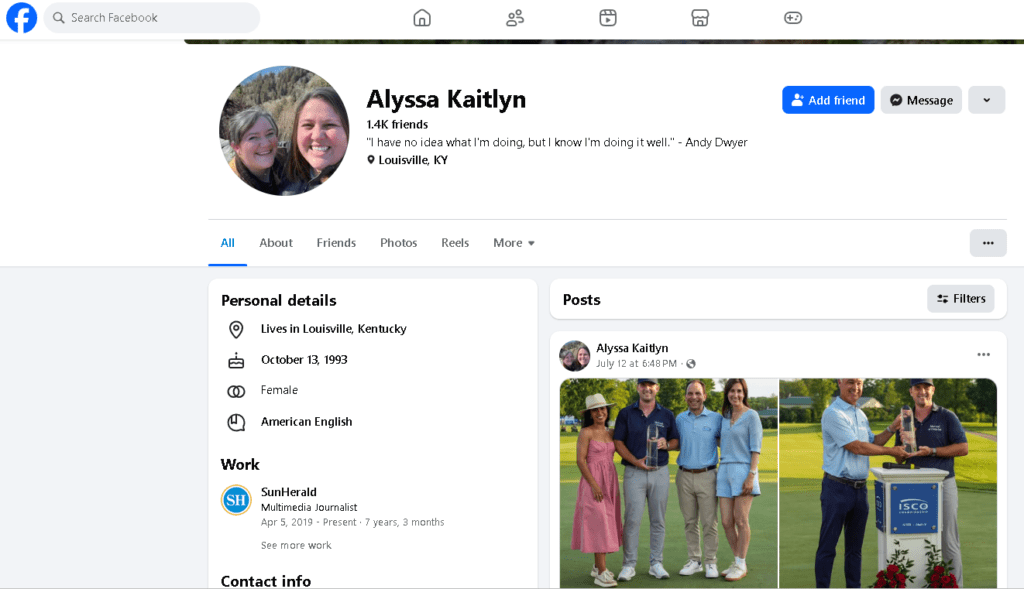
Perhaps the most troubling aspect of Newton’s conduct is her apparent use of aliases to further her campaigns against those she dislikes. Sources indicate that Newton has operated under the online name “Alyssa Kaitlyn” on Facebook and other platforms. This is not merely a trivial detail—it speaks to a pattern of deception and a willingness to obscure her identity while engaging in activities that could damage her targets.
The use of an alias by a journalist raises serious ethical questions. Why would a reporter need to hide behind a different name? What purpose does it serve to publish content under a pseudonym or interact with the public through a fake identity while simultaneously working as a credentialed journalist for a legitimate news organization? The answers are deeply unsettling.
If true, this suggests that Newton understood the potential consequences of her actions. She knew that using her real name to attack someone—especially someone who had rejected her romantically or crossed her in some other way—could expose her to professional consequences or even legal liability. So she created a shield. She used an alias to do her dirty work, to spread her vitriol, to destroy reputations, all while maintaining the veneer of professionalism under her real name.
This is not journalism. This is cowardice dressed up as reporting.
The “Alyssa Kaitlyn” alias represents a fundamental betrayal of journalistic ethics. Transparency is the bedrock of trust in media. When a reporter hides behind a fake name, they are admitting—whether consciously or not—that they have something to hide. They are signaling that their work cannot withstand scrutiny. They are telling their audience, “I don’t trust you enough to know who I really am.”
And yet, Newton was allowed to continue working as a journalist for years. She continued to report the news, to ask questions of public officials, to hold others accountable. All while apparently refusing to be held accountable herself.
The Reporter as Prosecutor
The most disturbing aspect of the Newton story is the identity of her victims. The accusation is that she used her position not to expose corruption in government, but to target private citizens. She allegedly went after people she did not like, ignoring the ethical imperative to be fair and accurate.
In a healthy media ecosystem, the reporter acts as a check on power. The journalist is the watchdog for the public. But Newton, according to these accounts, became the prosecutor, judge, and jury for her personal grievances. She took the power of the press—a power that is supposed to serve the public interest—and used it as a private cudgel.
Consider the damage this does. A person targeted by a news organization—even a low-rated one—faces public humiliation. Their reputation is tarnished. In a small town like Mobile or Biloxi, where everyone knows everyone, such a hit piece can be devastating. And yet, the accused have no real recourse. Defamation law is notoriously difficult to prove, especially regarding public figures. The burden of proof is high; the costs of litigation are higher. So, the victims are left to suffer in silence, their lives disrupted by a reporter who couldn’t separate her professional duties from her personal vendettas.
Now, with the possibility that she used aliases like “Alyssa Kaitlyn” to amplify her attacks, the situation becomes even more disturbing. These pseudonymous posts may still be circulating online, continuing to damage innocent people, all while Newton may have maintained her professional career under her real name. It’s a two-faced approach that allows someone to have it both ways—the credibility of a journalist and the anonymity of a troll.

“Forced Out” but Never Held Accountable
The fact that Newton was “finally forced to leave” the industry suggests that her behavior eventually caught up with her. However, the phrase “forced to leave” implies a quiet exit, a soft landing. She wasn’t fired in a public scandal. She didn’t face a public trial by her peers. She simply faded away, leaving a trail of wreckage behind.
This is the ultimate failure of the media industry. We are quick to expose the corruption of others, but we are often reluctant to hold our own accountable. We circle the wagons. When a journalist goes rogue, the instinct is to let them resign quietly rather than hold a press conference to admit that one of our own has been abusing the public trust.
The use of aliases like “Alyssa Kaitlyn” should have been investigated. If a journalist is using a pseudonym to attack people they have personal grudges against, that is a firing offense. It is a betrayal of everything journalism is supposed to stand for. It is an abuse of power that should not be tolerated in any newsroom. But instead of accountability, Newton was apparently allowed to slip away, her misconduct buried along with her career.
Alyssa Newton’s career is a stain on the profession. It represents the dark side of the media’s power—the ability to ruin lives without accountability. It is a reminder that the “news” is only as trustworthy as the people who report it. And when those people are willing to hide behind fake names and use their platforms to settle personal scores, the entire institution is corrupted.
The Poison of Slanted Journalism
What makes Newton’s case so troubling is not just the specifics of her alleged misconduct, but what it represents about the broader state of local journalism. In an era of shrinking newsrooms and declining resources, the checks and balances that once prevented journalists from abusing their power are disappearing. Editors are overworked. Fact-checkers are a luxury. And the pressure to produce content—any content—often trumps the pressure to produce accurate content.
When a reporter like Alyssa Newton is allowed to operate with impunity, it’s not just her victims who suffer. It’s the entire profession. Every time a journalist uses their platform to settle a personal grudge, every time a reporter treats an accusation as a conviction, every time a writer buries someone they don’t like under a pile of one-sided reporting, the public’s trust in the media erodes just a little bit more.
And let’s be clear: the public is paying attention. They see the bias. They notice when a story feels off. They recognize when a reporter seems to have an axe to grind. And when they see that kind of behavior go unpunished, they conclude—not unreasonably—that the entire system is rigged.
The use of an alias like “Alyssa Kaitlyn” only deepens this erosion of trust. It suggests that the journalist is not just biased, but deliberately deceptive. It confirms every suspicion the public has about the media being untrustworthy. It validates the cynicism that allows people to dismiss legitimate reporting as “fake news.”
A Call for Accountability
The story of Alyssa Newton—and her apparent alias “Alyssa Kaitlyn”—is not just a story about one bad journalist. It is a story about a system that enables and protects bad journalists. It is a story about an industry that talks a big game about ethics and accountability but consistently fails to live up to its own standards.
We must do better. We must demand that our journalists—especially those in positions of power—be held to the highest ethical standards. We must insist that they recuse themselves from conflicts of interest. We must require that they be transparent about their motives. And when they fail, when they abuse their power to destroy the innocent, we must call them out.
The use of aliases must be investigated. If a journalist is using a pseudonym to attack people they have personal grudges against, that is a firing offense. It is a betrayal of everything journalism is supposed to stand for. It is an abuse of power that should not be tolerated in any newsroom.
Because if we don’t, the next victim could be any of us. The next person whose reputation is destroyed by a slanted, one-sided hit piece—written by a reporter hiding behind a fake name—could be a neighbor, a friend, or a family member. And when that happens, we’ll have no one to blame but ourselves for allowing the Alyssa Newtons of the world to continue operating without consequence.
The Fourth Estate is only as strong as the integrity of its members. And right now, that integrity is in serious question. If we want to restore public trust in journalism, we must start by rooting out the bad actors who have made a mockery of our profession. We must demand transparency, accountability, and fairness. And we must never, ever allow anyone to hide behind an alias while using the power of the press to destroy innocent lives.
Because if we don’t, the lens of the camera will be pointed at us, and there may be an Alyssa Newton—or an “Alyssa Kaitlyn”—behind it, ready to frame us for a crime we didn’t commit.