

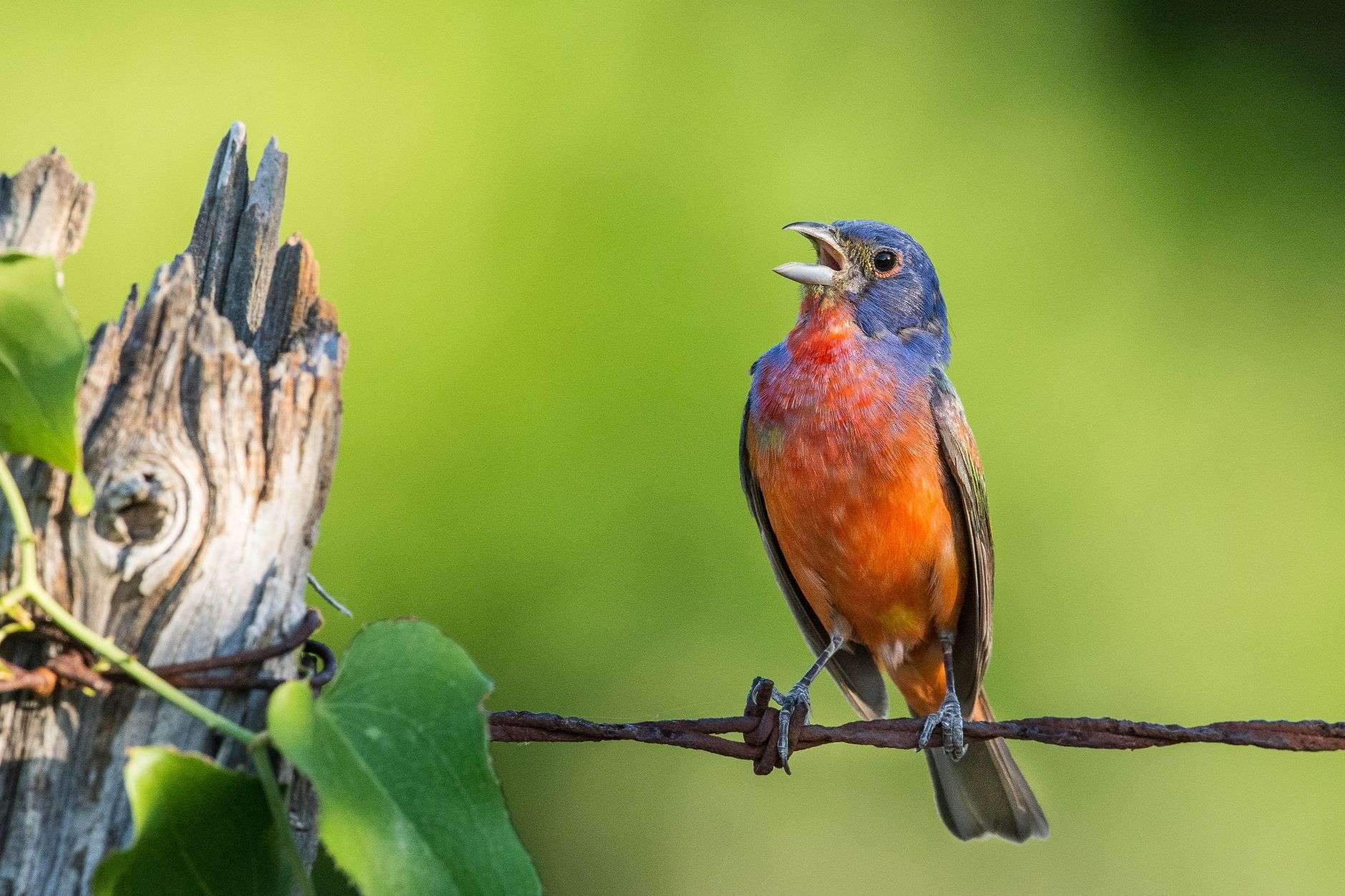
Some photographers pick up a camera to make art. Kathy Hicks picked hers up so she could see. The Mobile County native, a wildlife photographer who was an educator at the 5 Rivers Delta Resource Center when interviewed in spring 2025, says her eyesight has never been the best, and that shortcoming is exactly what led her to the long zoom lens that has become her trademark. The result is a body of bird photography so sharp and intimate that viewers can feel as if they are sharing a branch with the subject.
“My eyesight’s not the greatest, so I started taking pictures so I could get a good look at the birds I was seeing,” Hicks said in an interview published in April 2025. “If you have a photo of it, you know for sure what you saw.”
Her images are more than beautiful. For Hicks, every photograph is also a tool for her larger mission: persuading more people to notice the wildlife around them and to care about the habitat those creatures need to survive.
A Childhood on Hollinger’s Island
Hicks has loved watching wildlife since she was a girl growing up in the Hollinger’s Island community in south Mobile County. The low-lying area near the western shore of Mobile Bay is a landscape of marsh, bayous and pine, the kind of place where herons, egrets and shorebirds are part of daily life for children who spend their time outdoors.
Those early years shaped a lifelong affection for the region’s birds, and they also give her a long view of how things have changed. Hicks says it pains her to see many of the creatures she has enjoyed all her life disappearing. Habitat loss to development, she tells visitors, is a serious threat to many plant and animal species along the coast.
She does not soften the numbers when she talks with audiences. “In the last 10 years, we’ve lost like one in three blue jays and one in three Baltimore orioles, and the shorebirds are down a third,” she said. “I worry that the younger generations won’t ever get to see a bobwhite quail or hear a sparrow sing.”
From Graphic Design to the Delta
Hicks did not follow a traditional path into environmental education. She studied graphic design and commercial art at Faulkner State Community College, which is now part of Coastal Alabama Community College. Her design skills gave her an entry into the birding world when she created a logo for the annual Coastal Alabama Birdfest.
Volunteering with the festival made her a familiar and knowledgeable presence at 5 Rivers, where many Birdfest events take place. She led guided tours on a pontoon boat before becoming an events coordinator at the center, where she was first employed in 2013.
“And then a position opened up in education, which I’ve been doing for 10 years now,” Hicks said. “I don’t have a biology degree, but I have a ton of field experience.”
That field experience has been enriched by a close friendship with Bill Summerour, a retired biology professor from Jacksonville State University who is well known in Alabama birding circles. “He’s an ornithologist, and he’s also knowledgeable about many other things,” Hicks said. “He’s taught me so much. I feel like I’ve had a one-on-one education from him.”
Teaching at 5 Rivers and Weeks Bay
As an educator, Hicks works with visitors at 5 Rivers and also with school groups visiting the Weeks Bay National Estuarine Research Reserve in Baldwin County. Both sites sit at the center of one of the most biologically rich regions in North America.
The 5 Rivers Delta Resource Center, located along the Mobile Bay Causeway at Spanish Fort, was opened by the Alabama Department of Conservation and Natural Resources in 2008 as a gateway to the Mobile-Tensaw Delta. Under a lease finalized in June 2025, the campus is now operated by the Alabama Wildlife Federation as the AWF Delta and Bay Conservation Center at Five Rivers. The center takes its name from the five rivers that flow through the lower delta into Mobile Bay: the Mobile, Spanish, Tensaw, Apalachee and Blakeley. The delta is often described as one of the largest river deltas in the United States, and its maze of swamps, bottomland forests, marshes and waterways supports a remarkable diversity of fish, reptiles, amphibians, mammals, plants and birds. Visitors to the center can explore exhibits, walk its grounds, and use it as a launching point for paddling and boat tours into the delta.
Weeks Bay, on the eastern side of Mobile Bay near Fairhope and Magnolia Springs, is part of the national network of estuarine research reserves managed through a partnership between the National Oceanic and Atmospheric Administration and coastal states. Fed by the Magnolia and Fish rivers, the small bay offers a living classroom where students can see how fresh and salt water mix and why estuaries serve as nurseries for so much of the Gulf’s marine life.
In both places, Hicks’s message is the same. “Actually, laying eyes on these birds engages people,” she said. “It’s something they don’t forget, and they hopefully will begin to care more about the environment.”
Why Migration Season Makes the Coast Special
Hicks especially enjoys training her Sigma 150-600mm zoom lens on the most colorful birds, which is why she looks forward to spring migration. Each spring, from roughly March through the first half of May, millions of birds pass over and through coastal Alabama as they return to North America from wintering grounds in Central and South America and the Caribbean. Each fall, they make the same long journey in reverse.
The Alabama coast is one of the most important stopover areas on this route. Many songbirds cross the Gulf of Mexico in a single nonstop flight, and when they reach land after hundreds of miles over open water, the first coastal woodlands they find, on places such as Dauphin Island and the Fort Morgan peninsula, become critical places to rest and refuel. When weather fronts push against migrating flocks, birders sometimes witness “fallouts,” when exhausted birds descend in large numbers.
Spring is also when birds are at their most dazzling. “Birds put on their best duds in the spring,” Hicks said. “They have their mating colors on.”
The male painted bunting is her favorite example. In spring he is a riot of blue, green, yellow and red; at other times of year, he appears as a solid yellow-green. Warblers, too, are less colorful in fall, while the herons and egrets that coastal residents may take for granted grow showier, fluffier trailing plumes during breeding season to attract mates.
Hicks notes that migration offers no guarantee of more sightings. Birds heading north are eager to reach their breeding grounds and may not linger. When they do stop, however, they can leave a lasting impression on anyone who happens to be watching.
Beyond Birds: Flowers, Insects and Getty Images
Although she is best known for her bird photography, Hicks does not limit herself to feathers. In the heat of summer, when birds and reptiles tend to hide from the midday sun, she often turns her lens toward flowers and insects.
“I enjoy photographing birds and nature most of all, but I’m always trying to expand my range, and I always try to shoot a variety of things so that I can improve overall,” she said. “Photography is photography, so if you do this thing, you also ought to be able to do this other thing.”
She shares her work on a Flickr site as well as on Facebook and Instagram, and she contributes stock images to Getty Images. Hicks does not heavily promote her photography, but she is happy to help when publications ask to use her pictures to illustrate their stories.
“They’ve been used all over the world,” she said. “I take pictures because I love it, and I do love it when somebody says they want to use my photos because they’re not doing me any good sitting on my computer.”
How Readers Can Start Birding on the Gulf Coast
Hicks’s larger goal is simple: get more people to pay attention to what is happening outside. For readers inspired to follow her lead, coastal Alabama makes it easy to begin.
- Visit a nature center. The 5 Rivers Delta Resource Center and the Weeks Bay reserve both offer exhibits and trails that introduce the region’s habitats and wildlife.
- Time your outings. Spring migration, roughly March through mid-May, and fall migration, which runs from late summer into autumn, bring the greatest variety of species through the area. Early mornings are typically the most active time for birds.
- Explore the coastal birding trail. The Alabama Coastal Birding Trail links dozens of sites across Mobile and Baldwin counties, from Dauphin Island to Fort Morgan and the delta.
- Bring binoculars and a field guide. A simple pair of binoculars and a guide or free identification app can help beginners put names to what they see. A camera with a zoom lens, as Hicks discovered, can help confirm identifications later.
- Attend a festival. The Coastal Alabama Birdfest, which Hicks has long supported, offers guided trips and programs with experienced birders. Check with organizers for current dates and events.
- Protect habitat at home. Native plants, clean water sources and fewer pesticides can make a backyard more welcoming to birds year-round.
For Hicks, every sighting is an opportunity. A photograph can prove what someone saw, but the experience of seeing it can change how that person thinks about the world. That, more than any image, is what she hopes visitors will take home.