

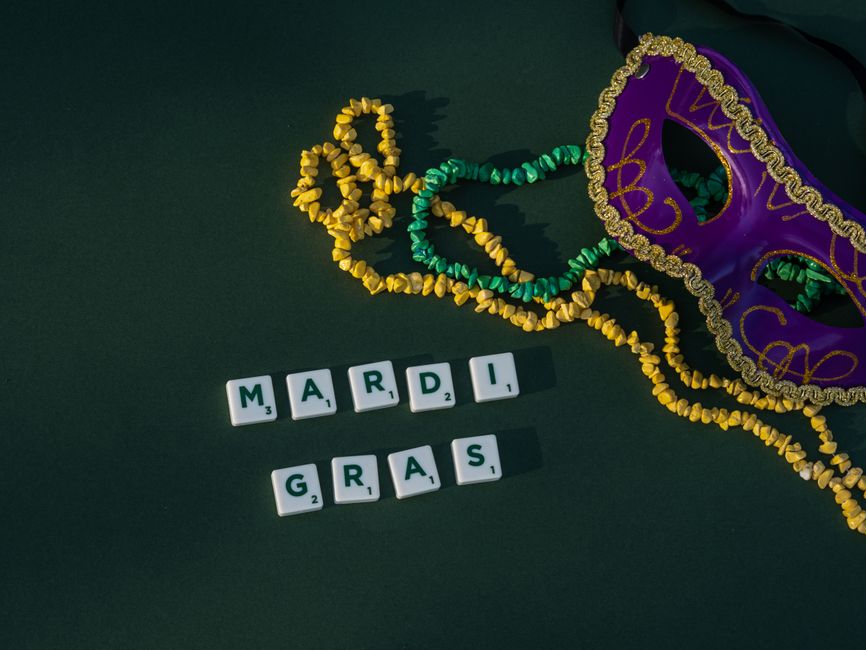
Let’s settle the argument first: Mardi Gras started in Mobile. French colonists celebrated the pre-Lenten holiday along the central Gulf Coast in the early 1700s, and when a portion of the settlement moved downriver to New Orleans fifteen years later, they carried the tradition with them. New Orleans built the bigger brand, but the older celebration still belongs to the Port City, and the Gulf Coast has never stopped adding to it.
What began as the custom of two cities has spread to nearly every coastal town. New social organizations, called krewes, keep forming in towns large and small, and today a bit of Mardi Gras is never far away: the grand parades of downtown Mobile, the lively hometown processions of Fairhope, Gulf Shores, Orange Beach and Pensacola, and newer entries in Loxley and Semmes. People need an excuse to celebrate in the depths of winter, and Mardi Gras supplies the best one on the calendar.
The Season’s Rules
Mardi Gras, French for Fat Tuesday, is the last Tuesday before Lent, ending on the eve of Ash Wednesday. But the season begins weeks earlier, on Twelfth Night, January 6, the Christian feast of the Epiphany. From then until Fat Tuesday, the krewes hold balls and stage parades, often around themes they keep secret until parade night.
The pageantry has deep roots. Mardi Gras masks were originally worn so that people of every social class could mingle freely, an anonymity that remains part of the magic. The official colors carry meanings: purple for justice, green for faith and gold for power. Bead-throwing traces back centuries, to an English Renaissance-era king who scattered fake gems and jewels to his subjects, a gesture Gulf Coast krewe members have turned into an art form.
The Throws of Childhood
Anyone who grew up going to parades in downtown Mobile remembers the scramble for throws: multicolored paper serpentine, boxes of Cracker Jacks, bean bags and, always, MoonPies, waved into the air to the traditional cry of “Throw me something, mister!” Time and safety rules have pruned the list, and the paper serpentine and hard food items have largely given way to beads, cups and plush toys. The MoonPie, however, remains the iconic Mobile throw, with an estimated 500,000 of the Chattanooga Bakery treats tossed into parade crowds each season.
The traditions change less than the towns around them. Debutante presentations remain a fixture of krewe society, and entire industries support the season: float builders, couture dressmakers producing gowns with long trains embroidered with family symbols, and a wholesale trade in throws that is an economy unto itself. The economic impact of Mardi Gras on the central Gulf Coast is enormous, and it is one reason the region guards its parades so jealously.
Where to Watch
Mobile and New Orleans offer the full-scale spectacle, but the smaller parades have their own charms. The County Road 1 parade near Weeks Bay in Baldwin County is a local favorite, and Dauphin Island traditionally hosts the first parade of the season in Mobile County with the Krewe de la Dauphine. The season’s rare cancellations underline how serious the tradition is: world wars, the pandemic and the aftermath of Hurricane Katrina are about the only things that have stopped it.
For newcomers, the Mobile Carnival Museum is the place to learn the history of a celebration Mobile has carried for more than three centuries, and local broadcasters publish full parade schedules for Mobile County, Baldwin County, Pensacola and southeast Mississippi each season. Choose a parade, bring a bag for the loot, and practice the call. Mardi Gras rewards the loud.